
Imagine buying a share in a startup project. You hand over your money, and the founders immediately sell half their shares to cash out. That’s not how sustainable businesses work. In the world of Initial Coin Offerings (ICOs), this scenario is prevented by vesting schedules. These are the rules that dictate when tokens allocated to teams, advisors, and early investors can actually be used or sold.
Vesting isn't just about fairness; it's about survival. Without it, an ICO would likely collapse under the weight of immediate selling pressure. As we move through 2026, understanding these schedules is no longer optional for anyone involved in crypto-it's essential due diligence. Whether you're an investor checking if a team is committed or a founder designing your tokenomics, knowing how these mechanisms work protects everyone involved.
The Core Components of Vesting
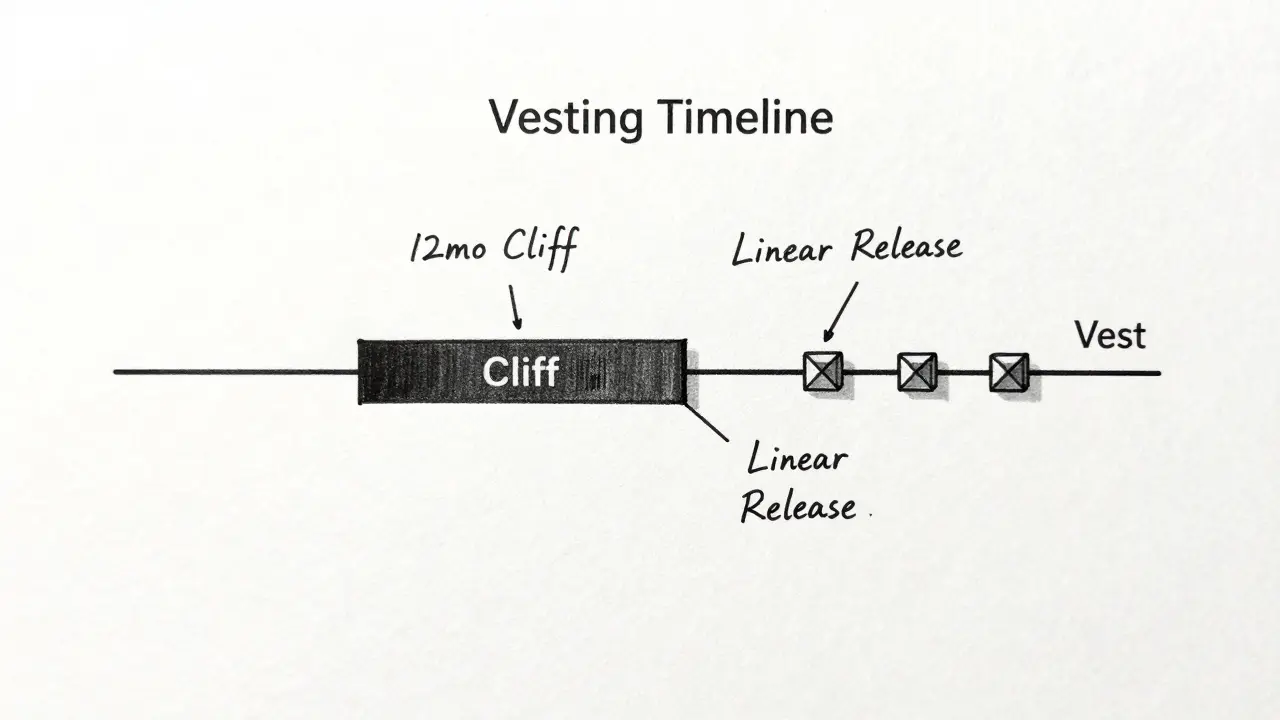
To understand any schedule, you need to break down its two main parts: the cliff and the vesting period. Think of them as the "waiting room" and the "slow drip."
- The Cliff: This is the initial waiting period where zero tokens are released. If a project has a one-year cliff, nobody gets anything for the first 12 months. It proves commitment. If the team leaves after six months, they get nothing.
- The Vesting Period: After the cliff ends, tokens start releasing gradually. This could happen monthly, quarterly, or upon hitting specific goals. This prevents a sudden flood of tokens hitting the market all at once.
In traditional startups, a standard four-year vest with a one-year cliff is common. In crypto, things are often more aggressive or complex because tokens are liquid assets that can be traded instantly on global exchanges.
Common Vesting Structures in ICOs
Not all projects use the same model. The structure chosen depends on who holds the tokens and what the project needs to achieve. Here are the three most typical approaches you will encounter.
1. Time-Based Linear Vesting
This is the simplest method. Tokens unlock at regular intervals over a set time. For example, a team might have 20% of the total supply allocated to them. They agree to a four-year vesting schedule with a one-year cliff.
| Timeframe | Action | Tokens Released |
|---|---|---|
| Months 0-12 | Cliff Period | 0% |
| Month 12 | Cliff Ends | 25% of allocation |
| Months 13-48 | Linear Vesting | Remaining 75% spread evenly (approx. 2.08% per month) |
This approach provides predictability. Investors know exactly when supply increases, allowing them to plan accordingly.
2. Milestone-Based Vesting
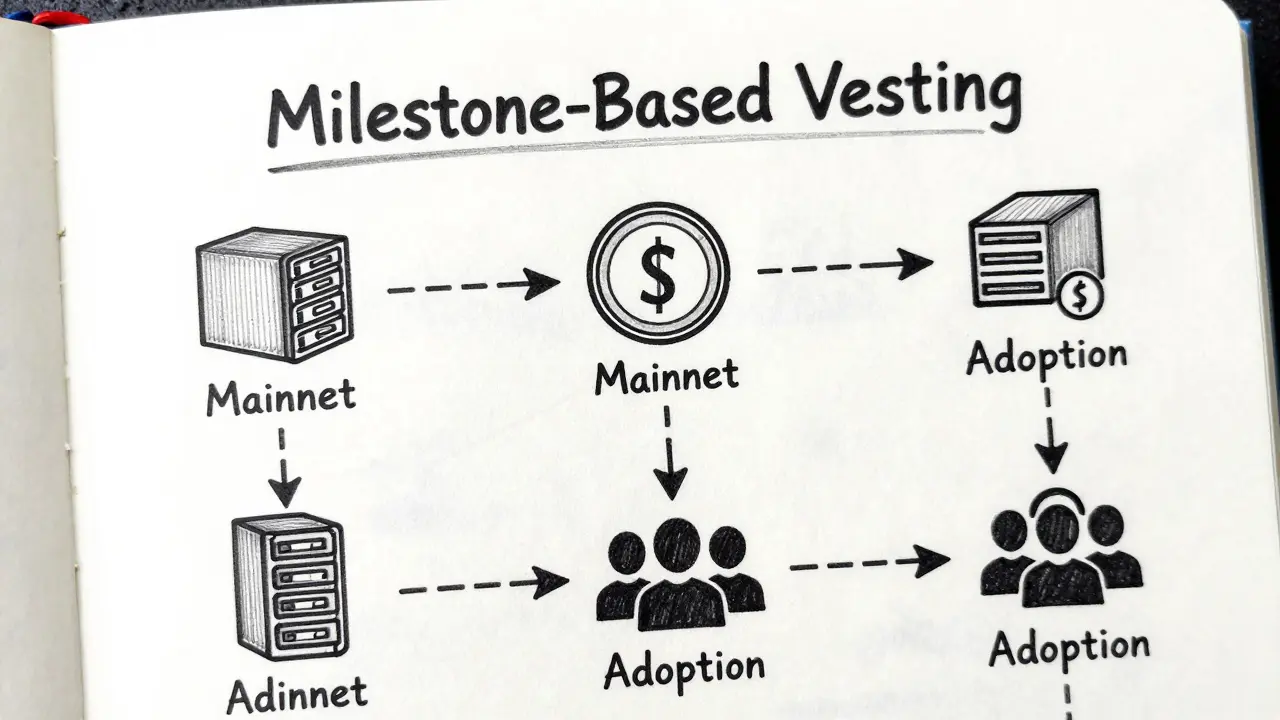
Here, time matters less than progress. Tokens unlock only when the project hits specific targets. Common milestones include:
- Launch of the Mainnet
- Achieving 100,000 active users
- Securing a partnership with a major enterprise
- Completing a security audit
This structure aligns incentives perfectly. The team only gets paid if they deliver value. However, it can be risky if milestones are vague or easily manipulated. Smart contracts must be written carefully to verify these achievements objectively.
3. Hybrid Models
Most modern ICOs use a mix of both. They might require a minimum time passage (e.g., 6 months) AND a specific milestone (e.g., beta launch) before any tokens release. This adds layers of protection against failure while rewarding genuine progress.
Vesting by Stakeholder Group
Different groups within a project have different roles, so their vesting schedules differ significantly. Let's look at who gets what and why.
Core Team Members
The founders, developers, and engineers usually hold the largest internal allocation, typically between 15% and 25% of the total supply. Because they have the most influence on the project's success, they face the strictest vesting terms. Standard practice for core teams involves a 12-to-24-month cliff followed by 24-to-48 months of linear vesting. This ensures that even if a founder wants to leave, they can't dump millions of dollars worth of tokens on day one. It signals to investors that the team is here for the long haul.
Advisors
Advisors provide expertise, connections, and credibility but don't do the daily work. Their allocation is smaller, usually 3% to 7%. Their vesting is also shorter, often ranging from 12 to 18 months total, with cliffs of just 3 to 6 months. Since their contribution is periodic rather than continuous, locking them up for four years doesn't make sense.
Early Investors & VCs
Investors who put in capital during private rounds expect liquidity sooner than the public. However, to avoid crashing the price upon public listing, they still face vesting. Typical schedules range from 12 to 24 months. Some deals include "accelerated vesting" clauses if certain conditions are met, such as a secondary sale opportunity or exchange listing.
Community & Public Sale
Tokens bought directly by the public in the ICO are usually fully vested immediately. Why? Because those buyers took the highest risk by investing late-stage without discounts. Locking their tokens would create illiquidity and anger the user base. However, some projects implement a "lock-up" period on exchanges for the first few weeks to stabilize initial trading.
Why Smart Contracts Matter
In traditional equity, vesting is managed by HR departments and legal paperwork. In crypto, it’s code. Smart contracts deployed on blockchains like Ethereum handle the distribution automatically. This brings huge advantages:
- Transparency: Anyone can view the contract code on the blockchain explorer. You can see exactly when tokens will unlock. No hidden agendas.
- Immutability: Once deployed, the rules cannot be changed unless pre-programmed governance mechanisms allow it. This prevents the team from arbitrarily extending vesting periods to keep themselves locked in.
- Automation: No manual transfers mean fewer errors and lower administrative costs.
However, this relies on the quality of the code. Bugs in vesting contracts have led to lost funds in the past. Always check if the vesting contract has been audited by reputable firms like CertiK or OpenZeppelin.

Red Flags to Watch For
As an investor, you should scrutinize the whitepaper or tokenomics section closely. Here are warning signs that a vesting schedule might be problematic:
- No Cliff: If the team gets tokens immediately, they have no skin in the game. They could sell everything and abandon the project.
- Short Total Duration: A total vesting period of less than 12 months for the team is suspicious. Real projects take years to build.
- Vague Milestones: Terms like "when the team feels ready" are unacceptable. Milestones must be measurable and verifiable.
- Disproportionate Allocations: If the team holds more than 30% of the supply with light vesting, the inflation risk is too high.
Evolution in 2026: STOs and DAOs
The landscape is shifting. With stricter regulations globally, many projects are moving toward Security Token Offerings (STOs). These often mirror traditional venture capital structures more closely, requiring rigorous compliance checks before tokens can be transferred. Additionally, Decentralized Autonomous Organizations (DAOs) are introducing new concepts. Instead of fixed schedules, some DAOs allow community votes to adjust vesting parameters based on performance. While innovative, this introduces complexity and potential governance attacks that traditional models avoid.
What is a cliff period in ICO vesting?
A cliff period is an initial timeframe during which no tokens are released to stakeholders. For example, a one-year cliff means team members receive zero tokens for the first 12 months. This ensures that participants remain committed to the project before accessing their rewards.
How long is a typical vesting schedule for ICO team members?
Typically, core team members face a vesting period of 24 to 48 months, often preceded by a 12-month cliff. This long duration aligns their interests with the project's long-term success and prevents early dumping of tokens.
Can vesting schedules be changed after an ICO launches?
Generally, no. Vesting schedules are enforced by smart contracts on the blockchain, making them immutable. Changes are only possible if the original contract includes specific governance mechanisms that allow for updates via community vote or multi-signature approval.
Why do advisors have shorter vesting periods than the core team?
Advisors contribute expertise and networks periodically rather than working full-time on development. Therefore, locking their tokens for four years is unnecessary and impractical. Shorter periods of 12-18 months reflect their intermittent involvement.
What happens if a team member leaves during the vesting period?
It depends on the contract design. Often, unvested tokens are forfeited entirely. Vested tokens may remain accessible, or they might be subject to a clawback clause where the company can reclaim them if the departure is deemed detrimental to the project.
Is milestone-based vesting better than time-based vesting?
Milestone-based vesting aligns payments directly with results, which is ideal for accountability. However, it requires clear, objective metrics. Time-based vesting offers more predictability for financial planning. Many successful projects use a hybrid of both to balance flexibility and certainty.