
Ethereum Scaling: How Layer 2s and Rollups Are Fixing Crypto's Biggest Problem
When you send crypto on Ethereum, you’re not just sending money—you’re paying for space on a crowded digital highway. That’s where Ethereum scaling, the set of techniques used to increase the speed and lower the cost of transactions on the Ethereum network. It’s not a buzzword—it’s the reason millions still use Ethereum despite fees hitting $50 during peak times. Without scaling, Ethereum would’ve become too slow and expensive for everyday use. But it didn’t die. It adapted.
Enter Layer 2 solutions, networks built on top of Ethereum that handle transactions off the main chain, then bundle them back in. These aren’t sidechains or altcoins—they’re direct upgrades to Ethereum’s core function. Think of them like express lanes built right on top of the main highway. Projects like rollups, a type of Layer 2 that processes hundreds of transactions in a single batch and posts proof back to Ethereum, cut costs by 90% and boosted speed to near-instant. Some rollups, like Optimism and Arbitrum, now handle more daily activity than many entire blockchains.
Why does this matter to you? Because if Ethereum can’t scale, it can’t compete. Bitcoin might be digital gold, but Ethereum is the world’s computer. And computers need to be fast. That’s why every major DeFi app, NFT marketplace, and Web3 game now runs on a Layer 2. You don’t need to understand the tech to use it—but you do need to know it exists. Otherwise, you’ll keep wondering why your transaction takes hours or costs more than your coffee.
What you’ll find below isn’t theory. It’s real-world cases: exchanges that failed because they ignored scaling, projects that died because they were stuck on Ethereum’s slow core, and others that thrived by moving to rollups before anyone else did. You’ll see how users in Nepal and Bolivia bypassed slow networks, how scams exploited high fees, and why platforms like Base and Cronos became popular not because they were flashy—but because they were cheap and fast. This isn’t about future promises. It’s about what’s already working—and what’s already dead.
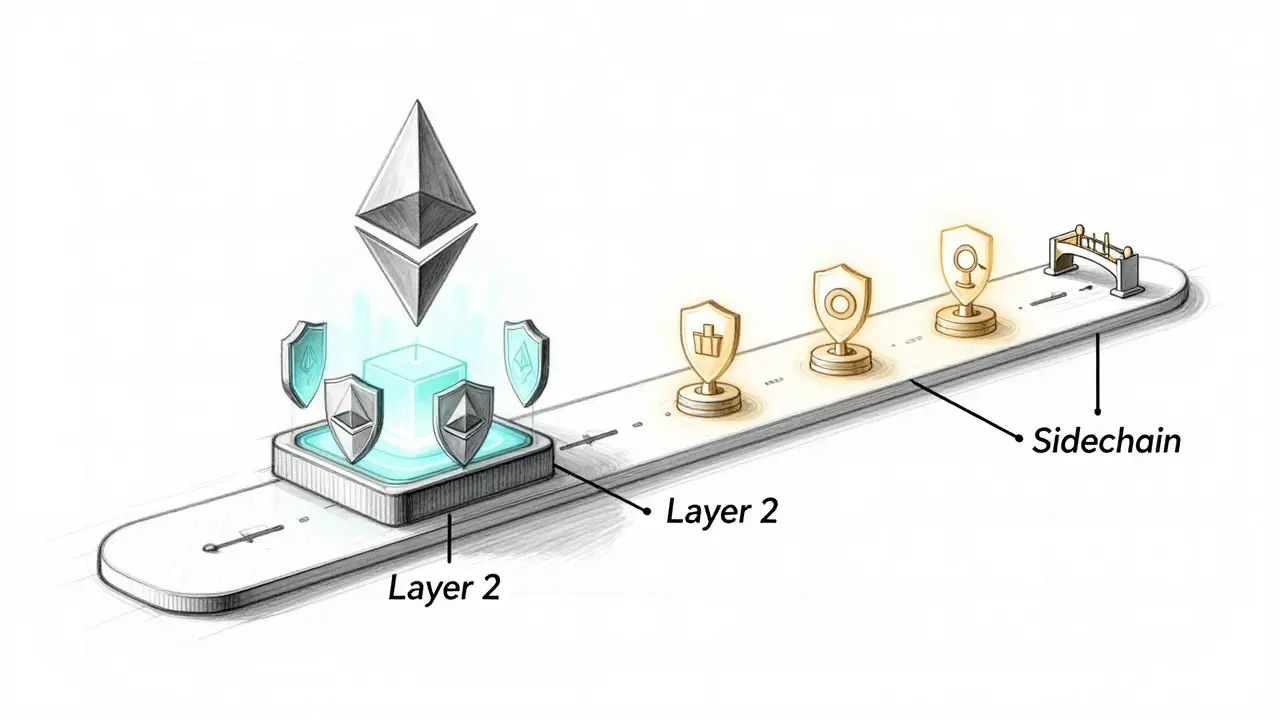
Sidechains vs Layer 2: Which Scalability Solution Fits Your Blockchain Project?
Sidechains and Layer 2 solutions both solve Ethereum's scaling issues, but they work in very different ways. Learn which one is right for your project based on security, speed, cost, and use case.