
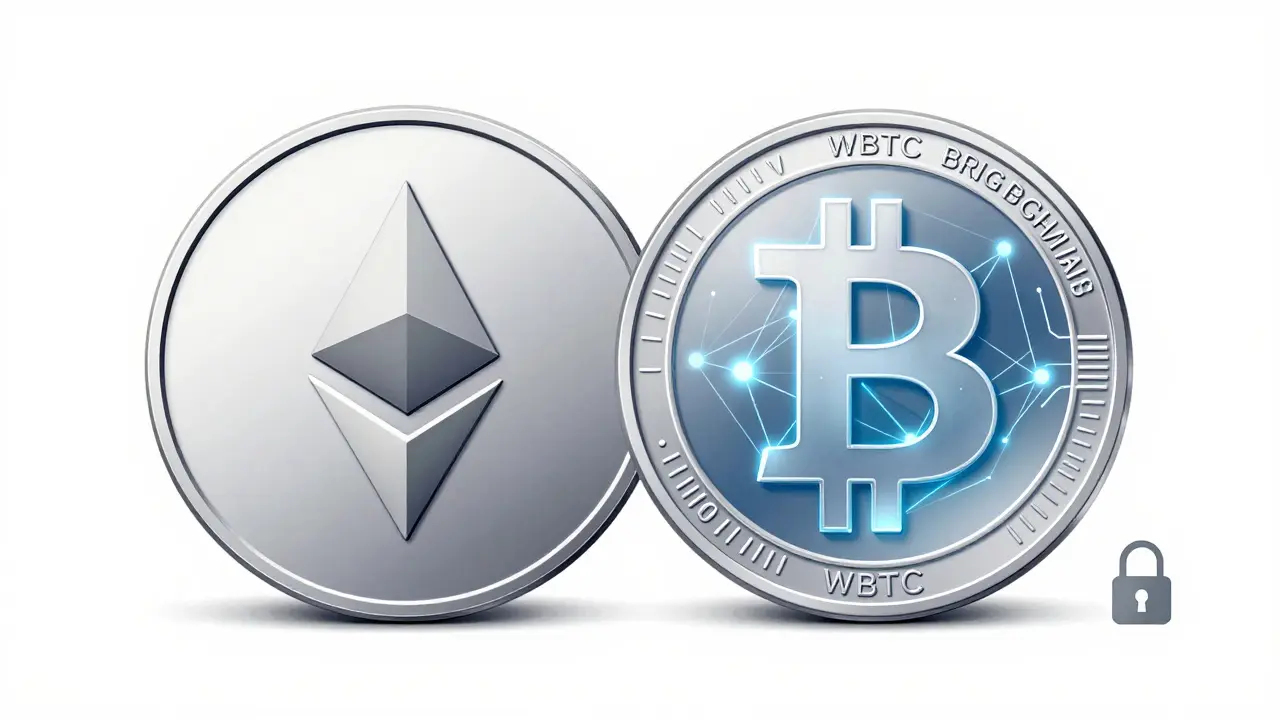
When you hold Bitcoin, you’re holding the real thing - secured by its own network, verified by thousands of miners, and unstoppable without controlling half the world’s computing power. But what if you want to use that Bitcoin in a DeFi app on Ethereum? You can’t. Not directly. That’s where wrapped assets come in. They’re not the real thing - but they act like it. And right now, over $12.5 billion in value is locked in them.
What Are Native Assets?
Native assets are the original cryptocurrencies that live on their own blockchains. Bitcoin (BTC) runs on the Bitcoin network. Ether (ETH) runs on Ethereum. Solana (SOL) runs on Solana. These assets follow their own rules, use their own consensus mechanisms, and can only interact with other assets on the same chain - unless you bridge them.
Native assets are simple: you send BTC from one wallet to another, and the Bitcoin network confirms it. No middlemen. No third-party contracts. Just math, cryptography, and decentralized validation. That’s why Bitcoin’s network has over 300 exahashes of hash power - it’s designed to be unbreakable. ETH pays for Ethereum gas. BTC can’t. And that’s intentional.
But here’s the problem: Bitcoin’s network doesn’t support smart contracts. Ethereum does. So if you own Bitcoin and want to lend it, earn interest, or trade it in a DeFi protocol, you’re stuck. Unless you wrap it.
What Are Wrapped Assets?
Wrapped assets are tokens that represent native assets on a different blockchain. The most famous example is WBTC (Wrapped Bitcoin). For every WBTC you hold, one real BTC is locked in a secure vault - usually managed by a trusted custodian like BitGo. In return, an equivalent amount of WBTC is minted on Ethereum as an ERC-20 token.
That means you can now send WBTC to a DeFi app like Aave or Compound and earn interest. You can use it as collateral. You can trade it on Uniswap. It behaves like ETH - but it’s backed by Bitcoin.
Other common wrapped assets include:
- WETH (Wrapped Ether) - ETH converted to an ERC-20 token for easier use in smart contracts
- renBTC (Ren Protocol’s decentralized Bitcoin wrapper)
- wMATIC (Wrapped Polygon)
- wSOL (Wrapped Solana)
Each one follows the same 1:1 rule: lock the native asset, mint the wrapped version. Burn the wrapped version, get the original back. Simple. But not without risks.
Key Differences: Wrapped vs Native
Let’s break it down side by side.
| Feature | Native Assets | Wrapped Assets |
|---|---|---|
| Blockchain Location | Only on their native chain (e.g., BTC on Bitcoin) | Can exist on multiple chains (e.g., WBTC on Ethereum, Polygon, Avalanche) |
| Security Model | Secured by native blockchain consensus (e.g., Bitcoin PoW with 300+ exahashes) | Secured by custodians or smart contracts - introduces trust assumptions |
| Liquidity Access | Limited to native ecosystem (Bitcoin DeFi liquidity: ~$500M) | Unlock access to larger ecosystems (Ethereum DeFi liquidity: $35B+) |
| Transaction Speed | Bitcoin: ~10 minutes per confirmation | WBTC on Ethereum: 15-30 seconds |
| Gas Fees | Bitcoin: $1-$25 | WBTC on Ethereum: $0.50-$5 (varies with congestion) |
| Functionality | Can pay native fees, vote on protocol upgrades | Cannot pay gas on native chain; no governance rights |
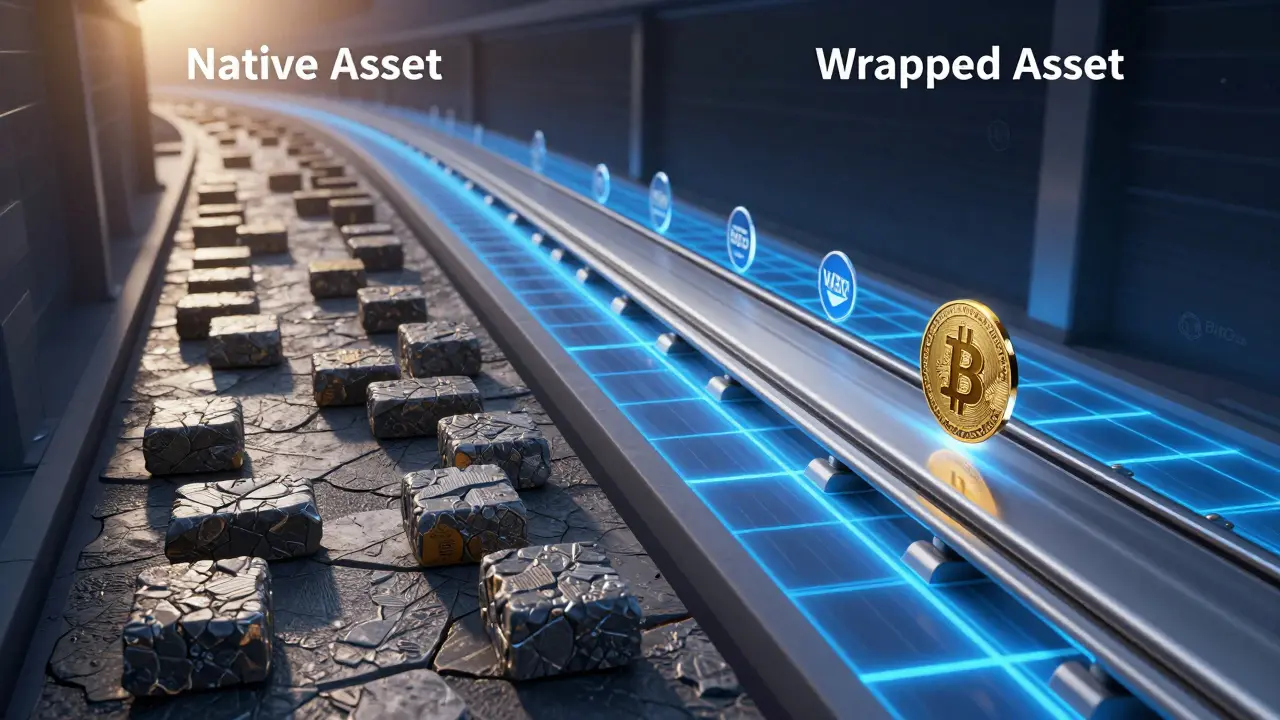
Native assets are pure. Wrapped assets are bridges. One is the original. The other is a passport.
Why Do Wrapped Assets Exist?
Blockchain networks are like islands. Bitcoin is one. Ethereum is another. Solana, Polygon, Avalanche - each has its own economy, its own rules, its own users. But people don’t want to choose just one. They want to use Bitcoin’s value on Ethereum. They want to stake Solana in a Curve pool. They want to earn yield on assets they already own.
Wrapped assets solve that. They let you take your Bitcoin and turn it into something that works on Ethereum - without selling it. That’s huge. In Q3 2023, wrapped assets accounted for 37% of all cross-chain liquidity. WBTC alone made up 78% of all wrapped Bitcoin usage.
Without wrapped assets, Bitcoin holders would be locked out of Ethereum’s $35 billion DeFi market. Now, they’re part of it. Institutions like Fidelity and JPMorgan are already using wrapped versions of their assets to move value across chains. Circle’s USDC is wrapped across 14 blockchains. This isn’t a niche experiment - it’s infrastructure.
The Hidden Risks
But wrapped assets aren’t magic. They come with real dangers.
Custodial risk: WBTC relies on BitGo - a licensed custodian - to hold the real BTC. If BitGo goes down, gets hacked, or refuses to release funds, your WBTC becomes worthless. That’s not decentralized. That’s centralized. And it’s the opposite of Bitcoin’s original promise.
Smart contract risk: In 2022, Samczsun audited 14 wrapped asset protocols. 9 of them had critical vulnerabilities. One glitch in the minting contract, and your wrapped tokens could be drained. The Nomad bridge hack in August 2022 stole $600 million - mostly wrapped assets.
Utility limits: You can’t use WBTC to pay Ethereum gas fees. You can’t vote on Ethereum upgrades with it. You can’t mine Bitcoin using WBTC. It’s a representation - not the real thing.
Abandonment risk: Smaller wrapped tokens like Wrapped Dogecoin were abandoned by developers. Users lost $87,000. No one was left to fix the contract. No one could help. You’re at the mercy of whoever built it.
And then there’s regulation. In February 2023, the SEC said certain wrapped tokens could be classified as securities if issued by centralized entities. That means WBTC - backed by BitGo and 18 merchant partners - could face legal scrutiny.
Real User Experiences
Reddit users love WBTC. One user posted in October 2023 that they were earning 4.2% APY on WBTC in Aave - and got 1,247 upvotes. Another user, u/BitcoinPurist, posted about withdrawal delays during the FTX collapse. Wrapped assets backed by centralized exchanges took over 72 hours to process. He called it "a betrayal of decentralization."
On Trustpilot, Coinbase’s WBTC service has a 4.2/5 rating. Users praise reliability but hate the 0.875% minting fee. renBTC, the decentralized alternative, scores 3.5/5 - slower, but no custodian. Users who care about control prefer it.
Developers? They’re constantly fixing mistakes. Over 37% of MetaMask support tickets involve users accidentally sending WBTC to a Bitcoin address - which destroys the tokens. Etherscan logged $2.1 million in lost wrapped assets this way in 2023. It’s easy to mess up.
What’s Next?
The future of wrapped assets isn’t fixed. Two paths are emerging.
One path leads to decentralized custody. Chainlink’s CCIP protocol - currently in beta - aims to replace custodians with decentralized oracles. No single company holds your Bitcoin. Instead, a network of independent nodes verifies the lock and release. That’s the future many developers want.
The other path leads to native cross-chain messaging. Vitalik Buterin believes we shouldn’t wrap assets at all. Instead, blockchains should talk directly to each other. Ethereum’s Shanghai upgrade in 2023 let users withdraw staked ETH natively - reducing the need for stETH wrappers. Polkadot and Cosmos are building native interoperability. If they succeed, wrapped assets become obsolete.
For now, though, we’re stuck in the middle. Wrapped assets are the bridge we have - not the bridge we want. By 2026, experts predict the 47 existing wrapped Bitcoin versions will shrink to just 5-7 major ones. WBTC, renBTC, and maybe a few others will survive. The rest will vanish.
Should You Use Wrapped Assets?
Here’s how to decide:
- Use wrapped assets if: You want to earn yield on Bitcoin in DeFi. You need faster, cheaper transactions than Bitcoin’s network offers. You’re comfortable with some centralization for access.
- Avoid wrapped assets if: You believe in full decentralization. You’re storing long-term value. You don’t trust custodians. You want to use your asset for governance or native fee payments.
Most people use them without realizing it. If you’ve ever deposited BTC into a DeFi app on Ethereum - you used WBTC. If you’ve ever swapped ETH for SOL on a DEX - you used wrapped SOL.
They’re not perfect. But they’re necessary. Until blockchains can talk to each other without middlemen, wrapped assets will keep the economy moving.
Are wrapped assets the same as the original cryptocurrency?
No. Wrapped assets are tokens that represent the original asset on a different blockchain. For example, WBTC is an ERC-20 token on Ethereum that represents Bitcoin. Each WBTC is backed by one real BTC locked in a custodian’s vault. But WBTC cannot be used to pay Bitcoin network fees or participate in Bitcoin governance. It’s a digital twin - not the original.
Can I convert wrapped assets back to native assets?
Yes - that’s how the system works. To convert WBTC back to BTC, you burn the WBTC tokens through the wrapping protocol’s smart contract. This triggers the custodian (like BitGo) to release an equivalent amount of Bitcoin from its reserve. The process usually takes 1-4 hours, depending on network conditions and custodian verification. Always confirm the correct withdrawal address - sending to a Bitcoin address from an Ethereum wallet will lose your funds permanently.
Which is safer: native assets or wrapped assets?
Native assets are safer in terms of decentralization and censorship resistance. Bitcoin’s network has over 300 exahashes of hash power - it’s nearly impossible to attack. Wrapped assets rely on custodians or smart contracts, both of which can be hacked or shut down. The 2022 Nomad bridge hack lost $600 million in wrapped assets. While WBTC has never been hacked, its custodian model introduces a single point of failure that native Bitcoin doesn’t have.
Do wrapped assets have governance rights?
No. Wrapped assets don’t grant voting rights or protocol governance on their native chain. You can’t vote on Bitcoin upgrades with WBTC. You can’t influence Ethereum’s future with WETH. They’re designed for liquidity and interoperability - not participation. If you want governance, you need the native asset on its original chain.
Why do gas fees for wrapped assets vary so much?
Gas fees for wrapped assets depend on the blockchain they’re on. WBTC runs on Ethereum, so its fees follow Ethereum’s congestion. During peak times, fees can hit $5 or more. On slower chains like Polygon, fees are under $0.10. Bitcoin’s native fees are higher and slower because of its design - 10-minute blocks and limited transaction capacity. Wrapped assets use faster, cheaper networks to make the original asset more usable.
Are wrapped assets regulated by governments?
Yes - and that’s a growing risk. In February 2023, the SEC said wrapped tokens issued by centralized entities could be classified as securities. WBTC, which is managed by BitGo and 18 merchant partners, falls into this gray area. If regulators classify WBTC as a security, exchanges may have to delist it. That’s why decentralized alternatives like renBTC are gaining attention - they avoid centralized control.


