
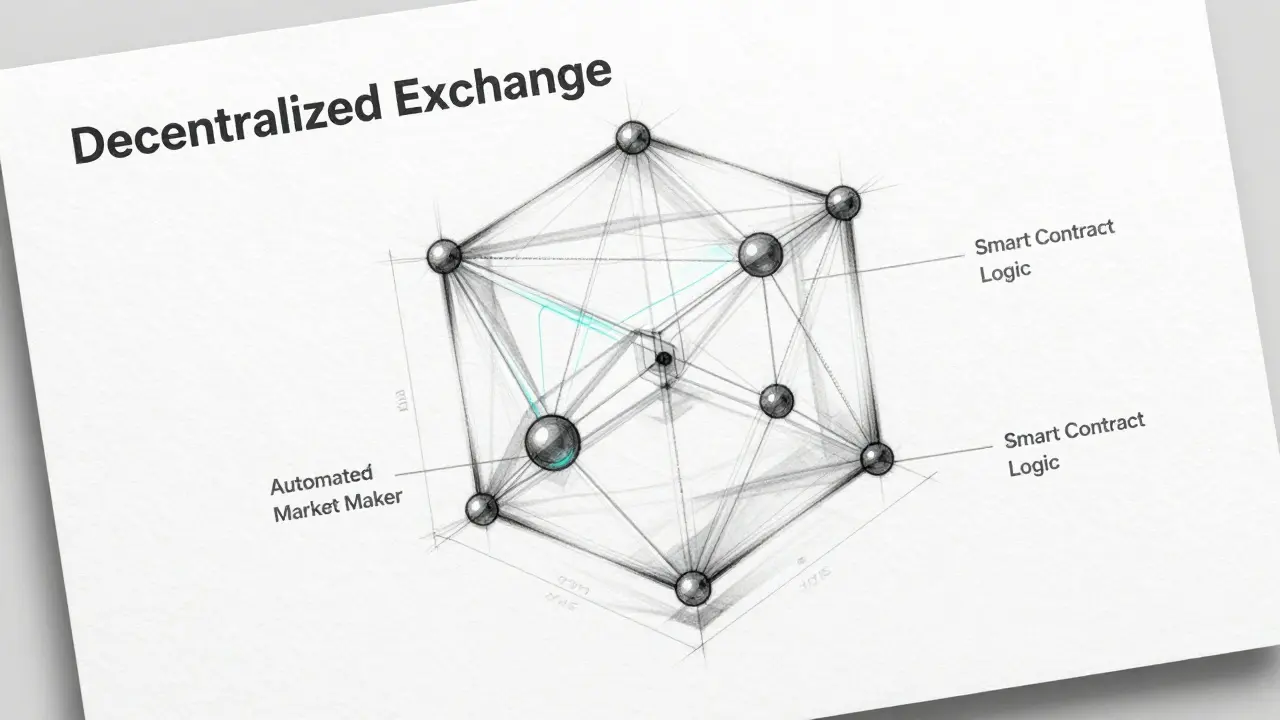
Imagine walking into a bank to exchange dollars for euros. You talk to a teller, they check the rate, and you get your money. Now imagine doing that same trade without a bank, without a human, and without anyone holding your funds. That is exactly what Uniswap is a decentralized exchange protocol that allows users to swap cryptocurrencies directly from their wallets using automated market makers. It is the largest decentralized exchange (DEX) in the world by volume, processing billions of dollars daily. But here is the catch: Uniswap doesn’t have a CEO, a board of directors, or a central office. Instead, it runs on code, and it is governed by people who hold its native token, UNI is the governance token of the Uniswap protocol, allowing holders to vote on changes to the platform's rules and fee structures. If you are asking "what is UNI crypto coin," you are really asking how ownership works in a system that belongs to no one and everyone at once. This article breaks down what UNI actually does, why it exists, and whether it is worth your attention in the current crypto landscape.
The Core Problem: Trusting Code Over Banks
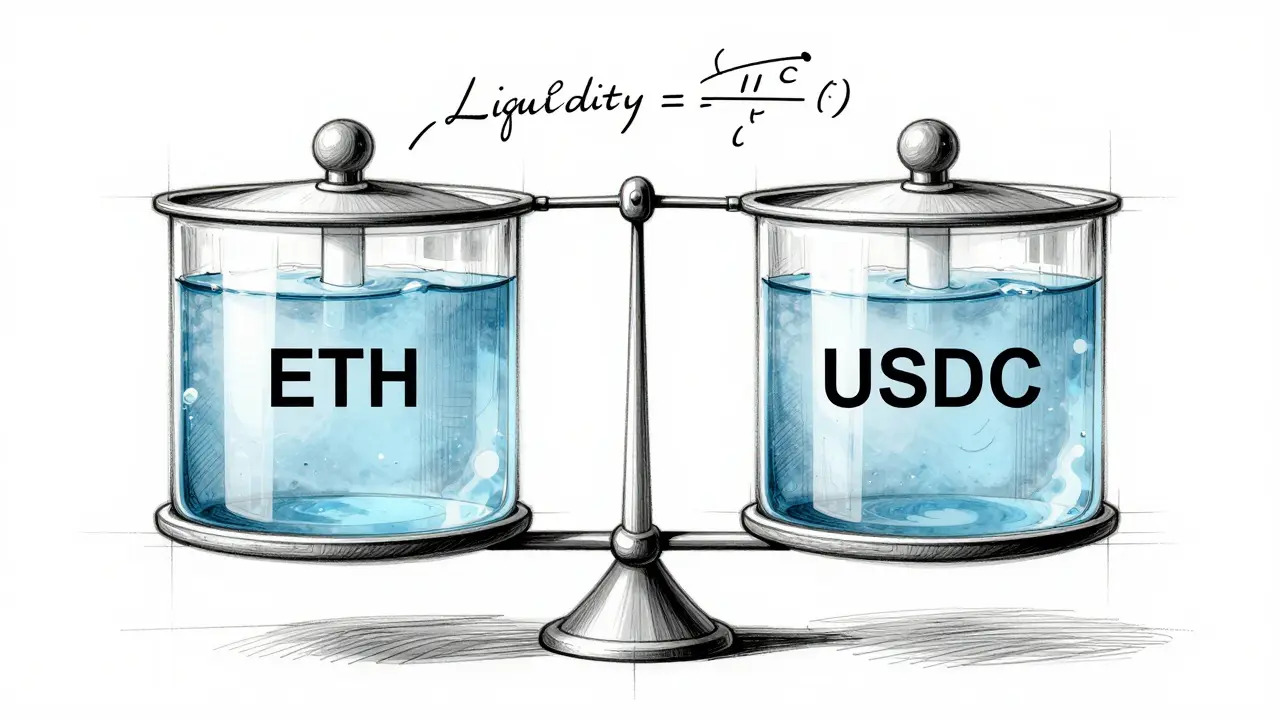
To understand UNI, you first need to understand why Uniswap was built. Traditional exchanges like Coinbase or Binance are centralized. They hold your money. If they go bankrupt, get hacked, or freeze your account, you lose access. In 2018, Hayden Adams launched Uniswap to solve this. He created an open-source protocol where trades happen between users’ wallets via smart contracts on the Ethereum blockchain. There is no order book-no buyer waiting for a seller. Instead, there are Liquidity Pools are collections of paired tokens locked in a smart contract that provide the funds necessary for traders to execute swaps instantly. Anyone can deposit two tokens (like ETH and USDC) into these pools. When you want to trade, you pull from these pools. The price is determined automatically by a mathematical formula based on the ratio of assets in the pool. This model is called an Automated Market Maker (AMM). Because it removes the middleman, it is permissionless. Anyone with an internet connection and a wallet can trade any ERC-20 token, even if it just launched five minutes ago.
So, What Does the UNI Token Actually Do?
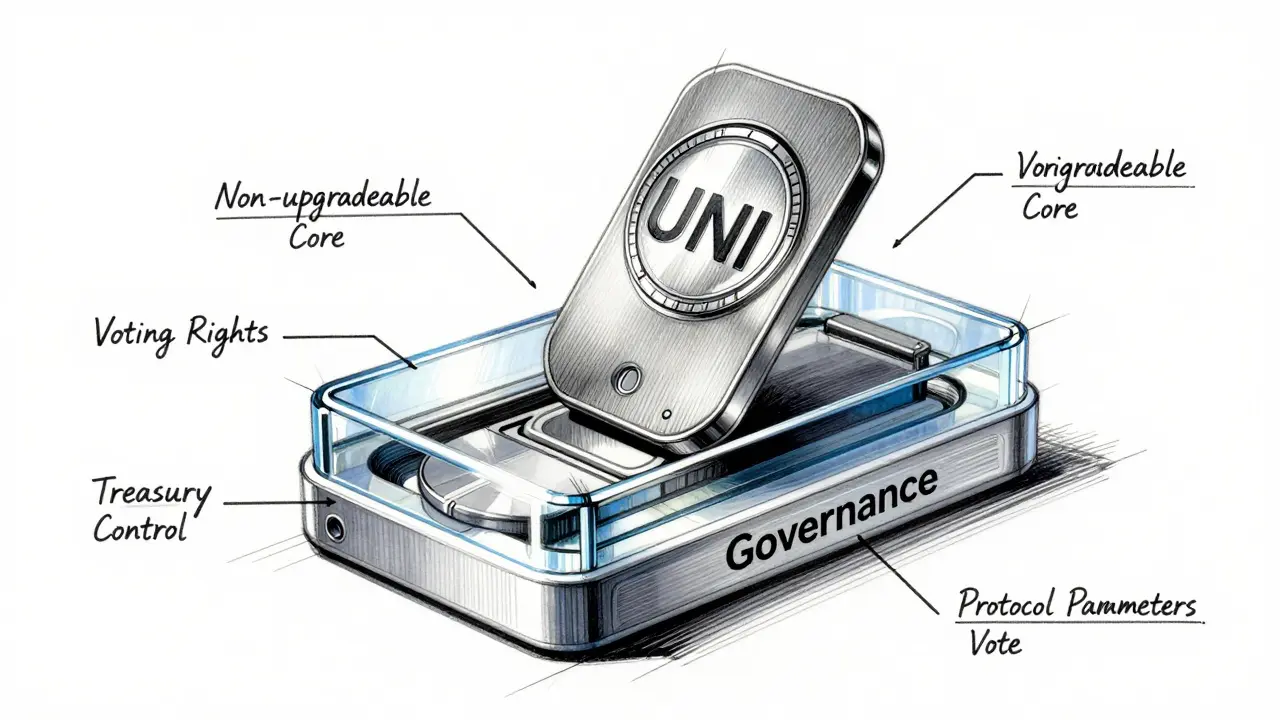
This is where most people get confused. Unlike Bitcoin, which you buy to store value, or Ethereum, which you buy to pay for network transactions, UNI has a very specific purpose: Governance. When you hold UNI, you are essentially a shareholder in a company that doesn’t exist legally. Here is what that power looks like:
- Voting Rights: UNI holders vote on proposals that change how Uniswap works. This includes decisions on fee structures, treasury spending, and new features. For example, the community recently voted to allocate $15 million from the treasury to fund the development of Unichain, a new Layer 2 solution.
- Protocol Control: While the core smart contracts are non-upgradeable (meaning no single person can change them), governance controls the parameters around them. Holders decide which networks Uniswap expands to and how revenue is distributed.
- No Staking Rewards (Yet): Currently, simply holding UNI does not earn you passive income from trading fees. This is a major point of debate. Critics argue that because UNI doesn’t capture protocol revenue, its value is disconnected from Uniswap’s massive success. However, future upgrades like Protocol V4 may introduce mechanisms to redirect fees to stakers.
Tokenomics: Supply, Distribution, and Inflation
Understanding the math behind UNI helps explain its price behavior. The total supply of UNI is fixed at 1 billion tokens. No more will ever be created. However, not all tokens are in circulation yet.
| Allocation Category | Percentage | Purpose |
|---|---|---|
| Community Airdrop | 60% | Distributed to early users and liquidity providers to decentralize governance immediately. |
| Team & Advisors | 20% | Vested over time to align long-term incentives with protocol success. |
| Investors | 20% | Early backers who funded development; subject to vesting schedules. |
How Uniswap Makes Money (And Why You Should Care)
Uniswap generates roughly $1.2 billion annually in trading fees. These fees are typically 0.3% per swap. Here is the critical part: Uniswap the protocol does not keep this money. All fees go directly to the Liquidity Providers (LPs)-the people who deposited their crypto into the pools. This raises a tough question: If UNI holders don’t get a cut of the profits, why is the token valuable? Proponents argue that UNI’s value lies in its strategic importance. As the standard for decentralized trading, UNI is essential for anyone serious about DeFi. Furthermore, upcoming updates like Protocol V4 and the launch of Unichain aim to improve capital efficiency and potentially introduce fee-sharing models. Until then, UNI is a bet on the growth of the entire decentralized finance ecosystem rather than a direct dividend stock.
Risks: Impermanent Loss and Smart Contract Vulnerabilities
If you plan to use Uniswap, especially as a liquidity provider, you must understand the risks. Buying UNI on an exchange is relatively safe, but interacting with the protocol carries unique dangers.
- Impermanent Loss: This is the biggest risk for LPs. When you provide liquidity, you lock in a pair of tokens. If the price of one token moves significantly compared to the other, the pool rebalances, leaving you with less of the appreciated asset and more of the depreciated one. You might end up with less value than if you had just held the tokens in your wallet. Estimates suggest impermanent loss can range from 5% to 30% depending on volatility.
- Smart Contract Risk: Although Uniswap’s code is heavily audited, bugs can exist. In 2022, over $1.8 billion was lost across DeFi protocols due to exploits. While Uniswap itself has remained secure, users often interact with other contracts connected to it, increasing exposure.
- Gas Fees: Trading on Ethereum mainnet can be expensive. During peak congestion, gas fees can exceed $50. This makes small trades uneconomical. Many users now prefer bridging to Layer 2 networks like Arbitrum or Optimism, where fees are pennies.
Uniswap vs. Centralized Exchanges: The Trade-Off
Should you use Uniswap or stick with Coinbase or Binance? It depends on your priorities.
| Feature | Uniswap (DEX) | Coinbase/Binance (CEX) |
|---|---|---|
| Custody | Non-custodial (You control funds) | Custodial (Exchange holds funds) |
| KYC Required | No | Yes |
| Token Selection | 10,000+ tokens (including new/meme coins) | Limited to listed tokens |
| Fees | 0.3% swap fee + Gas fees | Variable trading fees (often lower for large volumes) |
| Security Risk | Smart contract bugs / User error | Hacks / Exchange insolvency |
The Future: Unichain and Protocol V4
Uniswap is not standing still. The roadmap for 2025 and beyond is aggressive. The biggest development is Unichain is Uniswap's dedicated Layer 2 blockchain built on the OP Stack, designed to unify liquidity and reduce fragmentation across multiple networks. Currently, Uniswap operates on Ethereum, Polygon, Arbitrum, Optimism, and others. This fragments liquidity, making trades less efficient. Unichain aims to bring everything under one roof with faster block times (200ms) and a mechanism to redistribute MEV (Maximal Extractable Value) profits back to users. Additionally, Protocol V4 introduces "hooks," allowing developers to customize pool behavior. This could enable limit orders, leveraged positions, and other advanced trading features currently missing from DEXes. If successful, these updates could push Uniswap’s market share above 70% by 2026, solidifying its dominance in DeFi.
Is UNI a good investment?
That depends on your view of decentralized finance. UNI is not a yield-bearing asset today, so its value relies on governance utility and speculation on future fee-sharing models. If you believe DeFi will replace traditional finance and Uniswap will remain the leader, UNI is a strong play. However, be aware of the 27.6% inflation rate from unlocked tokens and the lack of direct revenue sharing.
Can I buy UNI with USD?
Not directly on Uniswap. Uniswap only trades crypto-to-crypto. You must first buy ETH or USDC on a centralized exchange like Coinbase or Kraken, send it to a wallet like MetaMask, and then swap it for UNI on the Uniswap interface.
What is impermanent loss?
Impermanent loss occurs when the price of tokens you’ve deposited into a liquidity pool changes compared to when you deposited them. You may end up with less value than if you had simply held the tokens in your wallet. It is called "impermanent" because if prices return to their original ratio, the loss disappears, but if you withdraw during volatility, the loss becomes permanent.
Does Uniswap charge high fees?
The swap fee is low (typically 0.3%), but Ethereum gas fees can be high. During network congestion, gas fees can exceed the cost of the trade itself. To avoid this, many users trade on Layer 2 networks like Arbitrum or Optimism, where fees are a fraction of a cent.
Who owns Uniswap?
No one owns Uniswap in the traditional sense. It is governed by UNI token holders who vote on proposals. The code is open-source, and the protocol runs autonomously on the blockchain. The Uniswap Labs company provides client interfaces and development tools, but they do not control the protocol itself.