
Understanding Redbelly Network
You’ve probably heard the buzz around real-world assets in crypto. But have you heard of the chain built specifically for them? That’s where Redbelly Network comes in. It isn’t just another generic blockchain trying to do everything. Instead, it focuses on one thing: making it safe and legal to tokenize real-world value.
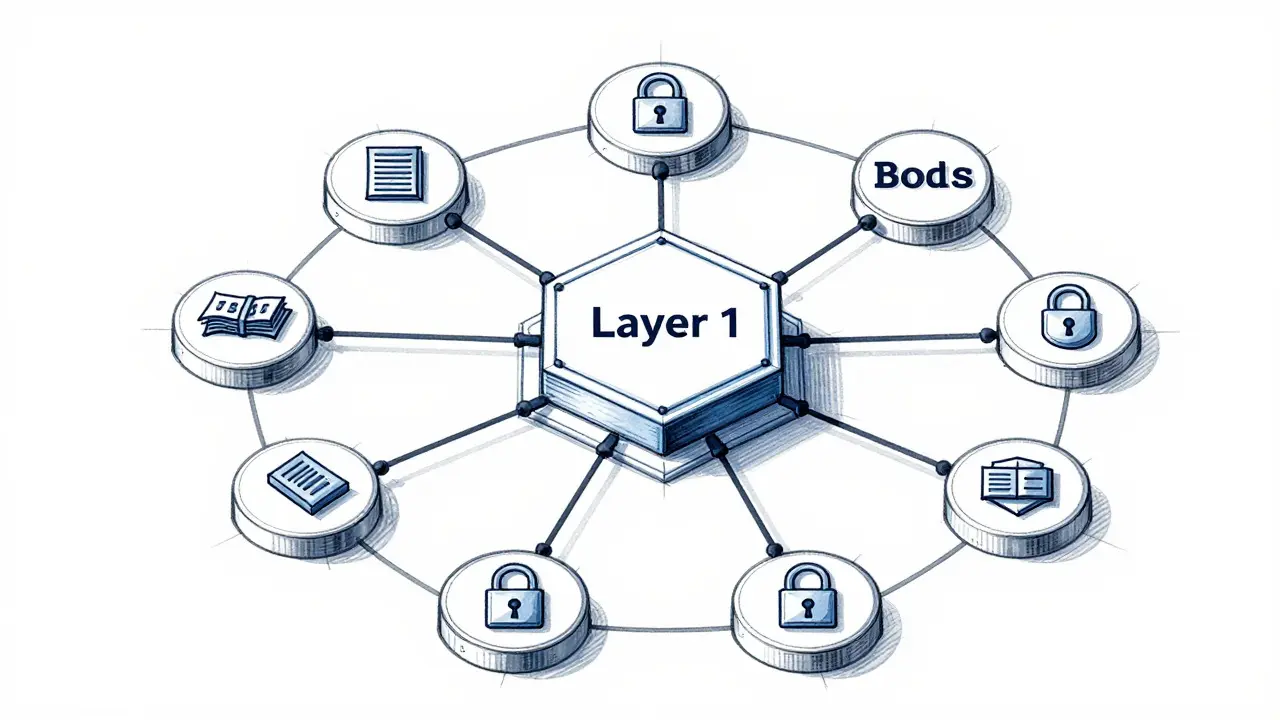
At its core, Redbelly is a Layer 1 public blockchain. It uses its own native coin, RBNT, which acts as the fuel for transactions and governance on the network. The project stands out because it was born from serious academic research at the University of Sydney and CSIRO, Australia’s national science agency. This gives it a technical pedigree that many newer chains simply don’t have.
Key Takeaways
- Purpose: Redbelly is designed specifically for compliant tokenization of real-world assets (RWAs) like securities and debt instruments.
- Technology: It uses Democratic BFT, the first fully formally verified consensus protocol, backed by US Patent 12093247.
- Tokenomics: The RBNT token has a hard cap of 10 billion coins, used for gas fees, staking rewards, and voting.
- Market Status: As of mid-2026, RBNT trades between $0.0028 and $0.0038 USD with a market cap near $10 million.
- Accessibility: You can buy RBNT on exchanges like Gate.io and MEXC, or bridge it from Ethereum using Polymer.
The Tech Behind the Hype: Formal Verification
Most blockchains rely on code that works "well enough" until someone finds a bug. Redbelly takes a different approach. Its foundation is Democratic BFT, a leaderless Byzantine Fault Tolerant consensus algorithm.
Here is why that matters. In traditional systems, if a few nodes act maliciously (Byzantine faults), the whole system can crash or split. Redbelly’s protocol has been mathematically proven to stay safe and keep running even when things go wrong. Professor Vincent Gramoli, the founder and CTO, describes this as the first time a blockchain consensus has been fully formally verified. They even secured US Patent number 12093247 for this specific technology.
This level of mathematical proof is crucial for finance. Banks and regulators don't trust "move fast and break things." They need guarantees. By embedding this verification into the protocol, Redbelly aims to be the digital ledger that institutions actually feel comfortable putting their money into.
Privacy Meets Compliance: The Identity Layer
If you want to trade stocks or bonds on a blockchain, you can’t just hide behind a random string of letters and numbers. Regulators require Know Your Customer (KYC) and Anti-Money Laundering (AML) checks. Most privacy coins hide your identity completely; most public chains expose it entirely. Redbelly tries to walk the middle path.
The network features an integrated identity layer. Every participant is known at the protocol level, but their personal data stays private. How? Through Zero-Knowledge Proofs (ZKPs) and verifiable credentials. These tools allow the network to verify that you are who you say you are without broadcasting your passport details to everyone on the internet.
There is also a feature called Polygraph. If someone tries to cheat or commit fraud on the network, Polygraph creates undeniable mathematical proofs of that misbehavior. This accountability makes Redbelly highly attractive for issuing regulated financial products, unlike standard DeFi platforms where bad actors can often vanish without a trace.

RBNT Tokenomics: Supply and Utility
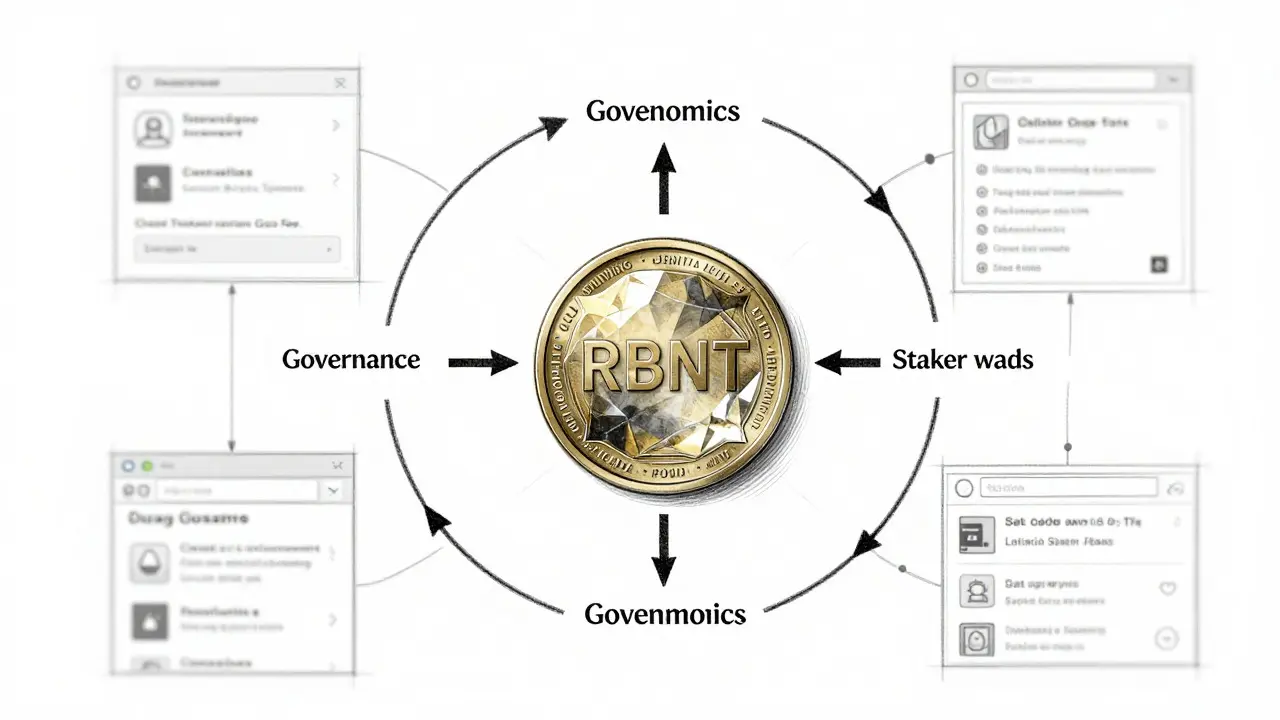
Let’s talk about the coin itself. The RBNT token serves three main jobs on the network:
- Gas Fees: Just like ETH pays for compute on Ethereum, you need RBNT to pay for transaction costs when deploying smart contracts or trading assets on Redbelly.
- Governance: Holders can vote on major platform decisions, shaping the future direction of the protocol.
- Incentives: Users earn RBNT rewards for staking, validating transactions, or participating in asset tokenization activities.
The supply mechanics are straightforward. There is a strict maximum supply of 10,000,000,000 (10 billion) tokens. No more will ever be created. This deflationary pressure means that as demand for network usage grows, the scarcity of available RBNT could theoretically drive up value.
Regarding distribution, team tokens were locked for 12 months after the Token Generation Event (TGE) and then released linearly over the next 24 months. This transparent vesting schedule helps prevent sudden sell-offs by early insiders, a common issue in lesser projects.
Market Performance and Where to Buy
Crypto markets move fast, and RBNT is no exception. Looking at data from July 2026, the token typically trades in the sub-cent range, hovering around $0.0037 USD. The total market capitalization sits near $10 million, placing it roughly in the top 1,000 cryptocurrencies globally.
However, volatility is high. At various points in late 2025, the price spiked above $0.02, only to settle back down later. This kind of swing reminds us that while the technology is mature, the market adoption is still growing.
If you want to get your hands on some RBNT, you have a few options:
- Centralized Exchanges (CEX): Platforms like Gate.io and MEXC offer direct trading pairs (usually RBNT/USDT). Gate.io tends to have the highest liquidity.
- Decentralized Exchanges (DEX): You can find RBNT bridged onto Ethereum via Uniswap V4.
- Bridging: If you already hold RBNT on Ethereum, you can use the Polymer bridge to move it back to the native Redbelly chain. Note that bridging directly from Solana to Redbelly isn't currently supported.
| Metric | Value |
|---|---|
| Price (USD) | $0.0037 - $0.0038 |
| Total Supply | 10,000,000,000 RBNT |
| Circulating Supply | ~2.66 Billion RBNT |
| Market Cap | ~$10.0 Million |
| Fully Diluted Valuation (FDV) | ~$37.6 Million |
How Does It Compare?
So, how does Redbelly stack up against giants like Ethereum or specialized chains like Polygon?
Ethereum is the king of smart contracts, but it struggles with scalability and high gas fees during peak times. More importantly, it lacks built-in identity verification. If you want to issue a regulated bond on Ethereum, you have to build complex off-chain compliance layers that sit awkwardly on top of the protocol.
Redbelly bakes compliance into the foundation. It doesn't try to be a general-purpose app chain for games or memes. It is a specialized tool for finance. Compared to other RWA-focused projects, Redbelly’s claim to fame is that formal verification. While others promise security, Redbelly proves it mathematically. However, being smaller means less liquidity and fewer developers building on it right now compared to established ecosystems.
Who Is This For?
Redbelly Network appeals to two distinct groups:
1. Institutional Issuers: Banks, hedge funds, or real estate firms looking to tokenize assets. They care about the patent-backed security, the KYC integration, and the ability to create single sources of truth for entire asset classes without leaking private client data.
2. Crypto Investors: People betting on the narrative that real-world assets will eventually dominate the blockchain space. Since RWAs represent trillions of dollars in value, capturing even a small slice of that market could significantly increase the demand for RBNT as the necessary utility token for those transactions.
Getting Started as a Developer
If you are a coder curious about building on Redbelly, the barrier to entry is relatively low. The team provides a faucet for testnet RBNT coins, allowing you to experiment without spending real money. Documentation covers the basics of funding accounts and paying gas fees.
While detailed CLI commands aren't always front-and-center in marketing materials, the architecture supports standard smart contract workflows. Developers interested in structured financial products should focus on the identity layer APIs to ensure their dApps meet regulatory standards automatically.
Is Redbelly Network safe to invest in?
Like all cryptocurrencies, RBNT carries risk due to market volatility. However, from a technical standpoint, it is considered robust because its consensus mechanism is formally verified and patented. This reduces the risk of critical software bugs that plague many other chains. Always do your own research before investing.
What is the maximum supply of RBNT?
The total and maximum supply of RBNT is fixed at 10,000,000,000 (10 billion) tokens. There is no inflationary issuance beyond this cap.
Can I bridge RBNT from Solana?
Currently, there is no direct bridging method available from Solana to the Redbelly Network. You can bridge from Ethereum using the Polymer bridge, but Solana support is not yet implemented.
Where did Redbelly Network originate?
Redbelly's technology originated from academic research at the University of Sydney and CSIRO (Commonwealth Scientific and Industrial Research Organisation) in Australia. It was founded by Professor Vincent Gramoli.
What is Democratic BFT?
Democratic BFT is Redbelly's leaderless Byzantine Fault Tolerant consensus algorithm. It is notable for being the first blockchain consensus protocol to be fully formally verified, meaning its safety and liveness properties are mathematically proven rather than just tested.