
Morpheus (MOR) isn't just another cryptocurrency. It's an attempt to build a decentralized network where artificial intelligence agents can work for you - autonomously, securely, and rewarded fairly. Launched in May 2024, MOR is the native token of a blockchain designed to power personal AI assistants that run on a distributed network of real people’s computers, not big tech companies.
How Morpheus Works: AI Agents on a Blockchain
Most blockchains handle money transfers or smart contracts. Morpheus handles AI tasks. Think of it like Uber for AI. If you need an AI agent to analyze your emails, schedule meetings, or monitor your crypto portfolio, you pay in MOR. Someone else - maybe you - runs a node that provides the computing power to make that happen. And they get paid in MOR for it.
The network has four main roles:
- Builders create AI tools, apps, and interfaces. They earn MOR when people use their creations.
- Capital Providers lock up stETH (staked Ethereum) to help fund the network. In return, they earn a 3.8% annual yield on their ETH plus extra MOR tokens.
- Code Contributors fix bugs, write new features, or improve the open-source code. Their rewards depend on how much their code gets used.
- Compute Providers run AI models on their own hardware - usually NVIDIA GPUs with 8GB+ VRAM. They get paid per task completed.
Every day, 14,200 MOR tokens are distributed across these roles. No pre-sale. No venture capital funding. The launch was designed to be fair - anyone with the right setup can join and earn.
Technical Setup: Can You Run a Node?
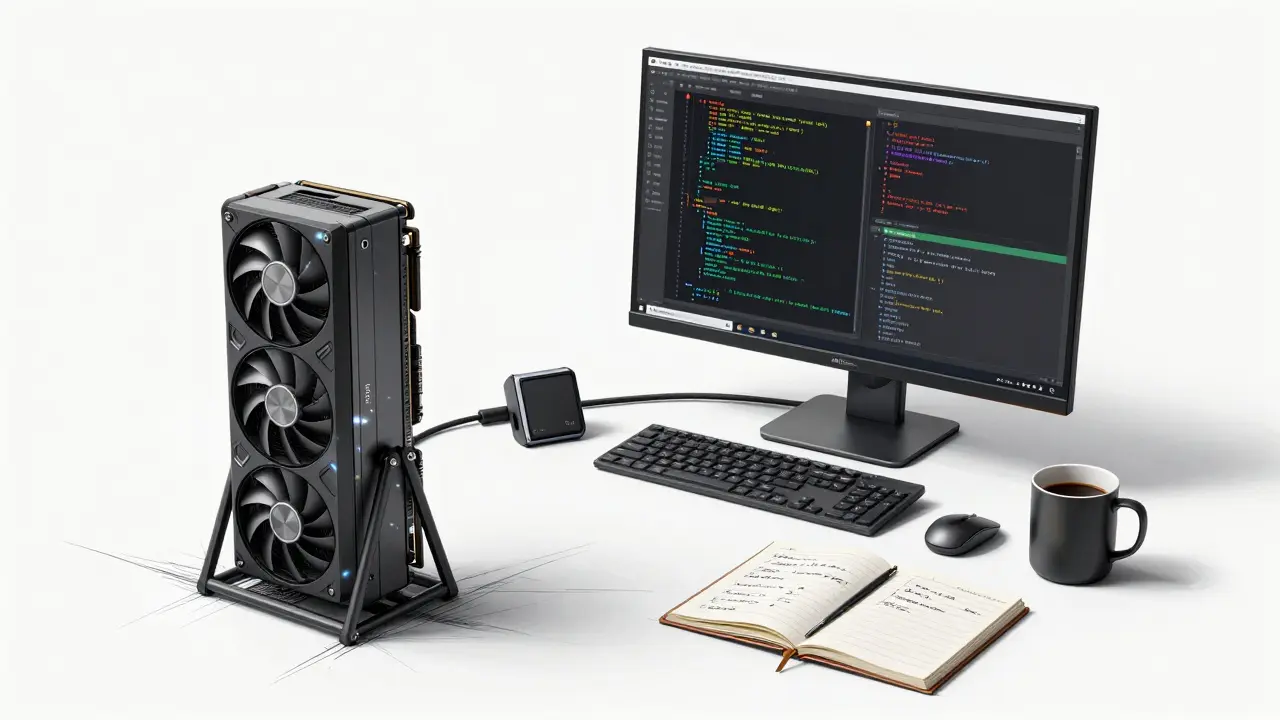
Running a compute node isn’t plug-and-play. You need:
- An NVIDIA GPU with at least 8GB VRAM (RTX 3060 or better)
- 32GB of system RAM
- 1Gbps internet connection
- Basic knowledge of Docker, Python, and Solidity
According to user reports from the Morpheus Discord community, it takes about 6.8 hours on average to get a node running. Many new users hit roadblocks - 63% report GPU driver issues, and 28% say they give up before finishing setup. The official documentation is detailed but not beginner-friendly. There’s no one-click installer.
Still, some users are making it work. One Reddit user, AI_Developer88, reported earning 142 MOR per month ($390 at the time) using an RTX 4090. After gas fees and electricity, their net profit was around $200/month. That’s not passive income - it’s a part-time job.
Where Can You Buy MOR?
As of early 2026, MOR trades on only one major exchange: CoinEx. That’s it. No Binance. No Coinbase. No Kraken. This lack of liquidity is a major red flag.
The 24-hour trading volume hovers around $27,000 - tiny compared to other AI crypto projects like Fetch.ai, which trades over $140 million daily. If you want to sell MOR, you might struggle to find buyers. One user lost $287 in failed withdrawal attempts due to CoinEx’s unstable API.
Most new holders get MOR through Bitget’s “Learn2Earn” program - answering quiz questions to earn small amounts. Only 28% of users stake their tokens. The rest are speculating, hoping the price will rise before they need to cash out.

How Does MOR Compare to Other AI Crypto Projects?
Morpheus isn’t alone in the AI blockchain space. Here’s how it stacks up:
| Project | Focus | Market Cap (Oct 2023) | Exchanges | Key Advantage |
|---|---|---|---|---|
| Morpheus (MOR) | Personal AI agents | $27 million | 1 (CoinEx) | StETH yield + MOR rewards |
| Fetch.ai | Enterprise AI agents | $1.42 billion | 27 | Strong partnerships, high liquidity |
| SingularityNET | AI marketplace | $423 million | 19 | Large AI model catalog |
| Ocean Protocol | Data sharing & privacy | $423 million | 21 | Best for data monetization |
Morpheus targets a narrower niche: personal AI assistants you control. That’s different from Fetch.ai, which sells AI services to companies, or SingularityNET, which acts like an app store for AI models. Morpheus wants you to run your own AI - not buy someone else’s.
Big Risks: Centralization, Liquidity, and Regulation
Despite its decentralized promise, Morpheus has serious centralization problems. Chainalysis found that 87% of compute power comes from just 12 nodes - all operated by the founding team. That means if those nodes go offline, the whole network stalls.
Then there’s liquidity. With only one exchange, MOR is easy to manipulate. A single large sell order could crash the price. And because the token rewards participants for contributing to the network, regulators like the SEC might classify it as a security - not a currency. Legal analysts warn this could trigger enforcement actions.
Support is another issue. Trustpilot reviews show a 2.8/5 rating. Nine out of twelve users complained about customer support taking over 72 hours to respond - if they responded at all.
Who Is Morpheus For?
Morpheus isn’t for casual crypto investors. It’s not for people who just want to HODL and wait for a moonshot.
It’s for:
- Developers who want to build AI tools and earn from usage
- Hardware owners with spare GPU power willing to run a node
- DeFi users who already stake ETH and want extra yield
- People who believe personal AI should be decentralized - not owned by Google or OpenAI
If you’re looking for a quick flip, avoid it. If you’re willing to invest time, hardware, and technical skill to help build something new - then Morpheus might be worth exploring.
What’s Next for Morpheus?
The team announced Project Prometheus - a Q1 2024 upgrade to add zero-knowledge proofs. This would let AI agents process data without revealing what they’re doing. That’s a big deal for privacy.
They’re also reportedly talking to TensorFlow and PyTorch teams about integration. If that happens, developers could plug Morpheus nodes directly into popular AI frameworks.
But the roadmap is ambitious. The team predicts a $50 million market cap by Q3 2024. Independent analysts call that unrealistic. With only 2,140 active participants and 0.0003% market share in the AI crypto space, growth is slow.
The network’s survival depends on two things: more compute providers and more liquidity. Without both, it’s just a cool idea with no users.
Final Thoughts: Innovation With High Risk
Morpheus (MOR) is one of the most ambitious crypto projects you’ve never heard of. It’s not trying to beat Bitcoin. It’s not trying to replace Ethereum. It’s trying to build a new kind of internet - one where AI belongs to you, not a corporation.
But ambition doesn’t guarantee success. The tech is real. The tokenomics are clever. The risks? They’re massive.
If you’re technically skilled, have spare hardware, and believe in decentralized AI - then MOR might be worth your time. If you’re looking for a simple crypto investment? Look elsewhere.
The next 12 months will tell us if Morpheus is a groundbreaking experiment - or another footnote in crypto’s long history of overhyped ideas.
Is Morpheus (MOR) a good investment?
Morpheus isn’t a traditional investment. It’s a participation platform. If you run a node or provide liquidity, you can earn MOR. But if you just buy and hold, you’re betting on the project surviving long enough for the price to rise - which is risky. With only one exchange and low liquidity, selling could be difficult. Only invest what you can afford to lose.
Can I mine Morpheus (MOR) like Bitcoin?
No, you can’t mine MOR. It’s not proof-of-work. You earn MOR by contributing to the network: running AI compute nodes, staking ETH, writing code, or building apps. Your reward depends on usage and performance, not hashing power.
Do I need a wallet to use Morpheus?
Yes. You need an EVM-compatible wallet like MetaMask, Trust Wallet, or Ledger to interact with the Morpheus network. You’ll use it to stake ETH, receive MOR rewards, and pay for AI services on the platform.
Is Morpheus legal?
There’s no clear answer yet. Because MOR rewards participants for contributing to the network, regulators like the SEC may classify it as a security. Legal experts warn the project could face enforcement action if it doesn’t register as a security. Always check your local laws before participating.
Can I use Morpheus without owning hardware?
Yes, but your options are limited. You can provide stETH liquidity to earn yield and MOR rewards without owning a GPU. You can also build apps or contribute code if you’re a developer. But if you want to earn by running compute nodes, you’ll need hardware with an NVIDIA GPU.
What’s the difference between Morpheus and ChatGPT?
ChatGPT is owned by OpenAI and runs on their servers. You don’t control it. Morpheus lets you run your own AI agent on a decentralized network. You decide what it does, who pays for it, and how it learns. It’s not a chatbot - it’s a personal AI assistant you own and control.
How do I get started with Morpheus?
First, get an EVM wallet like MetaMask. Then visit mor.org to learn about the four roles. If you have a GPU, follow the GitHub setup guide. If not, consider staking ETH or joining the Learn2Earn program on Bitget to earn small amounts of MOR. Be prepared for a steep learning curve.


