
Have you seen the news about Elon Musk’s new government department and thought, "There has to be a crypto for that"? You are not alone. In the world of cryptocurrency, political events and celebrity endorsements often spark immediate market reactions. One such reaction is the D.O.G.E. (Department Of Government Efficiency) token on the Base blockchain. But here is the catch: there isn’t just one token with this name. There is a massive amount of confusion in the market right now between several tokens using the same acronym, different prices, and vastly different levels of legitimacy.
If you are looking at charts and wondering why one version of D.O.G.E. costs fractions of a cent while another trades for over five dollars, you need to understand exactly what you are looking at. This article breaks down the specific Base network version, explains why it exists, and helps you navigate the minefield of copycat tokens before you lose money.
The Origin Story: From Executive Order to Blockchain Speculation
To understand the token, you first have to understand the real-world event that triggered it. On January 20, 2025, President Donald Trump signed an executive order establishing the actual Department of Government Efficiency. This was not a crypto project; it was a federal initiative aimed at cutting waste, modernizing IT systems, and reducing regulations. Elon Musk, who suggested the idea, became closely associated with its launch.
In the crypto world, speed is everything. Within days-and sometimes hours-of major announcements, developers create tokens to capitalize on the hype. The D.O.G.E. token on the Base network is one of these creations. It leverages the name and concept of the government department to attract attention. However, unlike established cryptocurrencies like Bitcoin or Ethereum, which solve specific technical problems, this token is primarily a speculative asset. Its value is driven by community interest, media coverage, and the ongoing narrative around government efficiency, rather than any underlying utility or technology.
This distinction is crucial. When you buy a token based on a news headline, you are betting on the continued relevance of that headline. If the news cycle moves on, or if the public perception of the department shifts, the token price can collapse just as quickly as it rose.
Identifying the Base Network Version
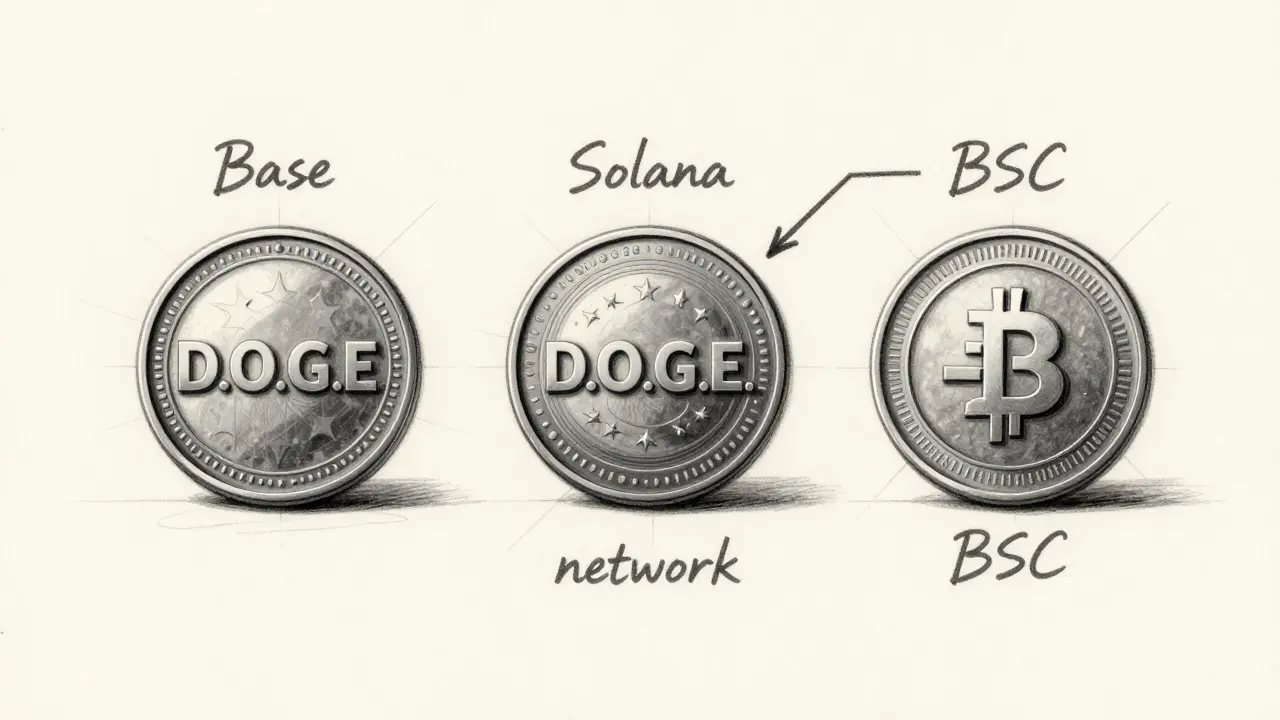
The most confusing part of the D.O.G.E. situation is that multiple tokens share the same ticker symbol: DOGE. To avoid buying the wrong asset, you must look at the blockchain network. The version we are discussing here operates on Base, a Layer 2 scaling solution built on top of Ethereum and backed by Coinbase.
Why does the network matter? Because each blockchain is separate. A token on Base is not the same as a token on Solana, Binance Smart Chain, or even the main Ethereum network. The Base network offers lower transaction fees and faster processing times compared to Ethereum mainnet, which makes it attractive for high-frequency trading and meme coins. However, being on a reputable network like Base does not automatically make a token legitimate or valuable. It simply means the infrastructure is reliable; the token itself may still be a risky speculation.
When checking your wallet or exchange, always verify the contract address. Never rely solely on the name or ticker. Scammers frequently create fake tokens with identical names on various networks to trick investors into sending funds to the wrong address.
| Feature | D.O.G.E. (Base Network) | Other D.O.G.E. Variants |
|---|---|---|
| Blockchain | Base (Coinbase L2) | Various (Solana, BSC, ETH Mainnet) |
| Approximate Price | $0.000023 - $0.000082 | $0.005 - $0.01+ |
| Market Cap | ~$22,800 - $80,000 | $5.4 Million+ (for larger variants) |
| Liquidity | Extremely Low | Moderate to High |
| Primary Driver | Niche Meme Speculation | Broad Political Hype |
Market Performance and Liquidity Risks
Let’s talk numbers, because they tell a stark story. As of mid-2026, the Base network version of D.O.G.E. trades at approximately $0.000023 per token. This represents a staggering 91% decline from its all-time high of $0.000264 reached in early 2025. For context, if you had invested $1,000 at the peak, that investment would now be worth less than $100.
More concerning than the price drop is the liquidity. Liquidity refers to how easily you can buy or sell a token without drastically affecting its price. The Base D.O.G.E. token has extremely low trading volume. Recent data shows daily volumes as low as $6.47. What does this mean for you? It means if you try to sell a significant amount of tokens, you might not find enough buyers. You could end up selling at a much lower price than expected, or worse, getting stuck with tokens you cannot sell at all.
Compare this to other D.O.G.E. variants tracked by platforms like CoinMarketCap, which show daily volumes exceeding $900,000. Those tokens have active markets. The Base version, however, appears to be largely abandoned by early investors. The lack of volume suggests that few people are actively trading it, which is a red flag for anyone considering entry.
The Confusion Factor: Multiple Tokens, Same Name
The biggest risk with D.O.G.E. isn’t just market volatility-it’s identity theft. There are at least three distinct tokens circulating under similar names:
- D.O.G.E. (Base): The micro-cap token discussed here, with minimal volume and a tiny market cap.
- D.O.G.E. (Other Chains): Variants on Solana or BSC that may have higher prices but equally speculative foundations.
- Dogecoin (DOGE): The original meme coin created in 2013, which is completely unrelated to the Department of Government Efficiency but shares the same ticker symbol.
This fragmentation creates substantial confusion. A user searching for "DOGE" might accidentally buy the wrong token. Some exchanges list multiple versions, requiring users to carefully select the correct blockchain. Others may only track the price without allowing trades, leading users to believe they can buy when they actually cannot. Always double-check the contract address and the network before executing any trade.
Regulatory and Legal Gray Areas
Using a government department’s name for a commercial product raises legal questions. The real Department of Government Efficiency is a federal entity with a budget and staff. While the crypto token is not officially affiliated with the U.S. government, the similarity in naming could lead to regulatory scrutiny.
The Securities and Exchange Commission (SEC) has been increasingly active in policing misleading securities offerings. If regulators determine that the D.O.G.E. token creators are misleading investors by implying an official connection to the government department, they could face enforcement actions. Additionally, trademark laws may protect the government’s use of the acronym, potentially leading to takedowns or delistings from major exchanges.
For investors, this adds another layer of risk. Beyond market fluctuations, there is the possibility that the token could be banned or removed from trading platforms due to legal pressure. This would likely result in a total loss of value for holders.
Community Engagement and Future Viability
A healthy crypto project usually has an active community. Think about Dogecoin or Shiba Inu-they have millions of followers on social media, dedicated subreddits, and constant development updates. The Base D.O.G.E. token lacks this ecosystem. There is little to no discussion on major crypto forums, no active development roadmap, and no whitepaper detailing technical features.
Without a community to drive adoption or a team to build utility, the token relies entirely on speculative interest. Given the 91% price drop and near-zero trading volume, it seems that initial interest has faded. Unless a new catalyst emerges-such as a major endorsement or a significant marketing campaign-the token is unlikely to recover its previous highs.
If you are curious about political-themed crypto projects, remember that they are inherently tied to the news cycle. Once the headlines fade, so does the price. The Base D.O.G.E. token is a prime example of a short-lived meme coin that capitalized on a momentary trend but failed to sustain long-term value.
Is the D.O.G.E. token on Base officially affiliated with the U.S. government?
No. The D.O.G.E. token on the Base blockchain is a decentralized cryptocurrency project created by private developers. It has no official affiliation with the U.S. Department of Government Efficiency or any federal agency. Any claims of official backing should be treated with extreme skepticism.
How do I distinguish between the different D.O.G.E. tokens?
Always check the blockchain network and the contract address. The Base version operates on the Base Layer 2 network. Other variants may exist on Solana, Binance Smart Chain, or Ethereum Mainnet. Use reputable tracking sites like CoinGecko or CoinMarketCap to verify the specific contract address before buying.
Why is the trading volume for the Base D.O.G.E. token so low?
Low trading volume indicates limited investor interest and liquidity. This can happen when a meme coin loses its hype, when early investors exit their positions, or when the broader market ignores the project. Low volume makes it difficult to buy or sell large amounts without significantly impacting the price.
Can I buy D.O.G.E. on Coinbase?
While Coinbase lists the price of the Base D.O.G.E. token for tracking purposes, it often marks it as "not tradable yet" or unavailable for direct purchase on their platform. This reflects the token's low liquidity and potential regulatory concerns. Always check the current availability on your specific exchange.
Is investing in political meme coins safe?
Political meme coins are highly speculative and carry significant risks. Their value is driven by news cycles and public sentiment, which can change rapidly. They often lack fundamental utility, active development, or strong communities. Investors should only allocate funds they are willing to lose entirely.