
Boeing Tokenized Stock, known as BAon, isn’t a cryptocurrency in the way Bitcoin or Ethereum is. It doesn’t have its own blockchain, doesn’t mine, and doesn’t rely on consensus mechanisms. Instead, it’s a digital token that mirrors the price of actual Boeing stock (BA) traded on the NYSE. Created by Ondo Finance, a fintech firm founded by ex-BlackRock executives, BAon lets people outside the U.S. buy exposure to Boeing shares without needing a U.S. brokerage account. Think of it like a digital IOU backed by real Boeing stock held in custody.
How BAon Actually Works
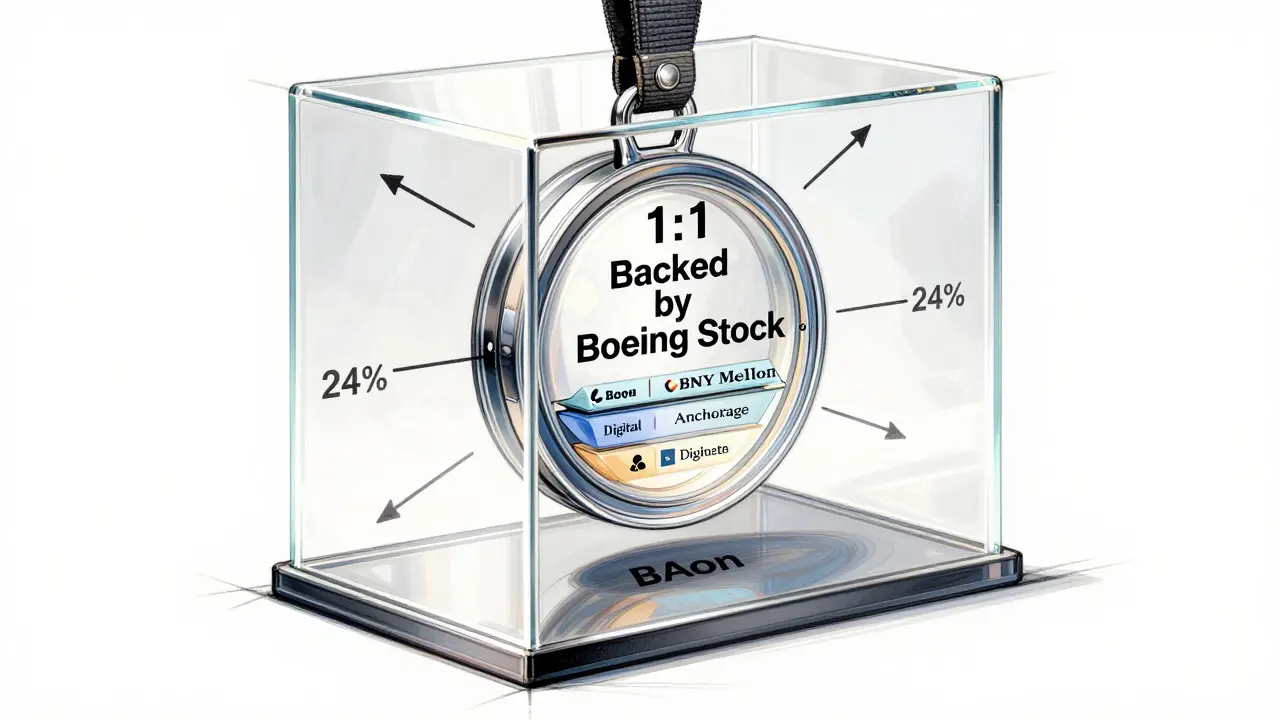
Here’s the simple version: if you buy one BAon token, you’re buying the economic value of one share of Boeing stock - plus any dividends it pays. But instead of owning the stock directly, you own a token that’s 1:1 backed by Boeing shares locked up by regulated custodians like BNY Mellon and Anchorage Digital. Ondo Finance doesn’t hold the stock itself. It just manages the system that lets authorized institutions swap real Boeing shares for BAon tokens, and vice versa.
This swap system is key. Only seven big players - like FalconX and Cumberland - can create or destroy BAon tokens by depositing or withdrawing actual Boeing shares. Regular users like you and me can only trade BAon on exchanges. We can’t mint or redeem tokens ourselves. That’s why the price of BAon often drifts from Boeing’s real stock price. If demand spikes on a crypto exchange but no one is redeeming tokens, the price can jump. If no one’s buying, it drops. That’s not tracking error - it’s liquidity failure.
Where You Can Trade BAon and Why Prices Differ
BAon trades on platforms like Bitget, Crypto.com, Phemex, and Coinbase. But here’s the catch: the price isn’t the same anywhere. On November 26, 2025, Bitget listed BAon at $223.86, while Coinbase showed $180.26. That’s a 24% difference. Why? Because there’s almost no arbitrage. Big traders can’t step in to fix the gap because the redemption process takes 24-48 hours and costs 1.5% in fees. So the market stays broken.
Compare that to Boeing stock, which trades $3.2 billion a day on the NYSE. BAon’s 24-hour volume? Around $53 on Phemex. Zero on CoinMarketCap. That’s not a liquid market. That’s a ghost town. If you wanted to buy $10,000 worth of BAon, you’d likely move the price. You couldn’t exit quickly. And if Boeing’s stock drops 5% overnight, BAon might not react at all - or it might overreact - because there’s no real-time feedback loop.
Who Uses BAon and Why
BAon isn’t for U.S. investors. You can already buy Boeing stock on Robinhood or Fidelity with zero fees. This is for people in countries where buying U.S. stocks is hard. Think Indonesia, Nigeria, Brazil, or Vietnam. In these places, capital controls, banking restrictions, or lack of access to international brokers make it nearly impossible to own Boeing shares. BAon gives them a workaround.
Ondo’s own data shows 42% of BAon holders are in Southeast Asia, 31% in Latin America, and 17% in Africa. These users aren’t day traders. They’re long-term investors who want exposure to a major U.S. industrial company. Some even say they use BAon to react to news after U.S. markets close. If Boeing announces a new contract at 8 p.m. in Singapore, they can trade BAon immediately - not wait until the next U.S. trading day.
The Hidden Costs and Flaws
There’s a big promise on Ondo’s website: "Dividends are automatically reinvested." That’s misleading. Dividends aren’t auto-reinvested. They’re paid out in U.S. dollars to your custodian account, and you have to manually log into Ondo’s portal to claim them. If you forget, you lose them. No one warns you about this until it’s too late.
Then there’s the redemption fee: 0.5% of the value, plus a 0.25% platform fee. That’s 0.75% just to turn your BAon back into real Boeing stock. And you can’t redeem unless you have at least $500 worth of tokens - about 2.77 shares. For someone buying $100 worth of BAon, redemption is impossible. That’s not investor-friendly. That’s a trap.
And the price premium? It’s real. BAon often trades 10-25% above Boeing’s actual stock price. Why? Because it’s scarce. There are only 5,805 BAon tokens in existence on Ethereum. Boeing has over 560 million shares outstanding. So even if you bought every BAon token, you’d only own 0.001% of Boeing. The rest is just perception. And perception drives price when supply is this tight.
Is BAon Safe?
The smart contracts behind BAon were audited by Trail of Bits and OpenZeppelin - two of the most respected names in crypto security. No critical bugs were found. The code is clean. But security isn’t the issue. The risk is structural.
BAon is tied to Boeing, a company that’s been under fire for production delays, FAA scrutiny, and falling orders. Boeing’s stock dropped 18% in 2024. If that trend continues, BAon will drop too. And because BAon is so illiquid, you won’t be able to sell fast enough to avoid the loss.
Also, Ondo Finance operates under U.S. Regulation S, which lets them sell to non-U.S. investors without registering with the SEC. That’s legal - but it means you have less protection. If something goes wrong, you can’t file a class-action lawsuit in U.S. courts like you could with a regular stock. Your recourse is limited.
How BAon Compares to Other Tokenized Stocks
Ondo also offers tokenized versions of Microsoft (MSFTon), Apple (AAPLon), and BlackRock’s Bitcoin ETF (IBITon). Here’s how they stack up as of November 2025:
| Token | Market Cap | 24-Hour Volume | Price Premium vs Underlying | Number of Holders |
|---|---|---|---|---|
| BAon (Boeing) | $1.04M | $0-$54 | 10-25% | 39-78 |
| MSFTon (Microsoft) | $3.27M | $112K | 4-8% | 215 |
| AAPLon (Apple) | $2.8M | $98K | 5-12% | 189 |
| IBITon (BlackRock Bitcoin ETF) | $87.3M | $28.5M | 0.5-1.2% | 1,200+ |
Notice the pattern? The more popular the underlying asset, the better BAon’s cousins perform. Microsoft and Apple have high global demand, so their tokens have real trading volume and tighter pricing. Boeing? It’s a riskier, more volatile company with less international appeal. And IBITon? Bitcoin’s global popularity dwarfs Boeing’s. That’s why IBITon has over 80 times the market cap of BAon.
Should You Buy BAon?
If you’re in the U.S., don’t. Buy Boeing stock directly. It’s cheaper, faster, and safer.
If you’re outside the U.S. and can’t access U.S. markets, BAon might make sense - but only if:
- You’re investing for the long term and won’t need to sell quickly
- You understand the 1.5% redemption fee and $500 minimum
- You’re okay with the price being out of sync with Boeing’s real stock
- You’re aware dividends aren’t auto-reinvested
It’s not an investment. It’s a workaround. And workarounds come with friction.
Boeing’s future isn’t guaranteed. Its stock has been volatile. BAon just adds another layer of risk: liquidity risk. You’re not just betting on Boeing. You’re betting that someone else will pay more for your token tomorrow - even though there are barely 80 people holding it.
What’s Next for Tokenized Stocks?
Ondo Finance says tokenized equities are the future. But right now, BAon feels more like a lab experiment than a product. The market cap is tiny. The volume is almost zero. The holders are fewer than a small Reddit thread.
Real adoption will come when:
- Redemption is instant and under $100
- Dividends are auto-reinvested
- Exchanges stop letting prices diverge by 20%
- More than 10,000 people hold the token
Until then, BAon is a curiosity - not a portfolio staple. It’s a glimpse of what global finance could look like. But it’s not there yet.


