

Leveraged Yield Farming Calculator
Calculate Your Potential Returns & Risk
Understand how leverage affects your yields and liquidation risk on Alpaca Finance. Input your parameters and see realistic scenarios.
Your Alpaca Finance Analysis
This is for informational purposes only. Actual results may vary due to market conditions.
Always monitor your health factor and BNB price movements.
Alpaca Finance isn’t just another crypto token. It’s a DeFi protocol built to let you borrow crypto to earn more crypto - and it’s been doing it on BNB Chain since 2021. If you’ve ever heard someone say they made 120% APY by farming with 5x leverage, they were probably using Alpaca Finance. But here’s the catch: this isn’t for beginners. It’s high-risk, high-reward DeFi that can turn your investment into a windfall… or wipe it out in minutes.
How Alpaca Finance Actually Works
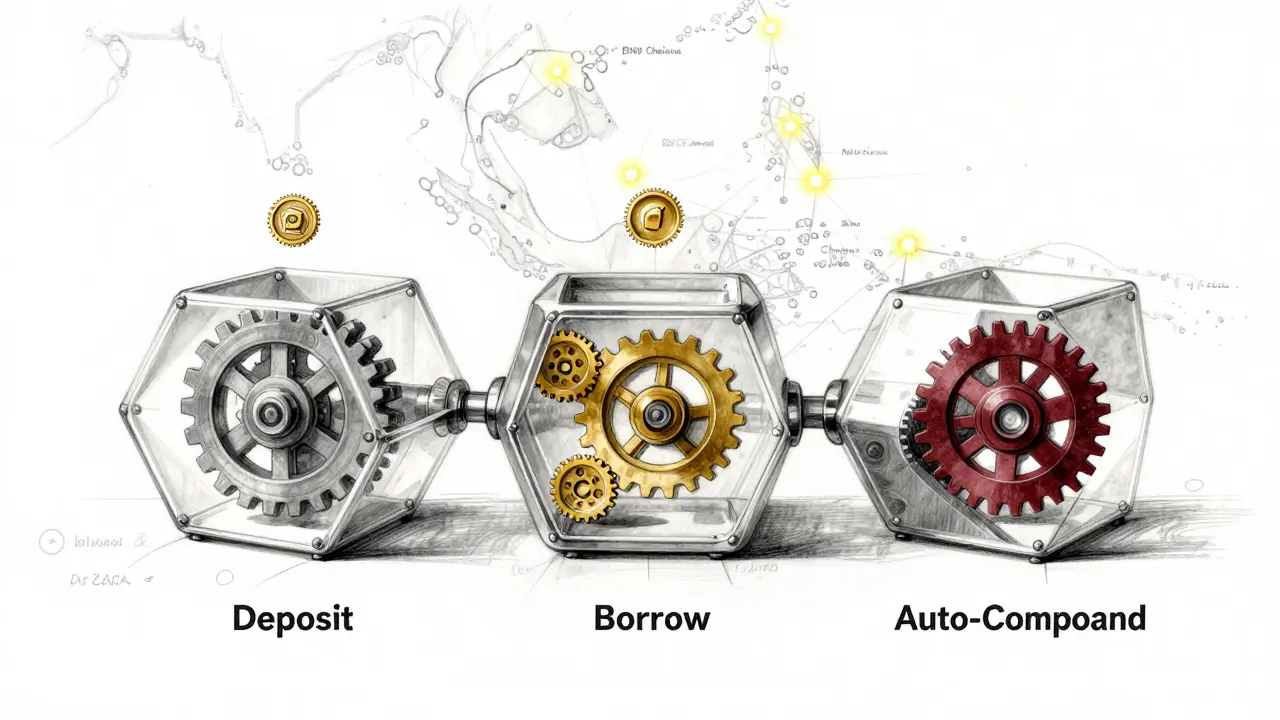
Alpaca Finance lets you do one thing most DeFi platforms don’t: borrow crypto to amplify your yield farming. Think of it like using a credit card to buy more stocks, but for crypto liquidity pools. You deposit assets like BNB or USDT, then borrow up to 7x that amount to add to a farming pool - say, CAKE-BNB. The protocol auto-compounds your rewards, so you’re not manually claiming and reinvesting. It happens every few minutes.The magic happens because you’re earning yield on your original deposit and the borrowed funds. If the pool pays 30% APY and you use 5x leverage, you’re technically earning 150% - minus fees and interest. But here’s what no one tells you: if the price of BNB drops 10%, your position can get liquidated. That’s not a bug. It’s built-in.
What Is ALPACA, the Token?
ALPACA is the native token of the protocol. It’s not a stablecoin. It’s not a meme coin. It’s a utility and governance token. You use it to vote on protocol upgrades, like changing liquidation thresholds or adding new farming pairs. You also earn ALPACA as a reward for providing liquidity or staking in the protocol’s vaults.As of July 2024, there are 151.66 million ALPACA tokens in circulation out of a max supply of 188 million. The market cap hovered around $828,760, making it a tiny player in the broader crypto market. But on BNB Chain, it’s one of the top lending protocols by volume. Daily trading volume hits over $200,000, and it has over 85,000 unique holders - mostly concentrated in Southeast Asia, where BNB Chain is popular.
How Alpaca Makes Money - And Why You Should Care
The protocol doesn’t charge you a fee to borrow. Instead, it takes a cut from two places:- 5% of all liquidation fees (reduced to 4% if a third-party bot does the liquidation)
- 10% of the 19% borrowing interest fee
That money doesn’t go to founders or investors. It’s used to buy back and burn ALPACA tokens. That’s a key difference from other DeFi projects. Alpaca launched as a fair-launch - no pre-sale, no team allocations, no private investors. Everyone got the same shot at the token.
This design built trust. But it also means the protocol’s survival depends entirely on user activity. If no one farms, no one borrows, and the buyback mechanism stalls. That’s why TVL (Total Value Locked) dropped from $120 million in early 2023 to $45 million by mid-2024. The protocol is shrinking, not growing.

How It Compares to Other DeFi Platforms
On BNB Chain, Alpaca’s main rivals are Venus Protocol and PancakeSwap’s lending markets. Venus lets you borrow up to 10x - higher than Alpaca’s 7x limit. But Venus doesn’t auto-compound. You have to claim and restake rewards manually. That’s a hassle. Alpaca does it for you.Compared to Ethereum-based giants like Aave or Compound, Alpaca is tiny. Aave’s TVL is over $4 billion. Alpaca’s is under $50 million. But here’s the trade-off: Ethereum is slow and expensive. BNB Chain is fast and cheap. Gas fees on Alpaca are often under $0.50 per transaction. On Ethereum, a single leveraged farm could cost $20 in gas.
But BNB Chain has its own risks. It’s controlled by Binance. If regulators crack down on Binance, BNB Chain could face restrictions. That’s a systemic risk Alpaca can’t escape.
Real User Experiences - Wins and Wipes
Reddit’s r/AlpacaFinance has 12,400 members. You’ll find stories like this:“Used 5x leverage on CAKE-BNB. Earned 120% APY for two months. Took profits, moved on. No liquidation.” - u/DeFiFarmer88
And then this:
“7x leveraged position. BNB dropped 8% in 3 hours. Liquidated. Lost everything. No warning.” - u/CrashProof
Trustpilot has 37 reviews. Average rating: 3.2/5. Positive reviews praise the clean interface and auto-compounding. Negative reviews scream about liquidations. One user wrote: “I watched my 5x position get wiped out while I was asleep. The app didn’t even send a notification.”
That’s the problem. Alpaca doesn’t warn you when your health factor is dropping. You have to monitor it yourself. The protocol’s health factor is a number that tells you how close you are to liquidation. If it hits 1.0 or below, you’re gone. Most users don’t know how to read it.
Who Should Use Alpaca Finance?
You should only use Alpaca Finance if:- You understand how leverage works in DeFi
- You know what a health factor is and how to track it
- You’re comfortable losing your entire deposit
- You have a BNB Chain wallet (MetaMask, Trust Wallet) and BNB for gas
- You’ve spent at least 8-12 hours learning how the system works
If you’re new to crypto, stick to simple staking or yield farming without leverage. Alpaca isn’t a place to learn. It’s a place to deploy knowledge.
What’s Next for Alpaca Finance?
In May 2024, Alpaca launched V2 - an upgrade with better liquidation logic and lower slippage. The roadmap includes:- Multi-chain expansion to Polygon and Avalanche (Q4 2024)
- NFT-based governance (Q1 2025)
- Institutional lending pools (Q3 2025)
But here’s the reality: no one knows if these will work. The protocol’s market share is shrinking. Competitors are catching up. And the crypto market in 2025 is nothing like it was in 2021.
Can ALPACA Reach $1? $10? $100?
Some price prediction sites say ALPACA could hit $98 by 2040. That’s a 247,000% increase. Sounds wild, right? But here’s the data:- Current price (July 2024): $0.0048-$0.0062
- Top 10 wallets hold 47.3% of all ALPACA
- 24-hour trading volume: $200,000
That’s not a liquid market. That’s a small, concentrated pool. If the top 10 wallets sell even 10% of their holdings, the price could crash 50% overnight. No algorithm can predict that. Only market sentiment and liquidity can.
Realistic projections? If Alpaca grows its TVL back to $100 million and gains traction on new chains, ALPACA might reach $0.10-$0.20 by 2026. That’s still a 20x gain from mid-2024 levels. But it’s not guaranteed. And it’s not safe.
The Bottom Line
Alpaca Finance is a powerful tool for experienced DeFi users. It’s one of the few platforms on BNB Chain that lets you farm with leverage - and do it automatically. But it’s also a minefield. Liquidations are common. Gas spikes during volatility. And the token’s value is tied to a single chain with regulatory risks.If you’re looking for a quick crypto win, avoid Alpaca. If you’re a seasoned DeFi user who wants to squeeze every last drop of yield out of your assets - and you’re ready to lose it all - then Alpaca might be worth your time. Just don’t go in blind. Monitor your health factor. Watch BNB’s price. And never use more leverage than you can afford to lose.
Is Alpaca Finance safe to use?
Alpaca Finance is not safe for beginners. It’s a high-risk DeFi protocol that uses leverage, which means your positions can be liquidated quickly if prices move against you. While the code has been audited and the protocol is live, the biggest risks come from market volatility and user error - not smart contract bugs. If you don’t understand how health factors work or how to monitor your position, you could lose everything.
How do I get started with Alpaca Finance?
First, set up a Web3 wallet like MetaMask or Trust Wallet. Then, buy BNB and send it to your wallet. Connect your wallet to the Alpaca Finance website. Deposit a supported asset (like USDT or BNB), then choose a farming pair and select your leverage (2x to 7x). The platform will auto-compound your rewards. Always check your health factor before and after opening a position.
What happens if my position gets liquidated?
If your health factor drops to 1.0 or below, your position is automatically closed. The protocol sells part of your collateral to repay your loan. You lose the borrowed amount and any unrealized gains. You may also lose some of your original deposit if the liquidation happens during a price crash. There’s no recovery - once liquidated, your position is gone.
Can I stake ALPACA tokens to earn rewards?
Yes. You can stake ALPACA in the protocol’s vaults to earn additional ALPACA rewards. You can also stake LP tokens from farming pairs to earn more. But staking doesn’t protect you from liquidation risk - it just gives you more tokens. The APY on staking varies, but it’s usually lower than leveraged farming - often between 10% and 30%.
Is Alpaca Finance available on Ethereum?
As of mid-2025, Alpaca Finance is still only on BNB Chain. However, the team announced plans to expand to Polygon and Avalanche by late 2024. Until then, you need a BNB Chain wallet and BNB for gas fees to use the platform. No official Ethereum version exists yet.
Why is ALPACA’s price so low?
ALPACA’s price is low because the protocol’s total value locked has dropped significantly since 2023, and trading volume remains small. With only $828,760 in market cap and 47% of tokens held by the top 10 wallets, there’s little liquidity. Large buyers can’t enter without crashing the price. It’s a classic case of low demand, high concentration - not a reflection of the protocol’s technical merit.


