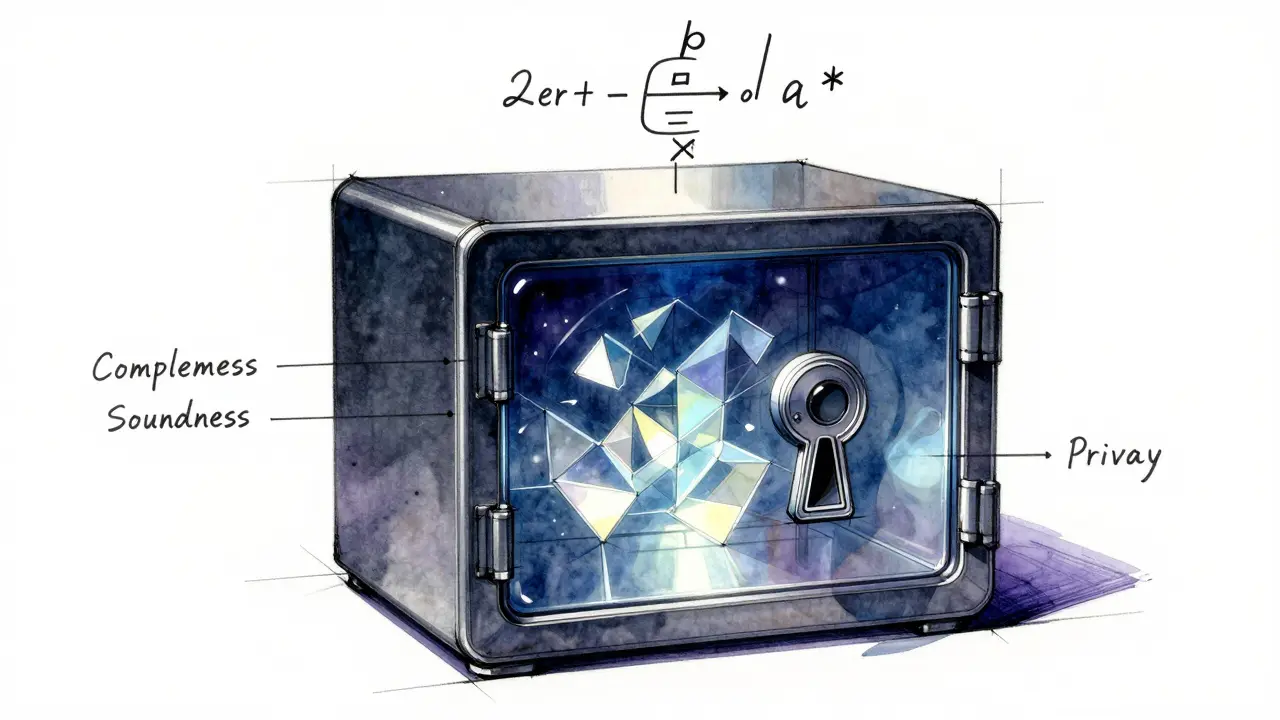
Imagine you want to prove to a friend that you know the combination to a safe, but you don't want them to see the numbers. You could open the safe and show them the contents, but that reveals the secret. Or, you could use a Zero-Knowledge Proof, which is a cryptographic protocol allowing one party to prove a statement is true without revealing any underlying information. This concept sounds like magic, but it’s actually pure mathematics. Since Shafi Goldwasser, Silvio Micali, and Charles Rackoff introduced this framework in 1985, it has evolved from theoretical computer science into the backbone of modern blockchain privacy.
If you’ve heard terms like zk-SNARKs or zk-STARKs buzzing around Ethereum and Polygon, you might wonder how they work under the hood. You don’t need a PhD in cryptography to grasp the basics, but you do need to understand the specific mathematical tools these systems rely on. Let’s break down the math behind zero-knowledge proofs so you can see exactly how privacy and verification coexist.
The Three Pillars of Zero-Knowledge Proofs
Before diving into equations, we need to define what makes a proof "zero-knowledge." Any valid ZKP system must satisfy three strict mathematical properties. If even one fails, the system is broken.
- Completeness: If the statement is true, an honest prover can always convince an honest verifier. Think of it as a reliable witness who tells the truth every time.
- Soundness: If the statement is false, no dishonest prover can trick the verifier into believing it’s true. The probability of cheating successfully must be negligible-typically less than $2^{-128}$, which is statistically impossible in practical terms.
- Zero-Knowledge: The verifier learns nothing beyond the fact that the statement is true. They gain zero additional knowledge about the secret itself.
For example, in the classic Schnorr identification protocol, soundness relies on the order of a cryptographic group. The error rate is precisely $1/|q|$, where $q$ is the group order. By repeating the interaction multiple times, we drive this probability down to near-zero, ensuring security.
Modular Arithmetic: The Clock Math Foundation
The most fundamental building block of ZKP mathematics is modular arithmetic, also known as clock math. Instead of numbers going on infinitely, they wrap around after reaching a certain value, called the modulus. On a 12-hour clock, 10 + 4 = 2. In math notation, we write this as $10 + 4 \equiv 2 \pmod{12}$.
Why does this matter for blockchains? Because computers have limited memory and processing power. Working within a finite field (a set of numbers with specific rules for addition and multiplication) allows us to perform complex calculations efficiently without overflow errors. Most modern ZKP systems operate in large prime fields, such as $F_p$ where $p$ is a massive prime number like $2^{254} + 0x0a$. This ensures that every non-zero number has a multiplicative inverse, which is crucial for solving equations later in the process.
From Logic Gates to Arithmetic Circuits
You can’t just hand a computer a vague statement like "I am over 18" and ask for a proof. Computers think in binary: 0s and 1s. To create a ZKP, we first convert the problem into a computational circuit using Boolean logic gates (AND, OR, XOR).
Here’s the key insight: any computation can be expressed using just two operations: addition and multiplication. When working with boolean values (0 and 1), multiplication acts as an AND gate ($1 \times 1 = 1$, otherwise $0$), and addition modulo 2 acts as an XOR gate. This property, known as functional completeness, means we can represent any algorithm-from SHA-256 hashing to smart contract execution-as a series of arithmetic constraints.
For instance, verifying a simple SHA-256 hash requires approximately 25,000 constraints. Verifying an entire Ethereum block? That jumps to over 100 million constraints. These constraints form an arithmetic circuit, which is essentially a system of polynomial equations that must all equal zero for the proof to be valid.

Polynomial Commitments and the Schwartz-Zippel Lemma
Once we have our arithmetic circuit, we face a new problem: how do we prove we solved it correctly without showing the solution? Modern ZKP systems like zk-SNARKs and succinct non-interactive arguments of knowledge solve this by converting the circuit into polynomials.
This is where the Schwartz-Zippel Lemma comes in. It states that if you have a non-zero polynomial of degree $d$ over a finite field, the probability that it evaluates to zero at a randomly chosen point is at most $d/|F|$, where $|F|$ is the size of the field. In simpler terms, if two polynomials are different, they will almost certainly produce different outputs at a random point.
Provers use this lemma to commit to their polynomial solutions. The verifier picks a random point, asks the prover for the value of the polynomial at that point, and checks if it matches. If the prover lied about the polynomial, they’ll likely fail this check. This probabilistic verification is the heart of why ZKPs are both secure and efficient.
Comparing ZKP Systems: SNARKs vs. STARKs
Not all zero-knowledge proofs are created equal. Different systems make different trade-offs between proof size, verification speed, and setup requirements. Here’s how the major players compare:
| Feature | zk-SNARKs | zk-STARKs | Bulletproofs |
|---|---|---|---|
| Proof Size | Small (188-288 bytes) | Large (45-150 KB) | Medium (1-2 KB) |
| Verification Time | Fast (~10ms) | Slower (100-500ms) | Linear with circuit size |
| Trusted Setup? | Yes (critical vulnerability if compromised) | No (transparent) | No |
| Quantum Resistance | No (relies on elliptic curves) | Yes (hash-based) | No |
| Best Use Case | On-chain verification (e.g., Zcash, zkSync) | Off-chain scaling & future-proofing | Private transactions without trusted setup |
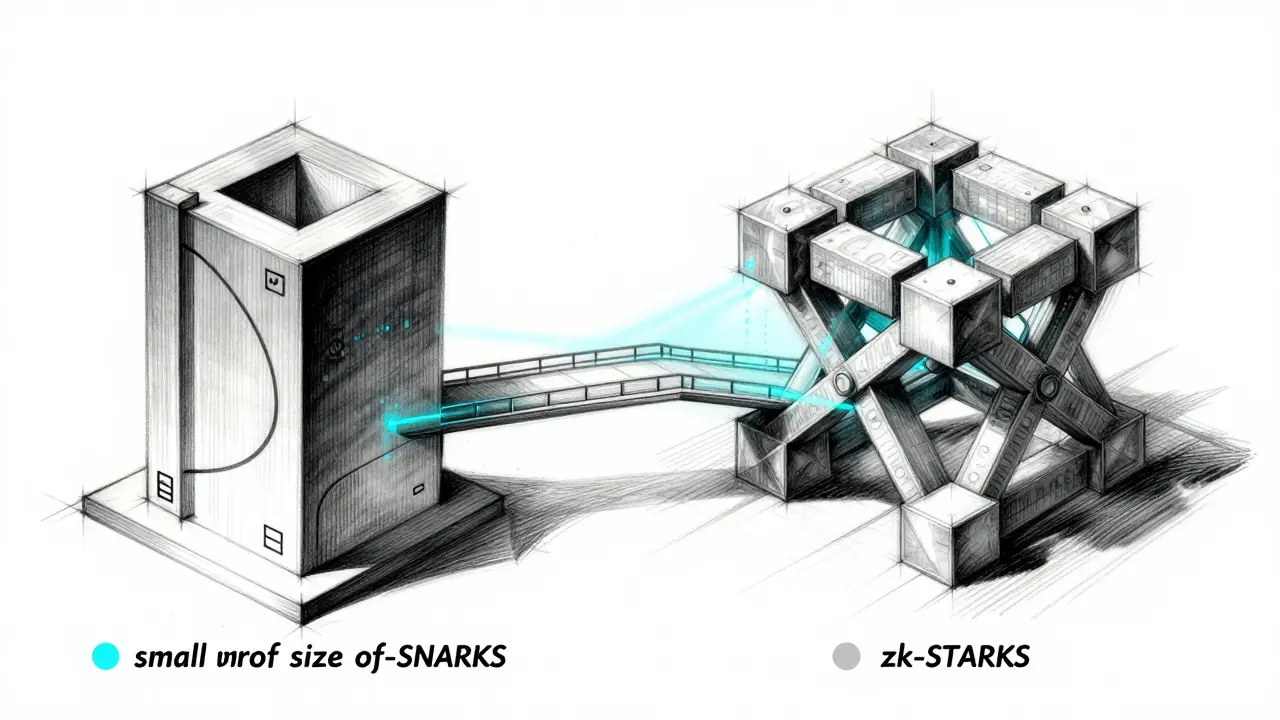
zk-SNARKs dominate current blockchain deployments because their tiny proof sizes fit easily into blockchain blocks. However, they require a "trusted setup" ceremony, where initial parameters must be generated securely. If anyone keeps a copy of the "toxic waste" from this setup, they can forge proofs. zk-STARKs eliminate this risk by relying on hash functions, making them quantum-resistant, but the larger proof sizes make them expensive to store on-chain.
Real-World Applications and Challenges
The market for ZKP technology is exploding, valued at $745.2 million in 2022 and projected to reach $5.23 billion by 2028. We’re seeing real-world adoption across industries:
- Blockchain Scaling: Ethereum’s Dencun upgrade (January 2024) introduced proto-danksharding (EIP-4844), reducing zk-rollup transaction costs by 10-100x. Projects like zkSync 2.0 and Polygon zkEVM leverage this to process thousands of transactions per second.
- Private Finance: JPMorgan uses ZKPs in its Onyx blockchain for private interbank transactions, ensuring compliance without exposing sensitive financial data.
- Data Privacy: Microsoft integrates ZKPs into Azure Confidential Ledger to provide verifiable data deletion proofs, crucial for GDPR compliance.
However, challenges remain. Generating proofs is computationally intensive. Current state-of-the-art provers take about 1 second to verify 1 million constraints on consumer hardware. For real-time applications, this latency is too high. Developers also struggle with circuit optimization; according to a 2023 survey, 68% of ZK developers spend more than 40% of their time designing and debugging circuits rather than writing application logic.
How to Learn ZKP Mathematics
If you’re a developer looking to enter this space, expect a steep learning curve. Mastering the necessary algebraic geometry and number theory typically takes 3-6 months of dedicated study. Here’s a practical roadmap:
- Master Modular Arithmetic: Get comfortable with finite fields, prime numbers, and basic probability theory.
- Understand Elliptic Curves: Study curves like BN254 or BLS12-381, which are used for cryptographic commitments in zk-SNARKs.
- Learn Circuit Design: Practice converting simple algorithms (like SHA-256) into arithmetic circuits using tools like Halo2 or Circom.
- Study Polynomial Commitments: Dive into KZG commitments and bilinear pairings to understand how SNARKs achieve succinctness.
Resources like the "ZK Whiteboard Sessions" YouTube series and the 0xPARC ZK MOOC offer structured paths for beginners. Remember, the goal isn’t just to memorize formulas-it’s to understand how computational integrity transforms into algebraic constraints.
What is the simplest example of a zero-knowledge proof?
The classic example is the "Ali Baba's Cave" scenario. Imagine a circular cave with a magic door in the middle that only opens with a secret word. Peggy (the prover) wants to prove to Victor (the verifier) that she knows the word without saying it. Victor waits outside while Peggy enters either the left or right path. Victor then shouts which path he wants her to exit. If Peggy knows the word, she can open the door and exit via the requested path. If she doesn't, she has a 50% chance of being trapped. Repeating this 20 times reduces the chance of cheating to less than 1 in a million.
Why do zk-SNARKs require a trusted setup?
zk-SNARKs rely on elliptic curve pairings to compress proofs. During the setup phase, random toxic waste parameters are generated. If any participant retains these parameters, they can generate fake proofs that look valid. This is why multi-party ceremonies are held, where many people contribute randomness, ensuring no single entity holds the full secret. zk-STARKs avoid this by using hash functions instead of pairings.
Can zero-knowledge proofs be hacked?
While the underlying mathematics is sound, implementations can have vulnerabilities. Bugs in circuit design, incorrect parameter generation, or side-channel attacks can compromise security. Additionally, quantum computers threaten current elliptic curve-based systems like zk-SNARKs, though hash-based systems like zk-STARKs are considered quantum-resistant.
What is the difference between a ZKP and a digital signature?
A digital signature proves that a message came from a specific sender (authenticity). A zero-knowledge proof proves that a statement is true without revealing the data behind it (privacy). For example, a signature proves you signed a contract; a ZKP proves you are over 18 without revealing your birthdate.
How long does it take to learn ZKP development?
Most developers report needing 3-6 months of focused study to become proficient. This includes learning modular arithmetic, finite fields, and circuit design languages like Circom or Halo2. The initial barrier is high due to the abstract nature of the mathematics, but once the core concepts click, the process becomes systematic.