
Imagine finding a token that delivers a 173x return before it ever hits a major exchange. That is the primary draw of Thruster v3 is a decentralized cryptocurrency exchange (DEX) launched in 2024 that operates exclusively on the Blast blockchain network. It isn't trying to be the next Binance or Uniswap; instead, it positions itself as a "home for Blast-native projects," focusing on taking tokens from zero to hero. But for most traders, the trade-off for early access is a wild ride of high slippage and zero safety nets.
The Core Trading Experience
If you've used a centralized exchange, forget everything you know about order books and customer support. Thruster v3 is a pure DeFi play. This means no KYC, no sign-up forms, and no one to call when a transaction fails. The interface is stripped down to the bare essentials: price charts, pair selection, and basic order flows. It's fast and clean, but it doesn't hold your hand.
The platform's liquidity is its biggest Achilles' heel. With a daily trading volume of around $1.1 million-the vast majority of which is just WETH/USDB-the order books are thin. If you're trading a few hundred dollars, you'll be fine. However, if you try to move $5,000 into a low-cap Blast token, you might face slippage exceeding 3.8%. In the world of DeFi, where the industry standard is closer to 0.85%, that's a steep price to pay for early entry.
| Metric | Thruster v3 | Uniswap v3 | PancakeSwap |
|---|---|---|---|
| Daily Volume | ~$1.1 Million | $1.2 Billion+ | ~$380 Million |
| Trading Pairs | 24 | 14,000+ | 1,200+ |
| Network Reach | Blast Only | Multi-chain | Multi-chain |
| Audit Status | No Formal Audit | Extensively Audited | Extensively Audited |
Liquidity Models and Rewards
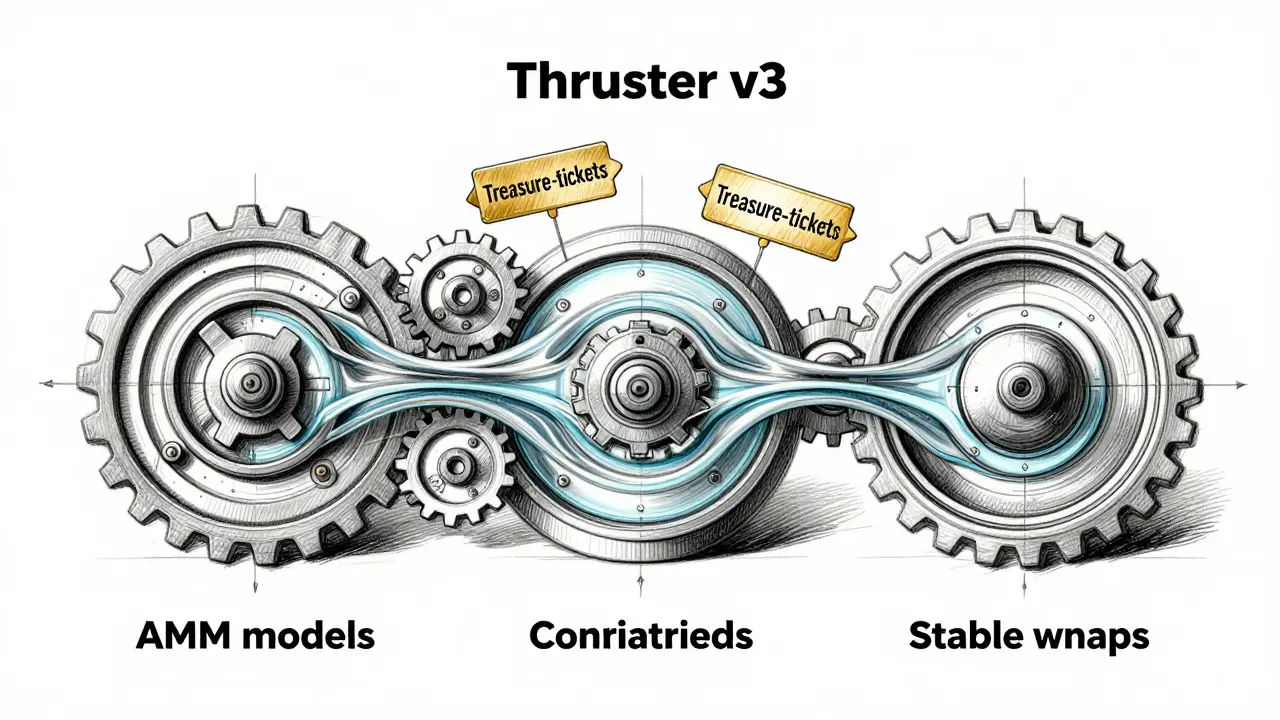
Thruster v3 doesn't just use one method to move money. It combines three different Automated Market Maker (AMM) models into one interface. You can use classic liquidity pools, concentrated liquidity positions (which let you pick a specific price range to earn fees, similar to Uniswap v3), or stable swap mechanisms for pegged assets. This flexibility is great for those who know how to manage their positions, but it's a minefield for beginners.
To keep people providing liquidity, the platform uses a Treasure-ticket reward system. Instead of just earning a slice of trading fees, users get tickets that incentivize participation. Some users have reported average rewards of 0.87% daily. While this sounds great, it's important to remember that liquidity providers in these early-stage pools are exposed to massive "impermanent loss" if the token price crashes-which happens often with "gem" hunting.
Setting Up Your Account (The DeFi Way)
Since there is no central authority, you don't "create an account." You connect a wallet. If you're new to this, expect the setup to take about 20 minutes. You'll need a Web3 wallet like MetaMask or Rabby configured for the Blast network.
- Bridge Your Assets: Use the official Blast bridge to move your ETH or stablecoins from Ethereum to the Blast Layer 2 network.
- Configure the Network: Add the Blast network parameters to your wallet so you can see your balance.
- Connect to Thruster: Hit the connect button on the site and sign the request with your wallet.
- Manage Gas: This is where most people trip up. You need ETH for gas fees on the Blast network. Even if you hold USDB, the transaction will fail if your ETH balance is zero.
The Risks: No Audits, No Safety Net
We need to talk about the elephant in the room: security. Unlike the big players, Thruster v3 has not undergone formal third-party audits. The smart contracts are public, meaning anyone with a degree in Solidity can read them, but there is no official "stamp of approval." This makes the platform a high-risk environment. If there's a bug in the contract, your funds could vanish, and there's no insurance or support team to help you recover them.
Furthermore, the platform's total lack of KYC (Know Your Customer) and AML (Anti-Money Laundering) procedures means it operates in a regulatory grey area. While this is a feature for those seeking privacy, it's a red flag for institutional investors or those worried about future compliance with frameworks like Europe's MiCA.
Final Verdict: Who is this for?
Thruster v3 is a specialized tool. It is not a general-purpose exchange. If you want a safe place to hold your Bitcoin or trade major coins with deep liquidity, stay far away from this platform.
However, if you are a "degen" trader-someone comfortable with high risk in exchange for high reward-and you are already active in the Blast blockchain ecosystem, Thruster v3 is practically essential. It is the only place to find certain native projects before they migrate to larger exchanges. You're paying for the privilege of early access with higher slippage and increased technical risk. Just make sure you aren't betting money you can't afford to lose.
Does Thruster v3 require KYC?
No, Thruster v3 is a fully decentralized exchange. You only need a compatible Web3 wallet to trade, meaning there are no identity verification processes or account registrations.
Why are my transactions failing on Thruster v3?
The most common reason is insufficient ETH for gas. On the Blast network, ETH is used to pay for transaction fees. Even if you are trading stablecoins like USDB, you must have a small amount of ETH in your wallet to cover the network costs.
What is the Treasure-ticket system?
It is a unique reward mechanism designed to incentivize liquidity providers. Instead of just earning trading fees, users earn "tickets" that provide additional returns on their positions, though the actual value depends on the pool's activity.
Is Thruster v3 safe to use?
It is high-risk. The platform has not undergone formal third-party security audits, and it deals with early-stage tokens that are inherently volatile. Only use funds you are willing to lose entirely.
Which network does Thruster v3 run on?
Thruster v3 operates exclusively on the Blast blockchain, a Layer 2 network designed to bring yield and scalability to Ethereum.


