Most people think of crypto rewards as simple inflation: you stake, the network mints more coins, and everyone gets a slice. SORA Validator Token is a specialized cryptocurrency created to reward validators and nominators who secure the SORA network using a Nominated Proof-of-Stake consensus model. Also known as VAL, it flips that script. Instead of just printing new money to pay for security, VAL burns tokens on every transaction and only re-mints a shrinking portion of what was burned. This makes it a deflationary asset by design, where the total supply actually goes down over time if network activity stays consistent.
If you are looking at this ticker and wondering if it’s just another low-cap altcoin or a clever economic experiment, you’re not alone. The data shows a micro-cap asset with thin liquidity, but the underlying mechanics are quite distinct from standard Proof-of-Stake chains. Here is how VAL actually works, why it exists, and what you need to know before interacting with it in 2026.
The Core Purpose: Rewarding Security Without Inflation
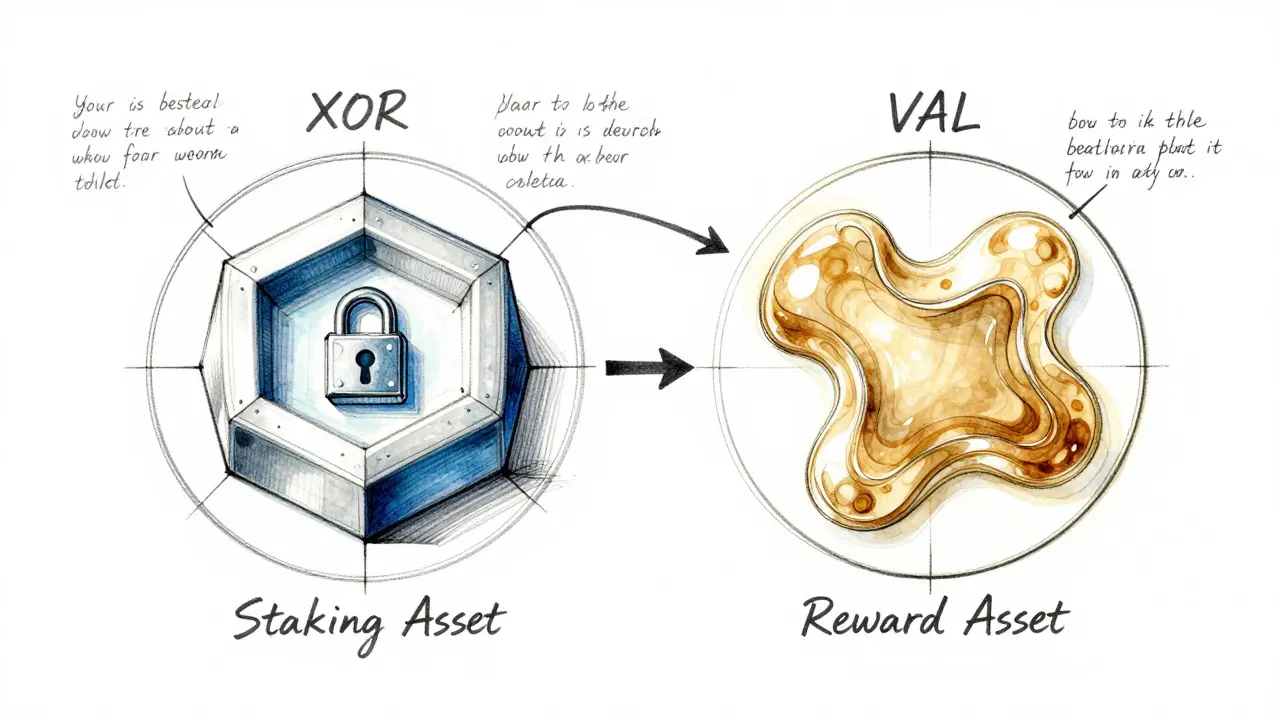
In most blockchain networks, the native token serves two jobs: paying for gas fees and securing the network through staking. When you stake those tokens, the protocol usually issues more of them as a reward. This creates constant inflation. SORA separates these roles. The primary token, XOR, is used for staking and nomination. You lock up XOR to help secure the network. But you don’t get paid in XOR. You get paid in VAL.
This separation is the heart of the system. By using a different token for rewards, SORA decouples the cost of security from the supply of its main utility token. Validators run nodes to produce blocks, and nominators delegate their XOR stakes to trusted validators. Both groups earn VAL. This incentivizes participation without forcing the XOR supply to expand indefinitely. It’s a multi-token economic design that aims to keep the base currency stable while still paying the people doing the heavy lifting to keep the chain running.
How the Deflationary Mechanism Actually Works
Here is where VAL gets interesting. Every single transaction on the SORA v2 network triggers a burn event. A specific amount of VAL is destroyed and removed from circulation. This means the total supply of 100 million VAL is constantly decreasing as people use the network. But wait-if the supply is going down, how do validators get paid? They are paid from the burned amount.
The protocol uses an "elastic reward" system. New VAL tokens are minted and distributed to validators and nominators based on a percentage of the total VAL burned in the last 24 hours. However, this percentage isn't fixed. It starts high to encourage early adoption and gradually drops over five years. Initially, 90% of the burned VAL is re-minted as rewards. Over time, this ratio decreases daily until it hits a floor of 35%. Once it reaches 35%, it stays there permanently.
- Early Phase: If 1,000 VAL is burned in a day, up to 900 VAL is minted back out as rewards.
- Mature Phase (after 5 years): If 1,000 VAL is burned in a day, only 350 VAL is minted back out.
This structure ensures that even though validators are always getting paid, the net effect on the total supply is deflationary. More is burned than is minted back into the system. It’s a mathematical guarantee that the token becomes scarcer over time, assuming the network keeps processing transactions.
Supply, Circulation, and Data Discrepancies
When you look up VAL on various tracking sites, you might notice some confusing numbers. The maximum supply is capped at approximately 100,000,000 tokens. That part is clear. But the circulating supply varies wildly depending on where you look. Some sources report a circulating supply of around 408,000 VAL, while others, like Etherscan, track over 66 million VAL on the Ethereum side.
Why the difference? VAL is a multichain token. It exists natively on the SORA network and also as an ERC-20 token on Ethereum. These two versions are connected by a trustless bridge. Market data providers often struggle to define what counts as "circulating." Some only count free-floating tokens available for trading on centralized exchanges, while others include all bridged assets. If you see a market cap of $3,500 versus $10,000, it’s likely due to which subset of the supply the tracker is measuring. Always check the source methodology when evaluating the size of this market.
| Source | Max Supply | Circulating Supply | Notable Context |
|---|---|---|---|
| SORA Wiki | ~100,000,000 | On-chain query required | Official documentation; precise figure via tokens.totalIssuance |
| Etherscan (Ethereum) | 100,000,000 | ~66,050,429 | Tracks ERC-20 representation; includes bridged assets |
| Investing.com | 100,000,000 | ~408,000 | Tracks specific exchange volumes; excludes locked/bridged balances |
| CoinGecko | 100,000,000 | Varies | Primary venue identified as Uniswap V2 on Ethereum |

Running a Validator vs. Nominating
You have two main ways to earn VAL. You can run your own validator node, or you can be a nominator. Running a validator requires technical expertise. You need a server that meets the SORA network’s hardware requirements, and you must maintain uptime to avoid penalties. Your income comes directly from block production and transaction fees processed during your active era.
Nominating is simpler. You don’t need to run hardware. Instead, you take your XOR tokens and delegate them to a validator you trust. You share in the rewards that validator earns, minus any commission they might take. This is the most accessible way for regular users to participate in the SORA economy. However, both validators and nominators face the same operational hurdle: claiming rewards.
VAL rewards don’t just appear in your wallet automatically. They accrue on-chain after each era. An era on SORA lasts roughly 15 minutes, so there are many eras in a day. Crucially, these rewards expire after 84 eras, which is about 21 days. If you forget to claim your VAL within three weeks, you lose it. This is a significant difference from other staking systems where rewards accumulate indefinitely. You need to actively manage your position, checking the staking interface regularly to payout your earnings.
Market Reality: Liquidity and Volatility
Let’s talk about the practical side of trading VAL. As of mid-2026, it remains a micro-cap asset. Prices have hovered in the range of $0.006 to $0.04 per token, depending on the date and volatility spikes. Daily trading volumes are often very low, sometimes under $500 on major decentralized venues like Uniswap V2. This means liquidity is thin.
If you try to buy or sell a large amount of VAL, you will likely experience significant slippage-your execution price will be worse than the displayed price because there aren’t enough orders in the book to absorb your trade. The intraday range can be wide relative to the price, making it susceptible to quick swings that may not reflect fundamental changes in the network. Most trading happens on Ethereum-based DeFi platforms rather than centralized exchanges, although listings on Binance and Coinbase exist, volume remains concentrated in a few spots.

Why Did SORA Create This Token?
The creation of VAL wasn’t just a developer decision. It was born from community governance. All the smart contracts for VAL were initially deployed in a disabled state. They couldn’t be used until a community member submitted cryptographic proof that an on-chain referendum had approved the activation. This highlights a core value of the SORA ecosystem: decentralization. The token’s existence is tied to a formalized voting process, not a unilateral launch by a team.
This governance origin suggests that future changes to VAL’s parameters would likely also go through similar on-chain referendums. For investors, this adds a layer of predictability but also complexity. You aren’t just betting on technology; you’re betting on the ability of the community to reach consensus on economic adjustments.
Risks and Considerations for Investors
Before you allocate funds to VAL, keep these risks in mind:
- Thin Liquidity: Exiting a position quickly can be difficult and costly due to low trading volume.
- Data Inconsistency: Valuation metrics vary significantly between trackers, making it hard to assess true market capitalization.
- Operational Burden: The 21-day reward expiry window requires active management. Passive staking strategies common in other ecosystems won’t work here without manual intervention.
- Network Dependence: VAL’s value is entirely derived from its utility within the SORA network. If SORA loses traction, VAL has little standalone value outside of speculative trading.
It is a niche tool designed for a specific job: securing the SORA chain. Its value proposition lies in its role within that staking economy, not in broad speculative adoption. If you understand the mechanics and are willing to manage the operational details, it offers a unique deflationary play in the crypto space.
What is the maximum supply of SORA Validator Token (VAL)?
The maximum supply of VAL is approximately 100,000,000 tokens. This cap is enforced on-chain, and the actual issued supply can be verified via the tokens.totalIssuance query on the SORA network.
How does VAL differ from XOR?
XOR is the primary token used for staking and nomination on the SORA network. VAL is exclusively the reward token paid to validators and nominators. You stake XOR to earn VAL, creating a dual-token economic system where the staking asset and the reward asset are separate.
Do I need to run a node to earn VAL?
No. You can earn VAL by becoming a nominator. This involves delegating your XOR tokens to an existing validator. You share in their rewards without needing to maintain your own hardware or ensure 100% uptime yourself.
What happens if I don't claim my VAL rewards?
VAL rewards expire after 84 eras, which is approximately 21 days. If you do not manually claim your rewards through the staking interface within this window, the unclaimed VAL is lost and does not carry over to the next period.
Is VAL available on Ethereum?
Yes, VAL is a multichain token. It exists as an ERC-20 token on Ethereum and can be moved between the SORA network and Ethereum using a trustless bridge. This allows holders to interact with Ethereum-based DeFi protocols like Uniswap.