

Most crypto users know the frustration: you want to trade ETH for MATIC, but your wallet only supports one chain. You need to bridge your assets, wait for confirmation, pay gas fees twice, and risk slippage. Rubic Exchange cuts through all that. It’s not just another DEX-it’s a cross-chain swap engine built to make trading between blockchains as easy as clicking a button.
Launched by a team including Alexandra Korneva, Rubic doesn’t try to be everything. It focuses on one thing: removing friction between blockchains. Whether you’re moving from Ethereum to Arbitrum, Bitcoin to Polygon, or BNB Chain to Solana, Rubic handles the routing, liquidity sourcing, and transaction execution-all in one click. No more juggling bridges, no manual approvals, no guessing which DEX gives the best rate. It just works.
How Rubic Works: Behind the One-Click Swap
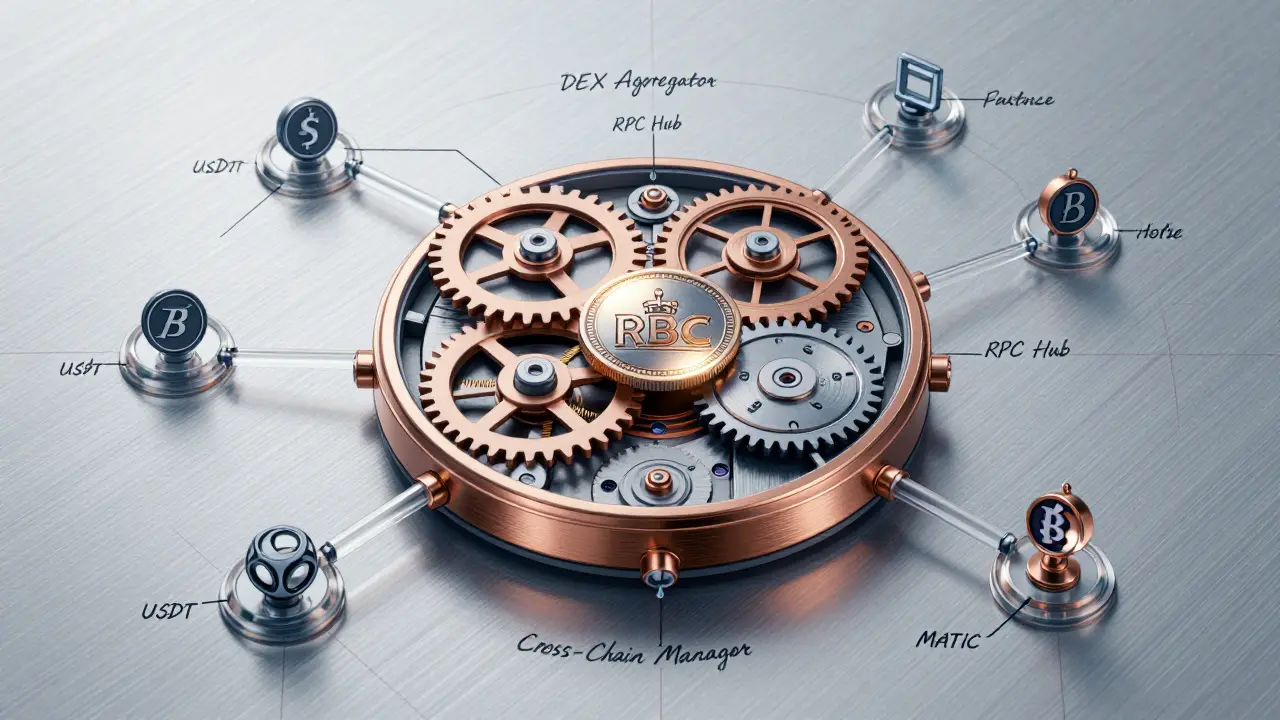
Rubic’s architecture isn’t magic. It’s smart engineering. At its core are three systems working together:
- External API providers-These pull real-time price data from major DEXs like 1inch, OpenOcean, ODOS, and XY Finance.
- RPC node-This acts as the communication hub between Rubic and each blockchain network, sending and receiving transaction data.
- Cross-chain manager-The brain of the operation. It compares prices across all connected DEXs, splits large orders to reduce slippage, and triggers swaps via audited smart contracts.
When you select ETH to swap for MATIC, Rubic doesn’t just pick one exchange. It checks 1inch, OpenOcean, and others across Ethereum and Polygon, then routes your trade through the path with the best rate and lowest fees. If your order is large, it splits it into smaller chunks across multiple DEXs to avoid price impact. All of this happens in under 30 seconds.
Unlike Uniswap or PancakeSwap, which are limited to their native chains, Rubic connects 15+ blockchains-including Bitcoin (via wrapped tokens), Ethereum, Arbitrum, Optimism, Polygon, BNB Chain, Solana, and Avalanche. That’s not a gimmick. It’s a necessity for anyone doing DeFi across multiple networks.
Security: Audited Contracts, No KYC
Security is where Rubic stands out from many DeFi platforms. Both its core swap contracts and staking contracts have been fully audited by third-party firms. That’s not common. Many DeFi projects skip audits to save time or money. Rubic didn’t. Coin Bureau specifically noted this as a rare advantage in a space full of unverified contracts.
And here’s another win: no KYC. You don’t need to upload ID, verify your address, or jump through regulatory hoops. You connect your wallet-MetaMask, Phantom, Coinbase Wallet, or any EVM-compatible wallet-and you’re good to go. This keeps Rubic accessible to users in countries with strict crypto regulations or those who value privacy.
The platform’s smart contracts are immutable once deployed. That means no admin keys can freeze your funds or change rules mid-trade. Transactions are executed directly on-chain, with no central server holding your assets. Your keys, your coins. Always.
The RBC Token: Utility, Not Just Speculation
Rubic’s native token, RBC, isn’t just for trading. It’s the engine that powers the ecosystem. Holding RBC gives you:
- Discounted swap fees (up to 30% off depending on holdings)
- Access to exclusive liquidity pools
- Staking rewards with APYs that vary based on network demand
- Early access to new chain integrations
As of early 2026, RBC trades on Gate.io, Uniswap V2, and CoinEx. Its all-time high was $0.0584, but like most DeFi tokens, it’s volatile. Price predictions vary wildly: TradingBeast forecasts $0.0264 by end of 2026, WalletInvestor expects $0.01142, and CoinLore’s algorithmic model predicts $0.0454-some even suggest $0.5664 in ten years. These aren’t guarantees. They’re speculative models based on historical patterns, which means take them with a grain of salt.
Right now, short-term sentiment is bearish. RBC is down 1.29% in 24 hours, -3.64% this week, and -3.44% this month. But history shows RBC often rebounds in July, which is its strongest month historically. April, on the other hand, is its weakest. If you’re holding RBC, seasonal trends matter more than daily noise.
What Rubic Can’t Do (And What It Can)
Rubic isn’t perfect. Here’s the honest breakdown:
Where Rubic Excels
- Cross-chain swaps-Best-in-class for moving between Ethereum, Polygon, Arbitrum, BNB Chain, and Solana.
- Low slippage-By aggregating liquidity from 6+ DEXs, it finds better rates than using any single exchange.
- Wallet flexibility-Supports MetaMask, Phantom, Coinbase Wallet, and more. No lock-in.
- Developer tools-The Rubic Relay widget lets other apps embed direct swaps on their sites. It’s used by several DeFi dashboards already.
- Buy crypto with fiat-You can directly purchase MATIC or BNB using Rubic’s Crypto Tap feature without leaving the platform.
Where Rubic Falls Short
- Liquidity depth-For obscure tokens (think small memecoins or niche DeFi projects), you’ll get better rates on dedicated DEXs like Uniswap or PancakeSwap.
- Single-chain swaps-If you’re just trading ETH for USDC on Ethereum, you’re better off with 1inch or Paraswap. Rubic adds unnecessary steps.
- Community size-It’s growing, but it’s not as large as Uniswap or SushiSwap. Fewer users means fewer real-time support threads and less peer help.
- Mobile UX-The web interface is smooth, but the mobile app (if you’re using it via wallet browser) can feel clunky compared to dedicated DEX apps.
Real User Experience: A Day in the Life
Imagine this: You’re in Wellington, holding ETH from a recent trade. You want to stake it on Polygon to earn yield. Normally, you’d:
- Send ETH to a bridge (like Polygon’s official one).
- Wait 10-20 minutes for confirmation.
- Pay another gas fee to swap ETH for WMATIC on Uniswap.
- Then stake WMATIC on a yield platform.
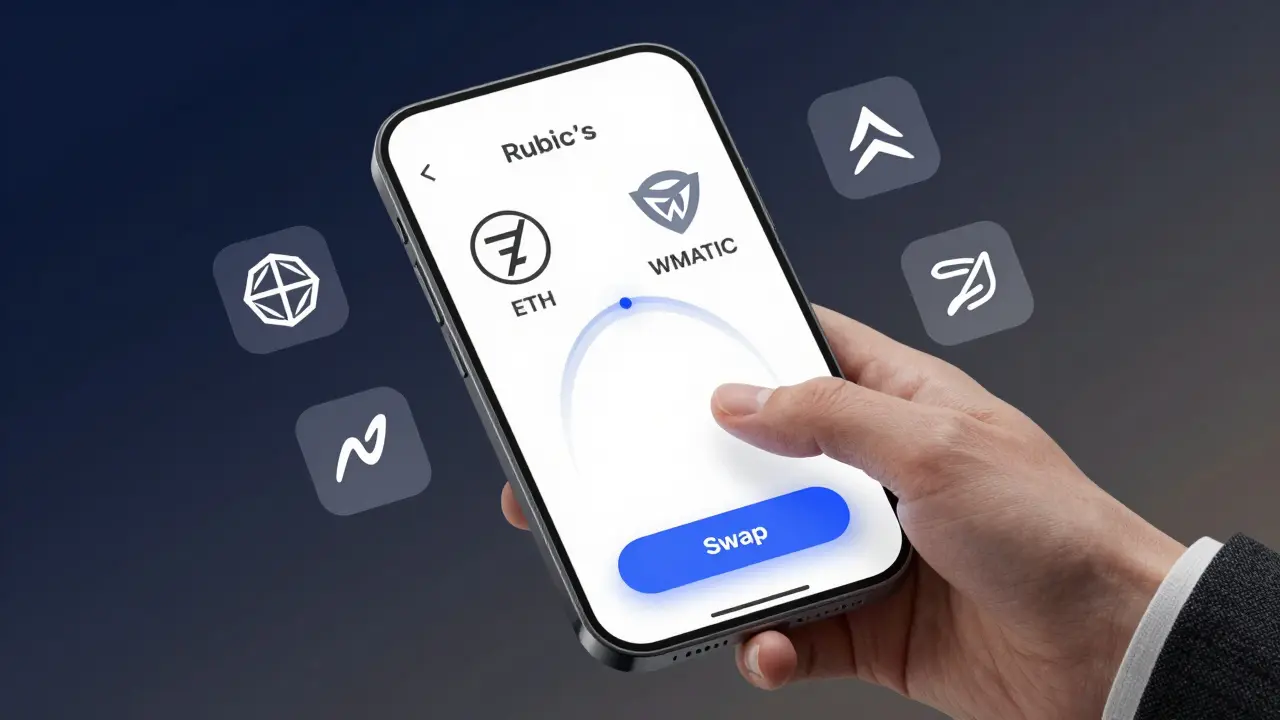
With Rubic? You open the site, connect MetaMask, select ETH as the input and WMATIC as the output, click swap, and confirm one transaction. Done. In under 20 seconds. No bridging, no extra steps, no guesswork.
Another user, based in Brazil, uses Rubic to buy BNB directly with USDT and then sends it to their BNB Chain wallet for DeFi farming. No centralized exchange. No withdrawal delays. Just a direct, trustless swap.
How Rubic Compares to Other Cross-Chain Tools
Let’s put Rubic next to its closest competitors:
| Feature | Rubic | THORSwap | Synapse Protocol | Uniswap (Ethereum only) |
|---|---|---|---|---|
| Supported Chains | 15+ | 12 | 10 | 1 (Ethereum) |
| One-Click Swap | Yes | Yes | Yes | No |
| Non-KYC | Yes | Yes | Yes | Yes |
| Liquidity Aggregation | 6+ DEXs | Thorchain DEXs | 3+ DEXs | 1 (Uniswap V3) |
| Wallet Support | MetaMask, Phantom, Coinbase Wallet | WalletConnect, MetaMask | MetaMask, Trust Wallet | MetaMask only |
| Fiat On-Ramp | Yes (BNB, MATIC) | No | No | No |
| Developer Widget | Yes (Rubic Relay) | No | No | No |
Rubic leads in three areas: number of supported chains, wallet flexibility, and the ability to buy crypto directly. THORSwap is strong in cross-chain routing but lacks fiat on-ramps. Synapse is fast but less transparent about its liquidity sources. Uniswap? Great for Ethereum-but useless if you’re not staying on one chain.
Final Verdict: Who Is Rubic For?
Rubic isn’t for everyone. If you only trade ETH and USDC on Ethereum, skip it. Use Uniswap or SushiSwap.
But if you:
- Use multiple blockchains daily
- Get tired of bridging and waiting
- Want to avoid KYC
- Trade between Ethereum, Polygon, Arbitrum, or Solana
- Want to buy MATIC or BNB directly with crypto
-then Rubic is one of the most efficient tools you’ll find.
It’s not the biggest DeFi platform. It doesn’t have the brand recognition of Uniswap. But it solves a real, daily pain point better than any other tool in its class. In a world where blockchain fragmentation is growing, Rubic doesn’t just adapt-it simplifies.
Try it. Connect your wallet. Do one swap. Then ask yourself: why did I waste time on bridges before?
Is Rubic Exchange safe to use?
Yes, Rubic is considered safe for users who understand DeFi risks. Its core swap and staking contracts have been audited by third-party firms, and it operates without centralized control. No KYC means no identity data is stored. However, like all DeFi platforms, you’re responsible for your own wallet security. Always double-check transaction details and never share your private keys.
Can I buy crypto with fiat on Rubic?
You can’t deposit fiat directly, but Rubic’s Crypto Tap feature lets you buy MATIC or BNB directly using other crypto assets like USDT or ETH. This bypasses centralized exchanges entirely. It’s not a traditional fiat on-ramp, but it’s the closest you’ll get on a non-KYC platform.
Does Rubic support Solana?
Yes. Rubic supports Solana via Phantom wallet integration. You can swap tokens between Ethereum, Polygon, BNB Chain, and Solana in one transaction. This is rare-most cross-chain tools only support EVM chains.
What’s the RBC token used for?
RBC is the utility token of the Rubic ecosystem. Holding RBC reduces swap fees, unlocks staking rewards, grants early access to new features, and gives voting rights in future governance decisions. It’s not a governance token yet, but the team has signaled plans to expand its role.
Why is RBC’s price dropping?
Short-term price drops are common for DeFi tokens due to market-wide sentiment, liquidity shifts, and speculative trading. RBC’s recent negative returns are tied to broader crypto market weakness, not platform failure. Rubic’s transaction volume and user base have remained steady, suggesting the underlying product is still in demand. Long-term value depends on adoption, not price.
Can I use Rubic on mobile?
Rubic has no native mobile app, but it works perfectly through mobile wallets like MetaMask or Coinbase Wallet. Just open the Rubic website in your wallet’s built-in browser. The interface is responsive and optimized for touch. Many users do this daily without issues.
Is Rubic better than THORSwap?
It depends on your needs. THORSwap is stronger in native asset swaps (like swapping BTC for ETH without wrapped tokens). Rubic excels in ease of use, wallet support, and direct fiat-like on-ramps (buying BNB/MATIC). If you’re trading between EVM chains and Solana, Rubic is simpler. If you’re moving native Bitcoin, THORSwap might be better.


