

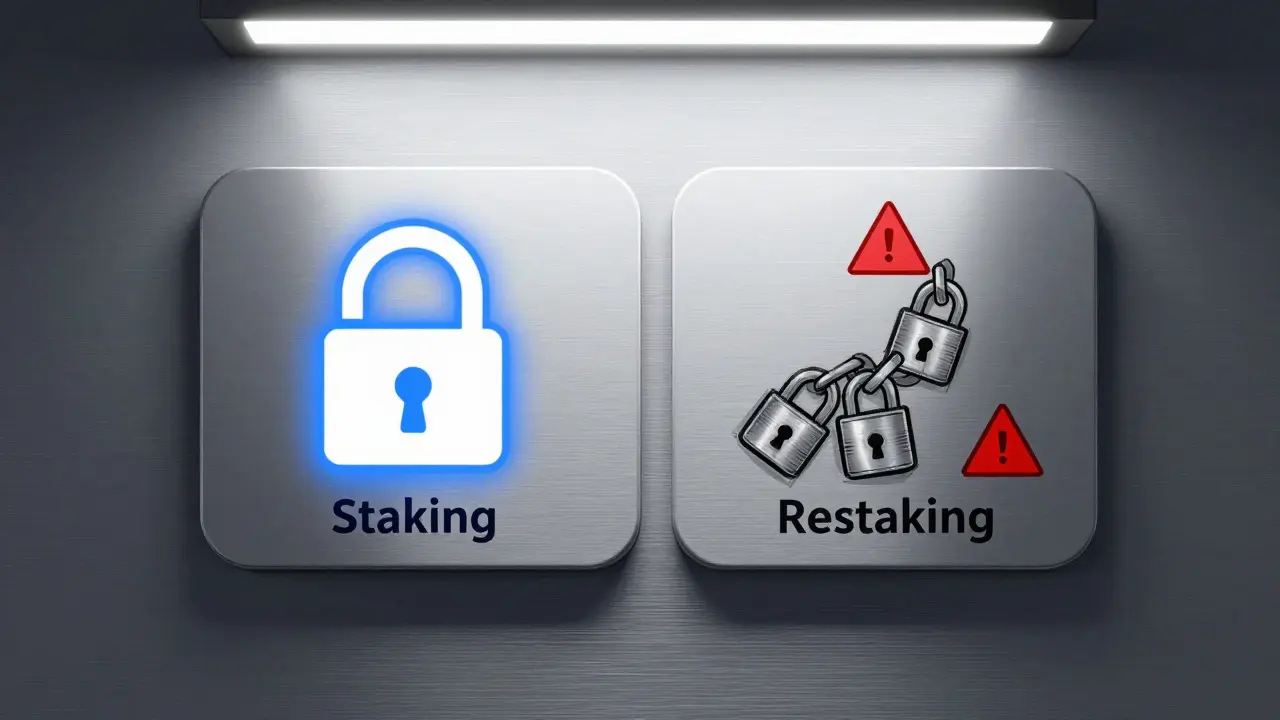
When you stake cryptocurrency, you lock up your coins to help secure a blockchain network-and get rewarded for it. It’s simple: more stakers mean a stronger, more reliable network. But now there’s another option: restaking. It sounds like staking, but it’s not the same. Restaking lets you use the same coins to secure multiple networks at once. That means more rewards, but also more risk. If you’re trying to decide between the two, here’s what you actually need to know.
How Staking Works
Staking is the backbone of proof-of-stake (PoS) blockchains like Ethereum, Solana, and Cardano. Instead of using energy-heavy mining, these networks let users lock up their native tokens-like ETH, SOL, or ADA-to validate transactions. In return, you earn interest, usually paid out weekly or monthly.
On Ethereum, for example, you need 32 ETH to run your own validator. If you don’t have that much, you can join a staking pool through services like Lido or Coinbase. These platforms let you stake smaller amounts and still earn rewards. As of late 2023, Ethereum staking offered around 3-5% annual percentage yield (APY). Cardano was closer to 4-6%. That’s not huge, but it’s passive income with no extra work.
The trade-off? Your coins are locked up. On Ethereum, it takes 27-32 days to withdraw your staked ETH. During that time, you can’t sell or move them. And if your validator goes offline or misbehaves, you could lose a portion of your stake-a penalty called slashing. Ethereum’s max slashing is 0.5 ETH per epoch, which is rare but possible.
What Restaking Is
Restaking changes the game. It lets you take your already-staked ETH and use it to secure other protocols-like decentralized oracle networks, privacy layers, or rollups-without locking up more money. Think of it like renting out your security deposit to multiple landlords at once.
This innovation came from EigenLayer is a protocol built on Ethereum that introduced restaking in 2022, allowing validators to extend their security commitments to other blockchain services. EigenLayer doesn’t replace staking-it builds on top of it. When you restake, you’re not withdrawing your ETH from Ethereum. You’re authorizing EigenLayer to use your staked ETH as collateral for other networks. In return, you earn extra rewards.
For example, if you’re staking ETH at 4.5% APY, restaking might add another 2-3% APY by securing a data availability layer or a zk-rollup. That pushes your total yield to 6.5-7.5%. Some users have reported effective APYs above 8% by stacking multiple restaking protocols. No extra coins needed. Just the same ETH, working harder.
Key Differences Between Staking and Restaking
Here’s how they stack up side by side:
| Aspect | Staking | Restaking |
|---|---|---|
| How it works | Locks coins to secure one blockchain | Uses staked coins to secure multiple protocols |
| Typical APY (2024) | 3-6% | 5-8% (base + restaking yield) |
| Capital efficiency | 100% (one asset, one purpose) | 200-300% (same asset, multiple roles) |
| Withdrawal time | 27-32 days (Ethereum) | Same, but extra steps to exit restaking |
| Slashing risk | Single network (e.g., Ethereum only) | Multiple networks-failure in one can slash all |
| Complexity | Low to medium | High-requires understanding multiple systems |
| Hardware/software needs | Standard validator setup | Higher-must handle cross-protocol integrations |
Restaking isn’t magic. It’s leverage. And leverage always comes with trade-offs.

Why Restaking Is Riskier
Here’s the big problem: correlated slashing. If you’re staking only on Ethereum, and your validator goes down, you lose a bit of ETH. That’s it.
But if you’re restaking, and the same validator node fails on Ethereum and on a second protocol-say, a decentralized oracle service-then you get slashed on both. That means you could lose 25% or more of your restaked assets in one event, according to EigenLayer’s own documentation.
It’s like having one insurance policy cover your house, car, and boat. If the insurer goes bankrupt, you lose everything. In restaking, the "insurer" is the same validator. If it messes up, the penalty cascades.
And it’s not theoretical. In late 2023, Reddit users reported over $2.3 million in losses from restaking mistakes. Many didn’t realize that withdrawing from one protocol didn’t automatically exit their restaking position. Others misconfigured their withdrawal credentials and lost funds permanently.
Who Should Use Restaking?
Restaking isn’t for beginners. It’s for users who:
- Already understand how staking works
- Have experience managing wallets and withdrawal keys
- Are comfortable with smart contract risk
- Want to maximize yield without adding more capital
Most experts recommend starting with staking first. Once you’ve run a validator for a few months without issues, then consider allocating 10-20% of your staked assets to restaking. Don’t go all-in. Don’t trust automated tools blindly. Test on a testnet first. Many experienced users say they spent 11 hours just setting up their first restaking configuration.
Also, avoid restaking if you’re using a custodial service like Coinbase or Kraken for your main staking. Those platforms don’t yet offer full restaking control. You’re better off using a non-custodial wallet like MetaMask with a liquid restaking token (LRT) like eETH or ezETH.
What’s Next?
Restaking is still new. As of early 2024, it accounts for about $15 billion in total value locked-roughly 7.5% of the entire staking market. But growth is explosive. It went from $0 to $15 billion in under a year.
Ethereum’s Dencun upgrade in January 2024 made restaking more efficient by cutting data costs by 90%. EigenLayer’s "passive restaking" update in Q1 2024 automatically compounds rewards across 12 protocols. Coinbase launched institutional restaking services in March 2024 with $500 million in initial deposits.
But regulators are watching. The SEC hasn’t said whether restaking counts as an unregistered security. If they do, platforms could be forced to shut down or change how they operate.
Long-term, restaking could become a standard layer for securing blockchain infrastructure. But it won’t replace staking. It’ll sit on top of it-like a turbocharger on an engine. The engine still needs to run well first.
Bottom Line
Staking gives you steady, predictable rewards with clear risks. Restaking gives you higher returns-but with hidden, cascading dangers. If you’re new to crypto, stick with staking. If you’re experienced and want to squeeze more yield out of your ETH, try restaking… but start small. Use 5% of your staked assets at first. Monitor everything. Understand every contract you interact with.
Restaking isn’t a shortcut to wealth. It’s a tool for those who know what they’re doing. And if you don’t? You’re not missing out. You’re just avoiding a trap.
Can you lose money with restaking?
Yes, and more easily than with regular staking. Restaking exposes you to correlated slashing-if one protocol your validator supports fails, you can lose part of your stake across all protocols you’re restaking on. This has already caused over $2 million in losses among inexperienced users in 2023. Always understand the slashing rules of every protocol you restake with.
Is restaking safer than staking?
No. Restaking increases risk because it links your security commitment across multiple systems. A single mistake-like a misconfigured withdrawal key or a failed oracle-can trigger penalties on all protocols you’re supporting. Staking on Ethereum alone limits your exposure to just one network.
Do you need more ETH to restake?
No. Restaking uses your existing staked ETH. You don’t need to buy more. Instead, you authorize protocols like EigenLayer to reuse your staked ETH to secure other services. That’s what makes it capital-efficient-you’re getting extra rewards without locking up additional coins.
Can you stop restaking and get your ETH back?
Yes, but it’s complicated. Exiting restaking requires two steps: first, you must withdraw from the restaking protocol (which can take days), then you must wait the full unbonding period (27-32 days on Ethereum) to get your ETH back. Many users get stuck because they don’t realize the restaking withdrawal isn’t automatic. Always check the documentation of the specific LRT you’re using.
What’s the best restaking protocol right now?
EigenLayer leads the market with 65% of restaking TVL, followed by KelpDAO and Renzo. But "best" depends on your goals. EigenLayer offers the most protocols to restake with, but has higher complexity. Renzo is easier to use and focuses on Ethereum L2s. Always compare APY, security audits, and withdrawal processes before choosing. Never trust a protocol without a public audit from a reputable firm.
Is restaking regulated?
It’s in a gray area. The SEC has not formally classified restaking as a security, but its February 2024 statement warned that multi-protocol yield mechanisms "may constitute unregistered securities offerings." This uncertainty could lead to future restrictions, especially for U.S.-based users. Many platforms now restrict restaking to non-U.S. residents for this reason.
Should I use restaking if I’m new to crypto?
No. Restaking requires deep understanding of Ethereum staking, withdrawal keys, slashing conditions, and smart contract risks. Most users who lose money with restaking are beginners who assumed it was just "staking with higher rewards." Start with simple staking on a trusted platform like Lido or Coinbase. Once you’ve done it successfully for six months, consider testing restaking with 1-2% of your portfolio.


