

Imagine building a decentralized application that processes user identities across three continents. You think you’re safe because your code is open-source and your ledger is immutable. Then, a regulator in Delaware or New Jersey sends a cease-and-desist letter. Why? Because privacy protocol regulations don’t care if your database is on a server in Virginia or distributed across thousands of nodes in Iceland. If you handle personal data, the law applies to you.
We are living through a seismic shift in how digital identity and data privacy intersect with blockchain technology. For years, the crypto space operated under a loose interpretation of anonymity. But as blockchains move from niche experiments to mainstream infrastructure for finance, healthcare, and supply chains, regulators have caught up. The question isn't whether these regulations will affect you; it's whether your current architecture can survive them.
The Clash: Immutability vs. The Right to Be Forgotten
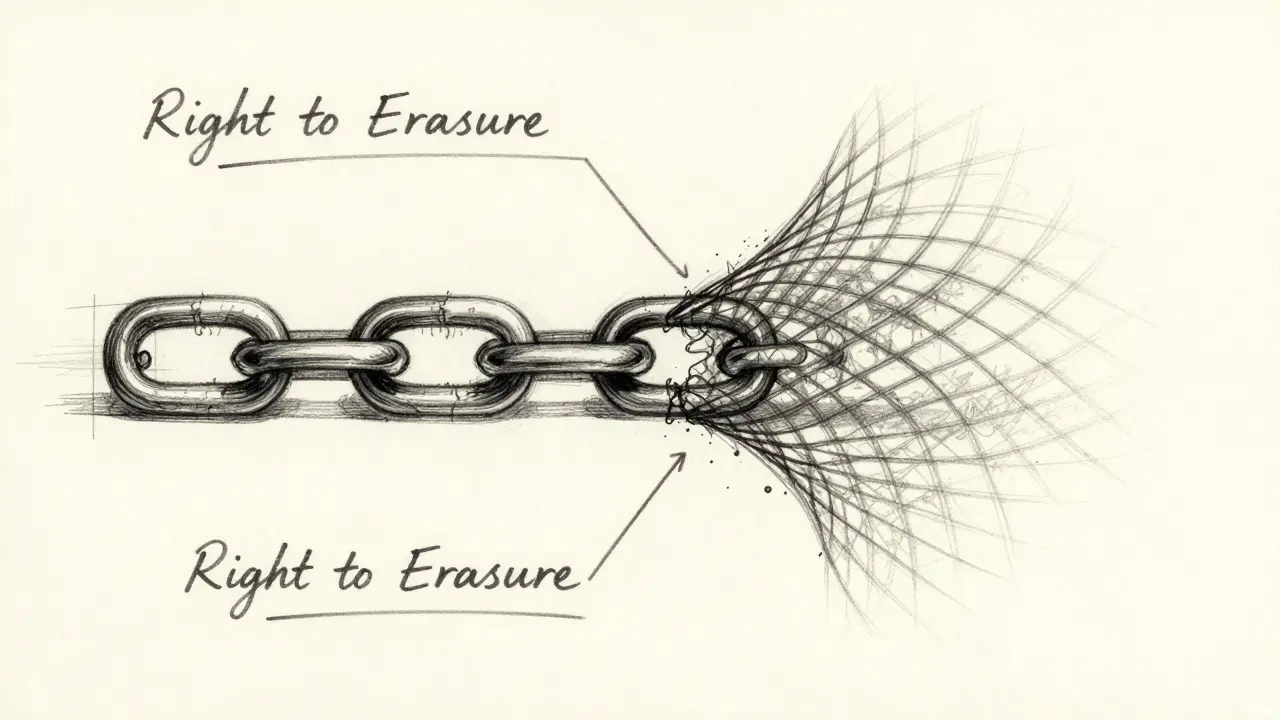
The core tension between blockchain and modern privacy laws is philosophical as much as it is technical. Blockchains are designed to be permanent. Once data is written, it cannot be erased. This immutability is a feature, not a bug, for audit trails and trustless systems. However, privacy regulations like the General Data Protection Regulation (GDPR) in Europe and the California Consumer Privacy Act (CCPA) in the US enshrine the "Right to Erasure" or "Right to Be Forgotten."
If a user asks you to delete their email address or social security number, and that data is hashed and stored on-chain, you technically cannot comply. This creates a legal liability for any organization acting as a data controller. To navigate this, developers must distinguish between on-chain and off-chain data storage. Personal Identifiable Information (PII) should never be written directly to the public ledger. Instead, use zero-knowledge proofs (ZKPs) or hash pointers. Store the actual PII in an encrypted, mutable off-chain database where it can be deleted upon request, while keeping only a cryptographic proof of existence on the blockchain.
The Fragmented US Landscape: More Than Just California
Many businesses still focus solely on GDPR and CCPA, assuming that covers their bases. This is a dangerous oversight. In 2025 and 2026, the United States saw a massive expansion of state-level privacy laws. We are no longer dealing with just two major frameworks; we are navigating a patchwork of over twenty distinct jurisdictions with varying rules.
New laws effective in recent months include the Iowa Consumer Privacy Act (ICPA), Delaware Personal Data Privacy Act (DPDPA), and the Maryland Online Data Privacy Act (MODPA). Each has unique thresholds and requirements. For instance, Delaware’s DPDPA has notably low applicability thresholds, requiring compliance from businesses processing data of just 35,000 consumers annually. If you run a DeFi platform or a token-gated community service, hitting this threshold is easier than you might think.
Furthermore, the response timelines vary wildly. Iowa allows 90 days to respond to consumer requests, while Delaware mandates a rapid 45-day turnaround. Minnesota provides a 30-day cure period until January 2026, whereas Maryland offers a more extended 60-day cure period framework. Missing these deadlines isn't just a minor error; it triggers significant fines and enforcement actions.
| State Law | Effective Date | Consumer Threshold | Response Time | Cure Period |
|---|---|---|---|---|
| Iowa (ICPA) | Jan 1, 2025 | 50,000 consumers | 90 days | Permanent |
| Delaware (DPDPA) | Jan 1, 2025 | 35,000 consumers | 45 days | Sunset Jan 1, 2026 |
| Maryland (MODPA) | Oct 1, 2025 | 35,000 consumers | 45 days | 60 days until Apr 2027 |
| Tennessee (TIPA) | July 1, 2025 | 175,000 consumers | 45 days | None specified |
Global Pressures: India, EU, and Beyond
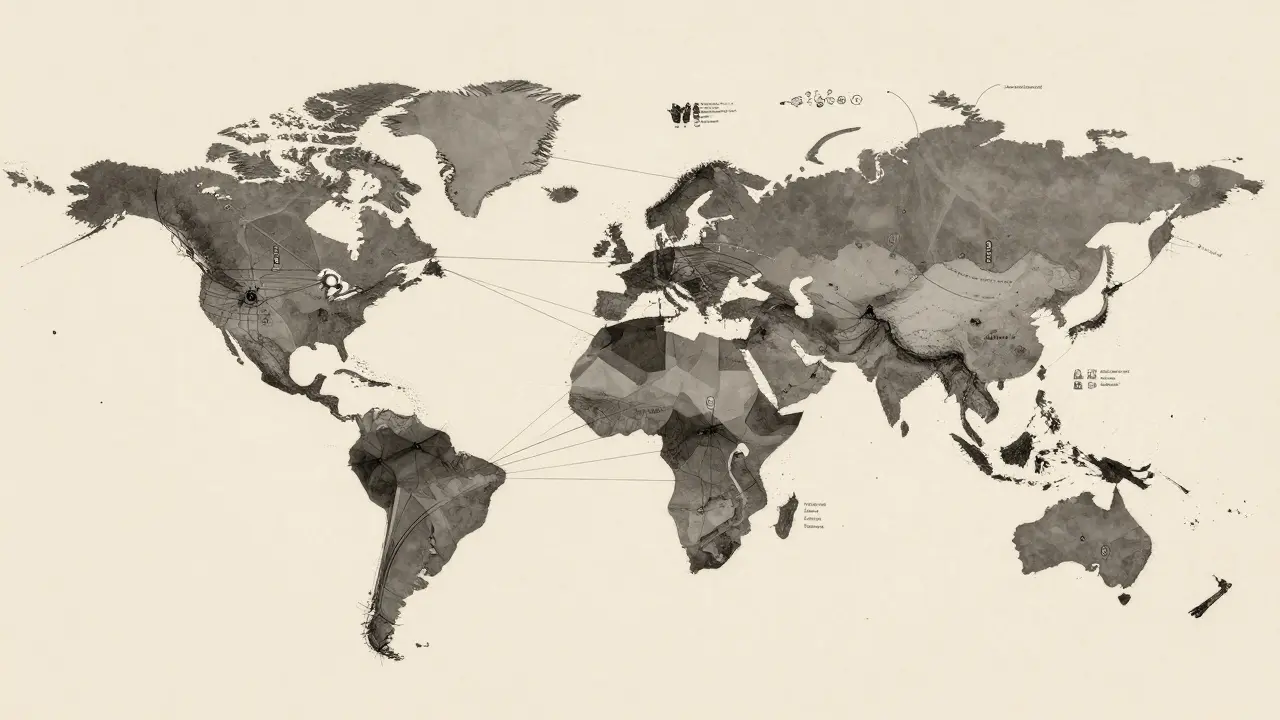
The regulatory pressure isn't limited to North America. India’s Digital Personal Data Protection Act (DPDPA), which gained momentum toward full effectiveness in 2025, establishes a comprehensive regime built around notice, consent, and fiduciary responsibilities. Any entity processing digital personal data of individuals in India-including cross-border blockchain operations-must comply. This includes strict breach reporting protocols and steep penalties for noncompliance.
In Europe, the landscape is evolving with the implementation of DORA (Digital Operational Resilience Act) and the EU AI Act. While DORA focuses on financial entities, its operational resilience requirements impact any crypto-asset service provider interacting with traditional finance. The EU AI Act adds another layer, regulating algorithms used for profiling or decision-making based on personal data. If your smart contract uses automated decision-making to approve loans or verify identities, you may fall under these stricter guidelines.
Technical Implementation: Building Privacy by Design
Compliance cannot be an afterthought added via a Terms of Service update. It must be engineered into your protocol. Here are practical steps to align your blockchain project with current privacy regulations:
- Data Minimization: Only collect what is strictly necessary. If your dApp doesn’t need a user’s phone number, don’t ask for it. This reduces your liability surface area significantly.
- Pseudonymization: Use techniques that separate identifying information from the data record. In blockchain terms, this means using wallet addresses as identifiers rather than linking them directly to names or emails in public logs.
- Automated DSAR Workflows: Data Subject Access Requests (DSARs) are now a standard part of user interaction. You need automated systems to track, verify, and fulfill these requests within the specific timeframes of each jurisdiction (e.g., 45 days for Delaware).
- Third-Party Mapping: Regulations like Delaware’s DPDPA require businesses to provide consumers with comprehensive lists of third parties receiving disclosed personal data. Maintain an updated vendor risk register that maps every oracle, API provider, and cloud service interacting with user data.
Enforcement and Penalties: The Cost of Ignorance
The stakes have never been higher. Enforcement mechanisms are becoming more aggressive. Delaware imposes fines up to $10,000 per violation. Iowa’s Attorney General has exclusive authority to enforce violations, with penalties reaching $7,500 per infraction. These are not one-time fees; they are per-violation costs. A single data breach affecting thousands of users could result in millions in fines.
Moreover, the Telephone Consumer Protection Act (TCPA) introduced new texting and calling rules in 2025. One-to-one consent requirements for prior express written consent became effective in late 2024 and early 2025. If your project uses SMS for multi-factor authentication (MFA) or marketing, ensure you have robust opt-in and opt-out workflows. The Federal Communications Commission (FCC) requires parties using automatic dialing systems to implement enhanced consent protocols. Failure to honor opt-out requests quickly can lead to class-action lawsuits independent of privacy regulators.
Strategic Recommendations for 2026 and Beyond
As we move further into 2026, the trend is clear: fragmentation is increasing, but tools are improving. Organizations require comprehensive data discovery capabilities across state lines. Relying on manual spreadsheets to track compliance is no longer viable. Invest in privacy management platforms that can automate preference centers and map data flows dynamically.
For blockchain projects specifically, consider adopting self-sovereign identity (SSI) standards. SSI allows users to hold their own credentials and share only verified claims without revealing underlying PII. This aligns perfectly with the spirit of privacy regulations by giving users control over their data. Projects like W3C Verifiable Credentials are leading this charge, offering a path to compliance that enhances user trust rather than eroding it.
Finally, conduct regular privacy impact assessments (PIAs). Treat them like security audits. Identify where PII enters your system, how it moves, and where it exits. Document everything. When a regulator knocks, having a documented, proactive compliance program is often the difference between a warning letter and a crippling fine.
Does blockchain immutability violate GDPR's right to erasure?
Not necessarily, if implemented correctly. You should avoid storing raw Personal Identifiable Information (PII) on-chain. Instead, store hashes or zero-knowledge proofs on the blockchain and keep the actual PII in an off-chain, mutable database. When a user requests deletion, you delete the off-chain data and render the on-chain hash useless, effectively satisfying the right to erasure.
Which US states have the lowest compliance thresholds for privacy laws?
Delaware’s Personal Data Privacy Act (DPDPA) has one of the lowest thresholds, applying to businesses processing data of just 35,000 consumers annually. Maryland’s MODPA also uses a 35,000 consumer threshold. Smaller startups and niche blockchain projects may trigger these requirements faster than they anticipate.
How do I handle Data Subject Access Requests (DSARs) in a decentralized app?
You need an automated workflow to receive, verify, and process DSARs. Since blockchain transactions are public, you cannot "delete" them. Your system must identify all off-chain records associated with a user’s wallet address or account ID and securely delete them within the statutory timeframe (e.g., 45 days for Delaware). Provide users with a portal to submit these requests easily.
What are the penalties for non-compliance with the Delaware DPDPA?
Delaware imposes fines of up to $10,000 per violation. Initially, there was a 60-day cure period allowing businesses to fix issues before penalties applied, but this sunsetted on January 1, 2026. Now, violations are subject to immediate enforcement action by the Attorney General.
Do I need to comply with Indian privacy laws if I operate globally?
Yes, if you process the digital personal data of individuals located in India. The Digital Personal Data Protection Act (DPDPA) applies extraterritorially to any entity processing such data, regardless of where the entity is located. This includes strict consent and breach notification requirements.