
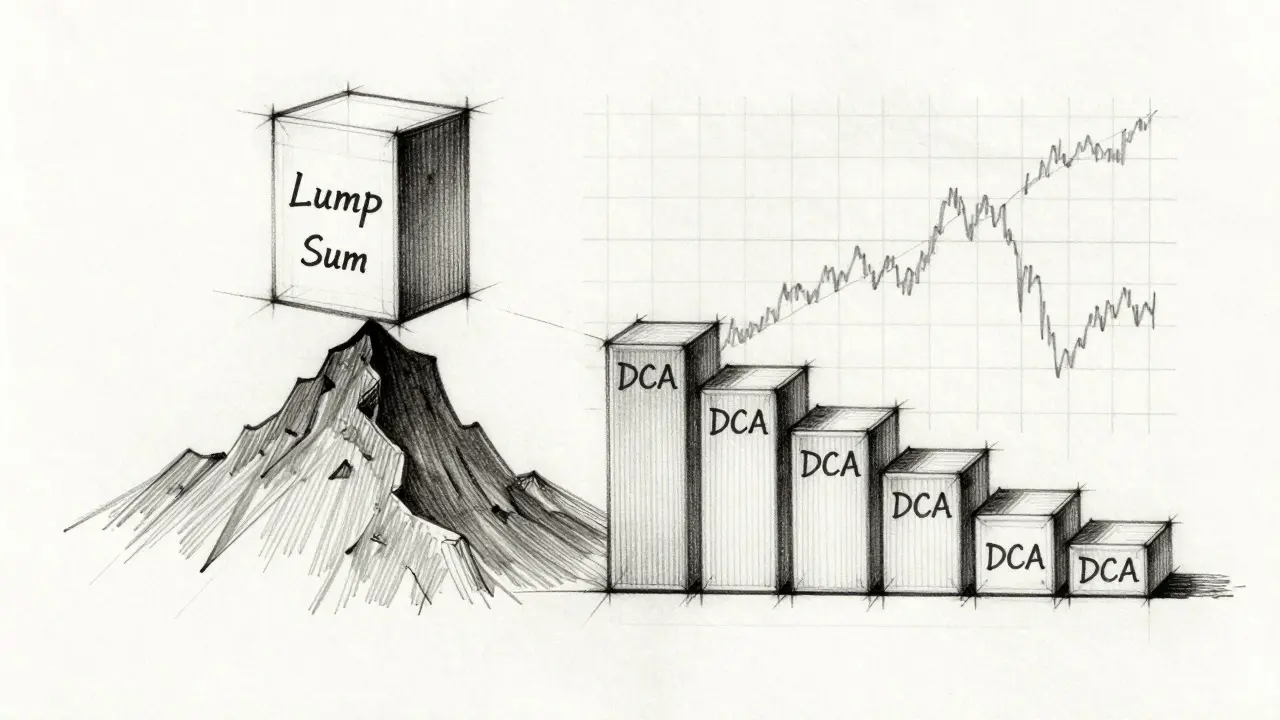
You’ve probably heard the advice a thousand times: "Don’t try to time the market. Just set up automatic buys and let Dollar Cost Averaging do the work." It sounds safe. It feels responsible. But does it actually make mathematical sense? Or is it just a comforting habit for investors who are afraid to pull the trigger on a large purchase?
The short answer is complicated. If you look at the raw numbers, putting all your money in at once usually wins. But if you look at how humans actually behave during market crashes, spreading out your purchases saves you from yourself. Let’s break down the actual math behind DCA, what the data says about its performance, and why the "proof" isn't as simple as a single formula.
The Math Doesn't Lie: Lump Sum Usually Wins
If we strip away emotions and look purely at historical probability, Lump-Sum Investing beats Dollar Cost Averaging more often than not. This isn't an opinion; it's statistical reality based on market trends.
Research published by the Financial Planning Association analyzed decades of market data using the CAPE (Cyclically Adjusted Price-Earnings) ratio. Their findings were stark: lump-sum investing outperformed dollar-cost averaging approximately two-thirds of the time. Why? Because markets generally trend upward over long periods. Every day your cash sits idle waiting for the next scheduled buy, it’s missing out on potential gains. In financial terms, this is called "time in the market" versus "timing the market," and the math heavily favors being fully invested early.
However, this assumes a perfect world where prices follow a predictable upward trajectory without massive, prolonged downturns. That’s where the story gets interesting.
When DCA Shines: The Market Peak Scenario
So, if lump sum is better two-thirds of the time, when is DCA actually superior? The answer lies in volatility and bad timing. Imagine you have $100,000 to invest, and today happens to be the absolute peak of the market before a crash. If you go all-in, you watch your portfolio drop 30% or 40%. That hurts. A lot.
A comprehensive analysis by Raymond James researchers looked at 40 years of S&P 500 data to test exactly this scenario. They compared four strategies:
- Standard Market Investing: Average annualized 10-year return of 11.7%.
- Lump-Sum at Market Peaks: Average annualized 10-year return of 8.3%.
- DCA at Market Peaks: Average annualized 10-year return of 10.4%.
- Cash Positioning: Average annualized 10-year return of 3.1%.
Notice the difference? When you buy at the top, lump-sum investing drags your returns down significantly (8.3%). But by using DCA, you spread those purchases over time. As the price drops, your subsequent buys get more units for the same amount of money. This lowers your average entry price. In the Raymond James study, DCA recovered much of that lost ground, achieving 10.4% returns-far closer to the ideal standard than the lump-sum approach.
This is the core mathematical advantage of DCA: it mitigates the risk of entering at a local maximum. It doesn't guarantee higher returns in a bull market, but it protects your downside in volatile or declining markets.
The 2020 Mathematical Breakthrough
For years, the debate was mostly empirical-we looked at past data and saw patterns. But in April 2020, academic researchers published a paper that changed the theoretical landscape. They developed closed-form formulae for the expected value and variance of investor wealth processes under DCA strategies.
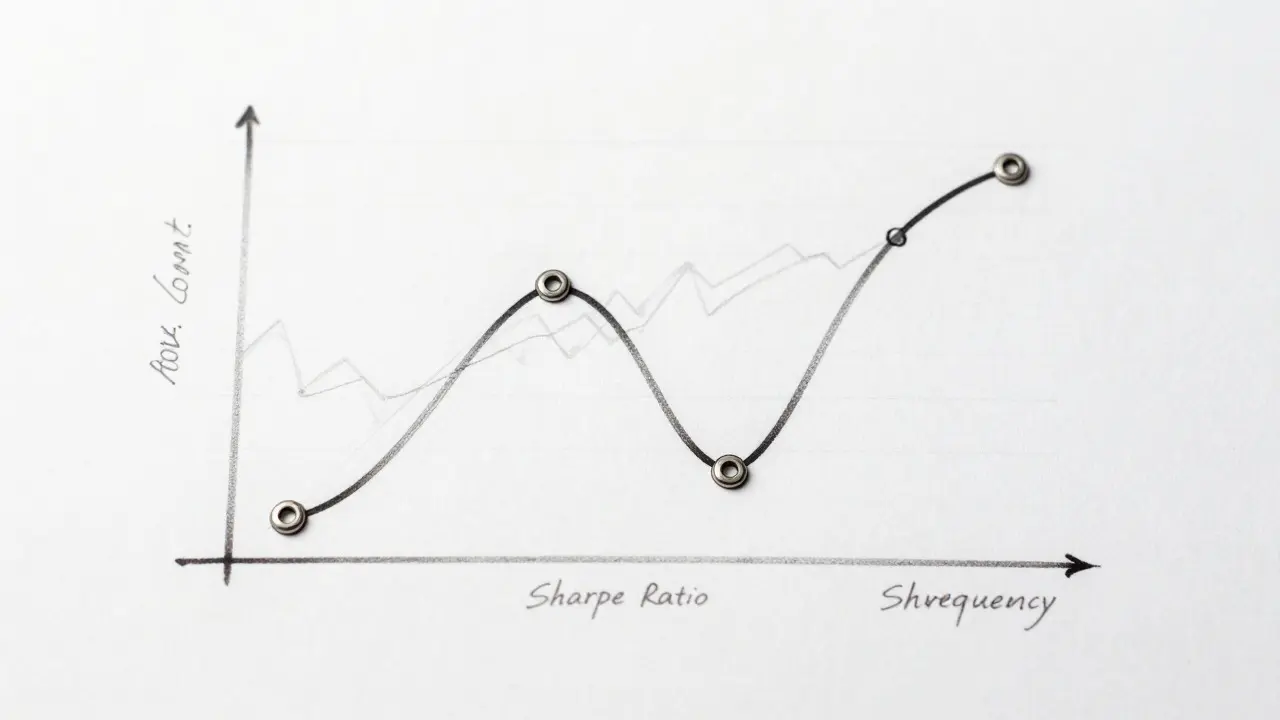
Before this, calculating the exact risk profile of DCA required complex simulations. This new framework allowed for precise, analytical proofs. One of the most counterintuitive findings was about frequency. You might think buying daily is better than buying monthly because you’re averaging more often. The math proved otherwise.
The impact of investment frequency on risk and return is non-monotonic. This means there isn't a straight line where "more frequent = better." At certain intervals, increasing frequency can actually worsen your Sharpe ratio (a measure of risk-adjusted return). The optimal frequency depends on the specific volatility structure of the asset you're buying. For highly volatile assets like cryptocurrencies, the sweet spot for DCA frequency might be different than for stable index funds.
This research also introduced methods to value DCA risk using Asian options-a type of derivative where the payoff depends on the average price of the underlying asset over a period. This connects DCA directly to sophisticated financial engineering, showing that it’s not just a retail investor hack, but a strategy with deep roots in quantitative finance.
Behavioral Finance: The Human Variable
Here is the catch: pure math ignores psychology. And in investing, psychology is everything. The UCLA Anderson School of Management conducted studies challenging the idea that stock prices follow a "random walk." They argued that traditional models fail to account for human behavior.
In 1995, behavioral finance expert Meir Statman proposed that DCA serves a crucial psychological function: it reduces regret. If you buy all your Bitcoin at $60,000 and it drops to $30,000, you feel foolish. You might panic sell. If you were DCA-ing, you’d see the drop and think, "Great, I’m getting more coins for my next installment."
This "regret minimization" is a tangible financial benefit. Investors who stick to their plan during crashes end up with better long-term outcomes than those who panic. DCA enforces discipline. It removes the emotional decision-making process from every single transaction. From a utility theory perspective (specifically von Neumann-Morgenstern utility functions), the peace of mind provided by DCA has real monetary value because it prevents costly behavioral errors.
| Strategy | Best Case Scenario | Worst Case Scenario | Psychological Stress | Mathematical Edge |
|---|---|---|---|---|
| Lump-Sum | Market immediately rallies | Buy at peak, immediate crash | High (fear of missing out / fear of loss) | Higher expected return (~67% win rate) |
| DCA | Gradual uptrend with dips | Steady decline (underperforms lump sum) | Low (automated discipline) | Better risk-adjusted returns in volatility |
| Cash Waiting | Perfect bottom call | Missing entire bull run | Very High (anxiety of timing) | Lowest expected return (3.1% in studies) |
Applying This to Crypto and Blockchain Assets
Why does this matter for blockchain knowledge? Because cryptocurrency markets are significantly more volatile than the S&P 500. The principles of DCA hold true, but the parameters change.
In traditional stocks, a 20% drop is a correction. In crypto, a 50-70% drop is common. This high volatility makes the "non-monotonic frequency" finding from the 2020 study even more relevant. Buying crypto daily might expose you to unnecessary noise and trading fees without improving your average price significantly. Weekly or bi-weekly intervals often provide a better balance between smoothing out volatility and staying invested.
Furthermore, the "Asian Options" concept applies here too. When you DCA into Bitcoin or Ethereum, you are effectively creating a personal average-price contract. Your final cost basis is the average of all your entry points. In a trending market, this ensures you don't put all your capital to work at the very top of a cycle.

How to Structure Your DCA Strategy
Based on the mathematical evidence, here is how you should approach DCA:
- Define Your Horizon: DCA works best over long periods (5+ years). Short-term DCA can still result in losses if the market is in a secular bear phase.
- Choose Frequency Wisely: Don't obsess over daily buys. Weekly or monthly intervals are usually sufficient to smooth volatility while keeping administrative friction low.
- Automate It: Use exchange features or third-party tools to automate purchases. This removes the "should I buy today?" question entirely.
- Accept Underperformance in Bulls: If the market goes straight up, DCA will lag behind lump-sum. Accept this as the insurance premium you pay for protection against crashes.
- Review Periodically: Once you have significant holdings, consider shifting some profits into a lump-sum reinvestment strategy if valuations look reasonable.
Common Misconceptions About DCA Math
One big myth is that DCA guarantees profit. It doesn’t. If an asset loses 90% of its value over five years, DCA will just give you a slightly better average entry price than a lump sum, but you’ll still lose money. DCA manages risk, not outcome.
Another misconception is that you need to predict the bottom. You don’t. The beauty of the math is that you don’t need to know where the market is going. You only need to believe in the long-term value of the asset. The variance reduction provided by DCA works regardless of direction, though it shines brightest when prices are erratic.
Is DCA mathematically proven to be better than lump sum?
No, it is not universally better. Statistical analysis shows lump-sum investing outperforms DCA about two-thirds of the time due to the general upward trend of markets. However, DCA provides better risk-adjusted returns during periods of high volatility or when starting investments at market peaks.
What is the optimal frequency for DCA?
There is no single "best" frequency. Research indicates the relationship between frequency and performance is non-monotonic. For most investors, weekly or monthly intervals offer a practical balance between smoothing volatility and minimizing transaction costs or administrative effort.
Does DCA work for cryptocurrency?
Yes, often more effectively than for stocks. Due to the extreme volatility of crypto assets, the risk-mitigation benefits of averaging entry prices are more pronounced. However, investors must ensure they use intervals that account for crypto's specific volatility cycles.
What is the "regret minimization" benefit of DCA?
Regret minimization refers to the psychological comfort of knowing you didn't buy everything at the highest possible price. This reduces the likelihood of panic selling during downturns, which historically causes more financial damage than poor entry timing.
Can DCA lead to lower returns than holding cash?
In a sustained bear market, yes. However, historical data from Raymond James shows that even in worst-case scenarios (buying at peaks), DCA significantly outperforms holding cash over a 10-year horizon (10.4% vs 3.1% annualized returns).