

Imagine you're trying to buy a rare collectible online. You have two choices: you can either hit the "Buy It Now" button and pay whatever the seller is asking right this second, or you can send a message saying, "I'll buy this, but only if you drop the price to $100." In the world of trading, these are the exact same logic as Market Orders and Limit Orders. One prioritizes speed, and the other prioritizes price.
When you step into a crypto exchange or a stock brokerage, you aren't just buying from a company; you're interacting with an Order Book. This is essentially a real-time list of everyone willing to buy and sell a specific asset at various price points. Understanding how your order interacts with this book is the difference between getting a great deal and losing money to Market Orders slippage.
The Need for Speed: Understanding Market Orders
A market order is a straightforward instruction to your broker or exchange: "Get me this asset right now, regardless of the price." You aren't haggling; you're accepting the current market rate. If you want to buy, you'll pay the lowest available asking price (the "ask"). If you want to sell, you'll take the highest available bid price.
The biggest draw here is certainty of execution. If you see a coin's price crashing and you need to get out immediately to save your capital, a market order is your best friend. You don't have time to set a price and hope someone hits it; you just want the position closed. However, this speed comes with a catch called slippage. Slippage happens when there isn't enough liquidity at the current price to fill your entire order, forcing the system to buy or sell at progressively worse prices to finish the trade.
For example, if you try to buy 10 BTC with a market order, but there are only 2 BTC available at $60,000, the exchange will automatically buy the next 8 BTC from sellers asking $60,100, $60,200, and so on. Suddenly, your average entry price is higher than you expected. This is why professional traders avoid market orders in "thin" markets where there aren't many active sellers or buyers.
Taking Control: The Power of Limit Orders
A Limit Order is the opposite of a market order. Instead of accepting the current price, you name your price. A buy limit order tells the exchange, "I only want to buy this if the price hits $X or lower." A sell limit order says, "I'll only sell this if the price reaches $Y or higher."
The primary benefit is price protection. You never have to worry about slippage because the order simply won't execute unless your specific price condition is met. This is ideal for "buying the dip" or setting a target profit price for an asset you already own. You can set these orders and walk away, knowing you won't overpay.
The trade-off? You lose the guarantee of execution. If you set a buy limit at $50,000 for Bitcoin, but the price only drops to $50,001 before skyrocketing to $70,000, your order will sit there unfilled. You saved money on the price, but you missed the trade entirely. This is the classic tug-of-war in trading: do you want the asset, or do you want the price?
| Feature | Market Order | Limit Order |
|---|---|---|
| Execution Speed | Immediate | Delayed (Conditional) |
| Price Guarantee | None (Subject to slippage) | Guaranteed or Better |
| Execution Guarantee | High (Almost certain) | Low (Price must be hit) |
| Ideal Use Case | High volatility / Urgent exit | Strategic entry / Profit taking |
| Order Book Role | Taker (Removes liquidity) | Maker (Adds liquidity) |
How the Order Book Actually Works
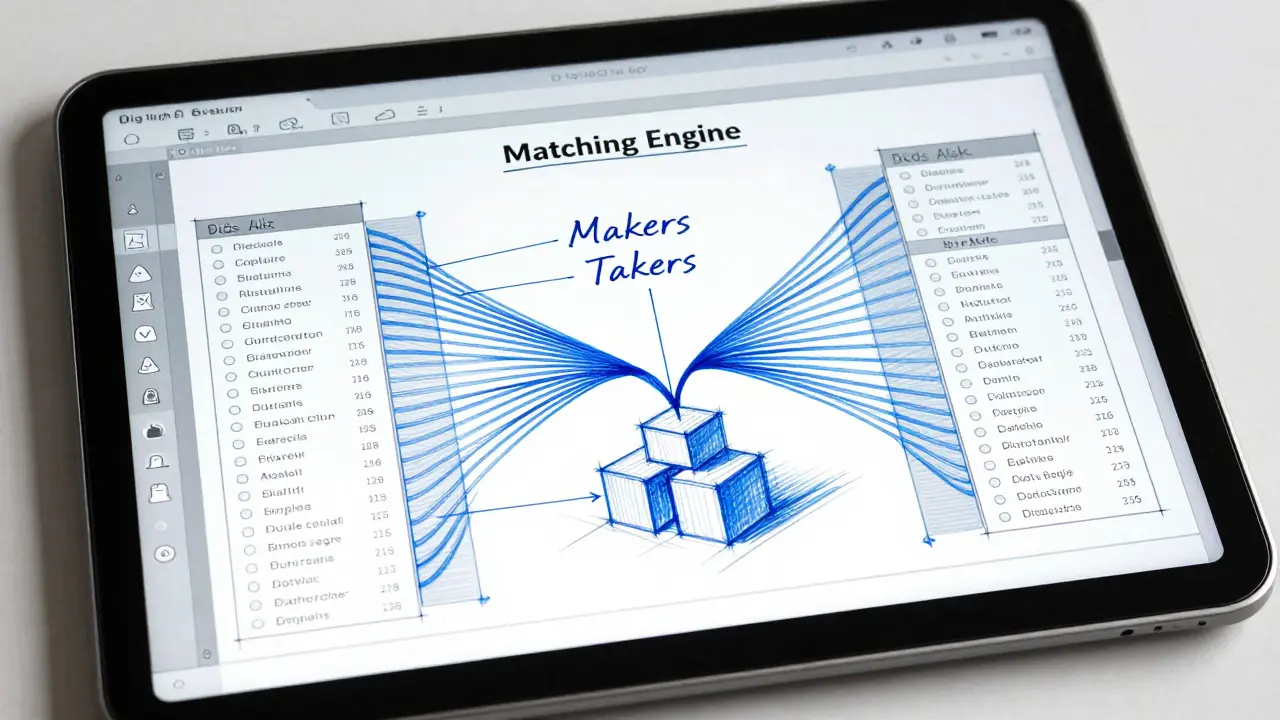
To understand why these two orders differ, you have to look at the Order Book as a matching engine. The book consists of two sides: the "Bids" (buyers) and the "Asks" (sellers). Limit orders are what actually build the order book. When you place a limit order to buy at $40,000, your order sits in the book as a "bid," waiting for a seller to come along.
Market orders, on the other hand, are the fuel that consumes the book. When you place a market buy order, you aren't adding a new line to the book; you are instantly matching with and removing the cheapest existing limit sell orders. In the industry, we call limit order users Makers (because they make the market) and market order users Takers (because they take liquidity away).
Many exchanges actually reward "Makers" with lower fees-or even rebates-because having a deep order book makes the exchange more attractive to other traders. If you're trading large volumes, using limit orders isn't just about price control; it's about saving a significant amount of money on trading fees over time.
Choosing the Right Tool for the Job
So, which one should you use? It depends entirely on your goal for the trade. If you are a long-term investor who doesn't care if the price of Ethereum moves by 0.5% today, limit orders are almost always the better choice. You can spend a few days fishing for a better entry price and save a chunk of change.
However, if you are day trading or managing a high-risk position, the risk of a "missed fill" is often worse than the risk of slippage. Imagine you're using a stop-loss strategy to prevent a total portfolio wipeout. If you use a limit order to sell and the price crashes through your limit too fast, the market might skip right past your price, leaving you holding a crashing asset. In those panic moments, a market order is the only way to guarantee you get out.
Another practical tip: consider the Bid-Ask Spread. This is the gap between the highest bid and the lowest ask. In highly liquid markets (like BTC/USDT), the spread is tiny, making market orders relatively safe. In obscure "altcoins" with low volume, the spread can be huge. Using a market order in a low-liquidity coin is like walking into a store and saying, "I'll buy this, and I don't care how much you overcharge me." It's a recipe for instant loss.
Common Pitfalls and Pro Tips
One of the biggest mistakes beginners make with limit orders is forgetting about the "opportunity cost." When you place a limit order, the exchange typically locks up the funds you're using for that trade. If you have $1,000 in your account and place a limit buy for $1,000 of a coin, you can't use that money for anything else until the order is filled or canceled. You've essentially frozen your capital.
To get the best of both worlds, some traders use a "limit-chasing" strategy. Instead of one giant limit order, they place several smaller orders at different price levels (layering). This ensures that if the price dips quickly and bounces back, they catch at least some of the move without risking the entire position at a single price point.
Lastly, be wary of "flash crashes." In these events, prices drop and recover in milliseconds. A limit order might be triggered at a devastatingly low price just before the recovery, leaving you to sell your assets at the exact bottom. This is why combining these basic orders with more advanced tools, like stop-limit orders, is essential for anyone moving beyond basic investing.
What happens if my limit order is never hit?
If the market price never reaches your specified limit price, the order simply remains "open" in the order book. It will stay there until it is either filled, you manually cancel it, or it reaches its expiration date (depending on whether it's a 'Day' or 'Good-Till-Canceled' order). You don't lose any money, but your funds remain locked in that trade.
Is slippage always bad?
Not necessarily, but it is an unplanned cost. In a rising market, a buy market order might suffer from "positive slippage" where you get a slightly better price than expected, though this is rare. Usually, slippage works against you, especially in volatile markets, meaning you pay more than you intended.
Which order type has lower fees?
Generally, limit orders have lower fees. This is because they act as "Makers," providing liquidity to the exchange's order book. Many platforms offer a "Maker-Taker" fee model where Makers are charged less (or even paid) to encourage a stable and deep market.
Can I change a limit order after placing it?
Yes. As long as the order has not been filled, you can cancel it or modify the price and quantity. Once a limit order is partially filled, you can still cancel the remaining unfilled portion.
When should I absolutely avoid market orders?
Avoid market orders when trading assets with low trading volume or very wide bid-ask spreads. In these "illiquid" markets, a single large market order can move the price significantly, leading to massive slippage and a much worse execution price than the one you saw on your screen.


