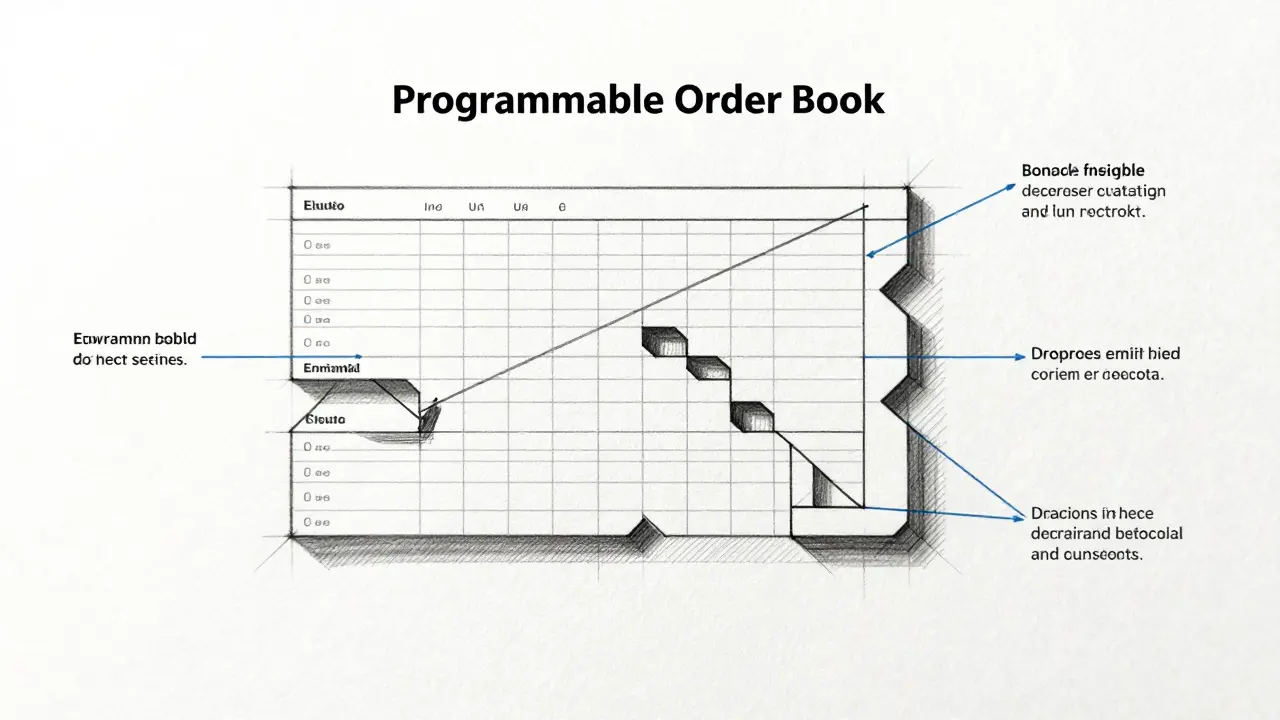
Most people who trade on decentralized exchanges (DEXs) are used to a specific feeling. You connect your wallet, you see a price, and you swap. If the slippage is too high, you either accept it or move to another pool. It’s simple, but it’s also rigid. That changes when you look at Mangrove, which is a programmable order book-based decentralized exchange that allows liquidity providers to post smart contracts as offers rather than locked commitments. Unlike the automated market makers (AMMs) that dominate the space, Mangrove operates like a traditional stock exchange but keeps your funds in your own wallet. This hybrid approach solves a massive problem for professional traders and sophisticated liquidity providers: capital efficiency.
Key Takeaways
- Non-Custodial Security: Mangrove never takes custody of your assets; your funds stay in your self-custodied wallet throughout the entire process.
- Programmable Liquidity: The platform uses an "Offer is code" model, allowing liquidity providers to leverage capital from other protocols instead of locking it up.
- Order Book Structure: It functions as an order book DEX, enabling limit orders, market orders, and amplified orders for better price discovery compared to AMMs.
- Trust Score: Independent validators like Scam Detector give Mangrove a medium trust score of 61.2/100, reflecting its newer status rather than fraud risk.
- Target Audience: Best suited for advanced users, market makers, and developers who can implement custom smart contract logic for liquidity strategies.
What Is Mangrove and Why Does It Matter?
To understand why Mangrove stands out, you have to look at how most DEXs work today. Platforms like Uniswap or Balancer rely on Automated Market Makers. These systems use mathematical formulas to set prices based on the ratio of tokens in a pool. While this is great for simplicity, it creates inefficiencies. Large trades suffer from significant slippage because there isn't enough depth in the pool. Liquidity providers often face impermanent loss, and their capital sits idle until someone actually trades against them.
Mangrove flips this model. Founded in 2021 and based in France, Mangrove introduces an order book structure to the decentralized world. But here is the twist: it doesn't just copy centralized exchanges. In a centralized exchange, you deposit money into the exchange's account. On Mangrove, you never hand over control. Your assets remain in your secure, self-custodied wallet. This eliminates counterparty risk, which is one of the biggest fears in crypto after numerous exchange hacks.
The real innovation lies in what Mangrove calls the "Offer is code" model. Instead of simply posting a static limit order with locked funds, liquidity providers can post arbitrary smart contracts as offers. This means an offer can be dynamic. It can pull liquidity from other protocols, borrow funds, or execute complex logic before a trade settles. For a trader, this means deeper liquidity and better prices. For a liquidity provider, it means you can earn yield on your spread while leveraging capital held elsewhere in the DeFi ecosystem.
How the Programmable Order Book Works
If you are new to decentralized finance, the term "programmable order book" might sound technical. Let’s break it down into plain English. Imagine you want to sell Bitcoin for Ethereum. On a standard DEX, you put both coins into a pool. On Mangrove, you can post an offer that says, "I will sell Bitcoin if the price hits X, but I don't need to lock my Bitcoin right now. I will source it from a lending protocol only if someone buys from me."
This architecture supports several advanced order types that give users much more flexibility:
- Market Orders: Execute immediately at the best available price, similar to buying stocks instantly.
- Limit Orders with Sourcing: Set a specific price, but allow the system to pull liquidity from other connected protocols to fill the order if necessary.
- Amplified Orders: This is a unique feature where you can post multiple limit orders using the same pool of funds. It maximizes capital efficiency by reusing collateral across different price levels.
- Automated Market-Making Strategies: Users can deploy bots or scripts that automatically adjust their offers based on market conditions, earning yield from the spread without manual intervention.
This level of customization is why Mangrove is often categorized under DeFi infrastructure rather than just a consumer trading app. It appeals to professional market makers who need granular control over their exposure. It also benefits large institutional traders who want to execute big orders without moving the market price drastically-a common issue on AMM platforms.

Security and Custody: Who Holds Your Keys?
Security is the number one concern for anyone entering the crypto space. When you use a centralized exchange like Binance or Coinbase, you are trusting a company to hold your money. If that company gets hacked, goes bankrupt, or freezes withdrawals, you lose access to your funds. Mangrove addresses this by being strictly non-custodial.
According to official documentation from mangrove.ai, Mangrove never takes custody of user assets. Every interaction happens directly between your wallet and the Mangrove smart contracts. You sign transactions, and the blockchain executes them. Your private keys never leave your possession. This aligns with the core ethos of decentralized finance: self-sovereignty.
However, "non-custodial" does not mean "risk-free." The risks shift from counterparty risk to smart contract risk. Since Mangrove relies on complex programmable offers, the security of those smart contracts is paramount. If a liquidity provider writes flawed code in their offer, they could expose themselves to exploits. Therefore, while the platform itself doesn't hold your funds, the complexity of the tools requires a higher level of user diligence. You must understand what you are signing.
Trust Assessment and Platform Legitimacy
Before deploying capital, it is crucial to assess the legitimacy of any platform. Independent third-party services help verify this. Scam Detector, a platform validator service, has assigned mangrove.exchange a trust score of 61.2 out of 100. This is classified as a "medium" trust rating.
Does a medium score mean Mangrove is unsafe? Not necessarily. In the context of emerging DeFi protocols, a medium score often reflects a lack of long-term operational history rather than evidence of fraud. Established platforms with years of uptime and millions of users typically score higher. Mangrove, founded in 2021, is still building its track record. The score suggests that while the platform operates legitimately, it may lack some of the extensive community recognition or historical data points that boost confidence scores for older projects.
Additionally, Mangrove is listed on CoinMarketCap, which tracks its trade volume and market pairs. Being included in such a major industry data aggregator indicates that the platform has sufficient trading activity and transparency to warrant monitoring. However, users should always perform their own due diligence. Check the GitHub repositories for open-source code audits, engage with the community on Discord or Twitter/X, and read recent updates from specialized DeFi publications like The Block.
Mangrove vs. Traditional AMMs and CEXs
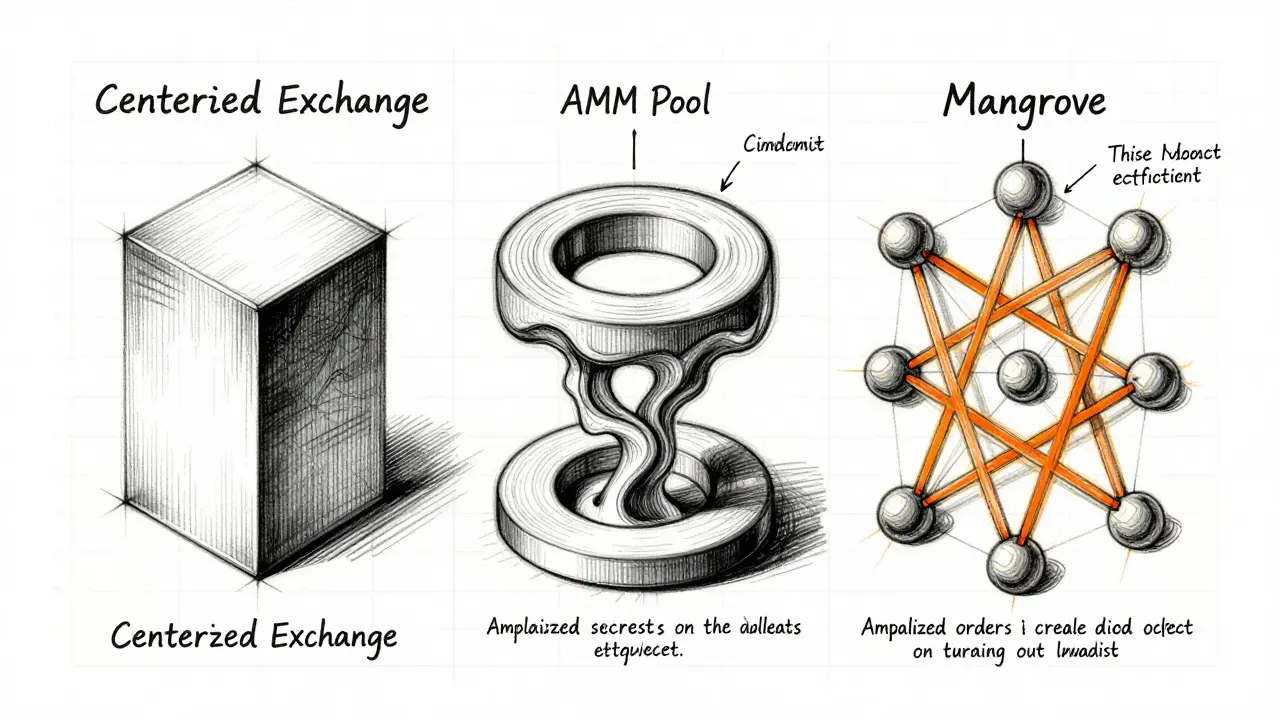
To see where Mangrove fits, let’s compare it to the two main alternatives: Centralized Exchanges (CEXs) and Automated Market Maker DEXs (like Uniswap).
| Feature | Centralized Exchange (e.g., Binance) | AMM DEX (e.g., Uniswap) | Mangrove (Order Book DEX) |
|---|---|---|---|
| Custody | Exchange holds funds (Custodial) | User holds funds (Non-Custodial) | User holds funds (Non-Custodial) |
| Pricing Mechanism | Order Book (Supply/Demand) | Mathematical Formula (x*y=k) | Order Book (Programmable Offers) |
| Liquidity Efficiency | High (Professional Market Makers) | Low (Capital Locked in Pools) | Very High (Leveraged/Sourced Liquidity) |
| Slippage for Large Orders | Low | High | Low to Medium |
| User Complexity | Low (Easy UI) | Medium (Wallet Connection) | High (Smart Contract Logic) |
As the table shows, Mangrove tries to combine the best of both worlds. It offers the price discovery and low slippage of a centralized order book but retains the security and autonomy of a decentralized, non-custodial system. The trade-off is complexity. Using Mangrove effectively requires understanding how to structure offers and potentially interacting with smart contracts. It is not designed for casual users who just want to buy $50 worth of a meme coin quickly.
Who Should Use Mangrove?
Mangrove is not a one-size-fits-all solution. Its value proposition is strongest for specific groups within the crypto ecosystem:
- Professional Market Makers: Those who provide liquidity can create sophisticated strategies that adapt to market conditions in real-time, earning spreads without tying up all their capital.
- Institutional Traders: Entities executing large block trades benefit from the order book structure, which minimizes market impact compared to swapping through thin AMM pools.
- DeFi Developers: Builders who want to integrate custom logic into liquidity provision can use Mangrove’s API and smart contract framework to build novel financial products.
- Advanced Retail Traders: Experienced users who are comfortable with gas fees, wallet management, and reading transaction details can find better execution prices than on standard DEXs.
If you are a beginner just starting your crypto journey, Mangrove might be overwhelming. The learning curve is steep. You need to manage your own keys, understand gas dynamics, and comprehend how programmable offers work. For these users, sticking to user-friendly AMMs or regulated centralized exchanges might be safer and simpler until they gain more experience.
Limitations and Risks to Consider
No platform is perfect, and Mangrove has limitations that potential users must acknowledge. First, the lack of comprehensive user reviews on mainstream platforms like Trustpilot or G2 makes it harder to gauge general user satisfaction. Most feedback comes from niche DeFi communities, which may not represent the average user experience.
Second, the reliance on smart contracts introduces technical risk. While the base protocol is audited, the "Offer is code" model means that individual liquidity providers can introduce bugs or vulnerabilities in their custom offers. If you are interacting with a poorly written offer, you could lose funds even if the Mangrove protocol itself is secure.
Third, liquidity fragmentation remains a challenge in DeFi. While Mangrove aims to aggregate liquidity, it still needs critical mass to compete with the deep pools of Uniswap or the volume of Binance. If a trading pair lacks active offers, you might find yourself unable to execute a trade or facing wide bid-ask spreads.
Finally, regulatory uncertainty looms over all DeFi projects. As governments worldwide tighten rules around cryptocurrency trading, platforms that facilitate complex financial instruments may face scrutiny. Mangrove’s French headquarters subject it to EU regulations, which provides some clarity, but the global nature of crypto means legal landscapes can shift rapidly.
Next Steps for Potential Users
If you are interested in trying Mangrove, start small. Do not deposit your entire portfolio. Begin by connecting your wallet to the testnet or mainnet with a minimal amount of funds. Explore the interface, place a small limit order, and observe how the order book behaves. Read the documentation thoroughly to understand how to structure safe offers.
Engage with the community. Join their Discord server or follow their official social media channels to get updates on new features, audits, and partnerships. Look for recent security audit reports from reputable firms. Verify the current trading pairs and volumes on CoinMarketCap to ensure there is enough activity for your needs.
Remember, in decentralized finance, you are your own bank. That brings freedom, but it also brings responsibility. Mangrove offers powerful tools for those who know how to use them. For the rest, it serves as a fascinating example of how DeFi infrastructure continues to evolve beyond simple swaps.
Is Mangrove a safe platform to use?
Mangrove is non-custodial, meaning it never holds your funds, which reduces counterparty risk. However, it relies on smart contracts, so users must be cautious of contract vulnerabilities. Always verify audits and start with small amounts.
What is the difference between Mangrove and Uniswap?
Uniswap uses an Automated Market Maker (AMM) model with fixed pools, while Mangrove uses a programmable order book. Mangrove allows for more complex trading strategies and better price discovery for large orders, but it is more complex to use.
Do I need to deposit funds into Mangrove?
No. Mangrove is non-custodial. Your assets remain in your personal wallet at all times. You interact with the protocol via smart contracts without transferring ownership of your funds to the exchange.
What does the "Offer is code" model mean?
It means liquidity providers can post smart contracts as offers instead of static limit orders. This allows for dynamic pricing, leveraging capital from other protocols, and executing complex logic before a trade settles.
Who is Mangrove best suited for?
Mangrove is best for advanced users, professional market makers, and developers who require sophisticated trading strategies and capital efficiency. It is less suitable for beginners due to its complexity.
What is Mangrove's trust score?
Scam Detector assigns Mangrove a medium trust score of 61.2 out of 100. This reflects its relatively new status and limited operational history rather than any indication of fraudulent activity.
Can I use Mangrove on mobile devices?
Yes, as long as you have a web browser and a compatible crypto wallet (like MetaMask) installed on your mobile device. The platform is accessed via the web interface at mangrove.exchange.
Are there trading fees on Mangrove?
Like most DEXs, Mangrove involves transaction costs. These include network gas fees for executing smart contracts and potential protocol fees. Specific fee structures can vary based on the liquidity provider's offer terms.