

Remember when you could buy Bitcoin with just an email address and a wallet? Those days are gone. As of 2026, walking into the world of cryptocurrency means walking through a digital checkpoint. KYC (Know Your Customer) requirements have shifted from being a minor annoyance to a fundamental gatekeeper for almost every centralized exchange.
If you are trying to move serious money, trade professionally, or simply keep your funds safe from hacks and scams, understanding these rules is no longer optional. It is the price of admission to the regulated crypto economy. This guide breaks down exactly what exchanges demand from you now, why they demand it, and how the technology behind these checks has changed in recent years.
What Is KYC in Cryptocurrency?
KYC stands for Know Your Customer. In the context of crypto exchanges, it is the mandatory process where a platform verifies your real-world identity before allowing you to deposit fiat currency or withdraw crypto assets. Think of it like opening a bank account. You cannot just walk in and ask for a loan without proving who you are. Similarly, modern exchanges need to link your digital wallet activity to a physical human being.
This isn't just bureaucratic red tape. The Financial Action Task Force (FATF an intergovernmental organization that sets standards for combating money laundering) updated its guidelines in 2019 to treat Virtual Asset Service Providers (VASPs) much like traditional banks. This meant applying strict Anti-Money Laundering (AML) and Counter-Terrorism Financing (CFT) rules to crypto. If an exchange wants to operate legally in major jurisdictions like the United States or the European Union, they must comply. If they don’t, they risk massive fines or shutdowns.
The Three Pillars of Modern Verification
When you sign up for a major exchange today, you aren't just uploading one photo. The process is built on three distinct pillars designed to answer specific questions about you as a user.
- Identity Verification (Who are you?): This is the first step. You will be asked to upload a government-issued ID, such as a passport, driver’s license, or national ID card. Most platforms now use AI to scan this document for signs of tampering, checking holograms, UV features, and text consistency. You will also likely need to take a "liveness check"-a selfie video or a series of photos-to prove you are a real person holding the ID right now, not someone using a stolen photo.
- Screening (Should we trust you?): Once your identity is confirmed, the exchange runs your name against global databases. This includes sanctions lists (like those from OFAC in the US), Politically Exposed Persons (PEP) lists, and adverse media reports. If you happen to share a name with a sanctioned individual or a high-risk political figure, the system flags you for manual review. This helps prevent terrorists or corrupt officials from washing dirty money through the platform.
- Transaction Monitoring (What are you doing?): This happens after you start trading. The exchange connects your verified identity to your on-chain behavior. Using blockchain analysis tools, they monitor your deposits and withdrawals. If you receive crypto from a known darknet market or a mixing service, the system triggers an alert. This ongoing monitoring ensures that even if you pass the initial check, your continued activity remains compliant.
How Long Does Verification Take in 2026?
A few years ago, waiting days for approval was common. That frustration has largely vanished thanks to automation. As of 2025 and moving into 2026, the average KYC verification time on major exchanges has dropped to approximately 3.5 minutes. Compare that to the 7-minute average in 2023, and you can see how efficient these systems have become.
Why the speed? Artificial intelligence and machine learning algorithms now handle the heavy lifting. They can instantly detect forged documents, match facial biometrics with sub-second accuracy, and cross-reference global sanctions lists in real-time. For most users with clear, standard IDs from recognized countries, the process feels instant. You upload, you snap a selfie, and you are trading.
However, delays still happen. If your ID is from a country with less standardized documentation, if the lighting in your selfie is poor, or if your name triggers a false positive on a sanctions list, you may face a manual review. This can extend the wait time to 24-48 hours. Always ensure your documents are well-lit, unexpired, and clearly visible to avoid these bottlenecks.
Why Do Users Actually Want KYC?
You might think privacy advocates would hate this shift. And historically, they did. But the data shows a surprising change in sentiment. According to recent industry statistics, 58% of crypto users in the United States prefer platforms that require KYC. Why?
- Fraud Protection: Knowing that everyone else on the platform has been vetted reduces the risk of dealing with scammers. It creates a layer of trust.
- Security: Strong identity verification makes it harder for hackers to hijack accounts. If a hacker tries to reset your password, they often need to re-verify identity, which stops them cold.
- Institutional Access: Big money moves slowly and carefully. Institutional investors, who make up a huge chunk of market liquidity, require strict compliance. 67% of institutional investors cite strong KYC protocols as a deciding factor when choosing a platform. By forcing retail users into KYC, exchanges create a safer environment that attracts professional capital.
Furthermore, implementing robust KYC protocols has been shown to reduce crypto fraud risk by 38%, according to a 2025 CipherTrace report. When your money is safer, you worry less about losing it to theft or rug pulls.
Centralized vs. Decentralized: Where Can You Hide?
If you are determined to avoid sharing your passport details, your options are shrinking but not entirely gone. Here is how the landscape splits:
| Feature | Centralized Exchanges (CEX) | Decentralized Exchanges (DEX) |
|---|---|---|
| KYC Requirement | Mandatory for fiat on/off ramps | Generally None (Wallet-only) |
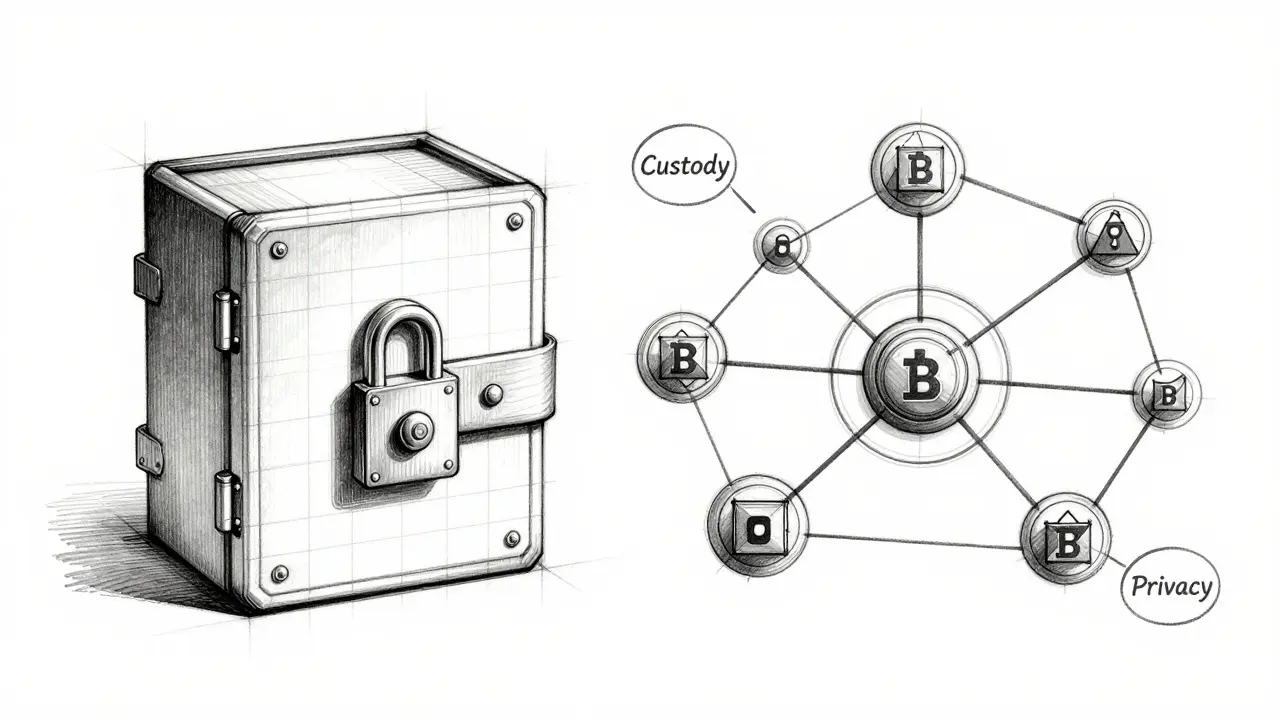
| Control of Funds | Exchange holds custody | User holds custody (Non-custodial) |
| Privacy Level | Low (Linked to real identity) | High (Pseudonymous) |
| Fiat Support | Direct bank transfers, cards | Requires third-party bridges |
| Regulatory Risk | Low (Compliant entities) | Medium (Regulators targeting interfaces) |
Centralized exchanges like Coinbase, Binance, or Kraken are fully compliant. In 2025, 92% of centralized crypto exchanges globally were fully KYC compliant. You cannot bypass this if you want to use their banking integrations.
Decentralized Finance (DeFi) platforms, accessed via wallets like MetaMask, traditionally required zero KYC. However, the tide is turning. As of 2025, 41% of DeFi platforms now offer optional KYC processes, up from 25% in 2024. Some protocols are beginning to integrate "proof-of-personhood" solutions to allow governance voting without revealing full identities, while others are partnering with identity providers to satisfy regulators. Pure anonymity is becoming harder to maintain at scale, especially as regulators push for the implementation of the "Travel Rule," which requires sharing sender/receiver data between platforms for large transactions.

Tiered Accounts: A Middle Ground?
Some exchanges try to balance accessibility with compliance by offering tiered accounts. In this model, you can open a basic account with minimal info-perhaps just an email and phone number-but your withdrawal limits are capped low (e.g., $1,000 per month). To increase your limit, you must complete full KYC.
This approach works for casual traders who only want to dabble. However, be aware that even "non-KYC" tiers on centralized platforms often collect metadata (IP addresses, device fingerprints) that can be subpoenaed. True privacy usually requires moving off-platform to non-custodial wallets and decentralized swaps, accepting the trade-off of slightly higher technical complexity.
Common Pitfalls During Verification
Even with fast AI processing, users still get rejected. Here is how to avoid the most common errors:
- Glare and Shadows: Never photograph your ID under direct sunlight or with a flash that creates glare on the plastic surface. Use natural, diffuse indoor lighting.
- Cropped Edges: Ensure all four corners of your ID are visible in the frame. AI scanners need the full border to verify authenticity.
- Name Mismatches: The name on your crypto exchange account must match the name on your ID and your bank account exactly. Nicknames cause automatic rejections.
- Expired Documents: Double-check expiration dates. An ID expired by even one day will fail automated checks.
The Future: Privacy-Preserving KYC
The tension between regulation and privacy won't disappear. Instead, technology is evolving to bridge the gap. We are seeing the rise of Zero-Knowledge Proofs (ZKPs) in identity verification. These cryptographic methods allow you to prove you meet certain criteria (e.g., "I am over 18" or "I am not on a sanctions list") without revealing your actual name, address, or ID number to the exchange.
While not yet universal, ZKP-based KYC is expected to become a standard feature for premium users by late 2026. It promises to give regulators the assurance they need while giving users the privacy they crave. Until then, expect the current model of document uploads and selfies to remain the norm for the vast majority of traders.
Is KYC mandatory for all crypto exchanges?
For centralized exchanges operating in regulated markets like the US, EU, UK, and Canada, yes, KYC is mandatory for fiat transactions and significant crypto withdrawals. Decentralized exchanges (DEXs) generally do not require KYC, though some are introducing optional verification for higher limits or governance rights.
What documents do I need for crypto KYC?
You typically need a government-issued photo ID (passport, driver's license, or national ID) and proof of address (utility bill or bank statement dated within the last 3 months). Some exchanges may also request a selfie video for liveness detection.
How long does KYC verification take?
As of 2026, the average verification time on major exchanges is about 3.5 minutes due to AI automation. However, complex cases or manual reviews can take 24 to 48 hours.
Can I trade crypto without KYC?
Yes, but with limitations. You can use decentralized exchanges (DEXs) like Uniswap or PancakeSwap without KYC. However, converting fiat currency (USD, EUR) to crypto usually requires a centralized broker or P2P platform, which will likely enforce KYC.
Why do exchanges require KYC?
Exchanges require KYC to comply with Anti-Money Laundering (AML) laws set by bodies like the FATF. It also helps prevent fraud, protects user accounts from hacking, and allows exchanges to partner with traditional banks.
Is my personal data safe during KYC?
Reputable exchanges use encryption and secure storage for your documents. However, storing sensitive data always carries some risk. Choose established, regulated platforms with strong security reputations to minimize exposure.