
When you need to swap crypto instantly without waiting for order books to fill or deposits to clear, Kyber Network stands out. Unlike centralized exchanges like Binance or Coinbase, Kyber doesn’t hold your funds. It doesn’t even use an order book. Instead, it connects you directly to liquidity pools on the Ethereum blockchain - all in one transaction. This isn’t just a technical detail. For merchants, developers, and anyone who needs guaranteed settlement, it’s the whole point.
How Kyber Network Works
Kyber Network is a decentralized liquidity protocol. It doesn’t act like a traditional exchange. Instead, it aggregates liquidity from professional market makers, decentralized exchanges, and individual liquidity pools. When you swap tokens, Kyber finds the best rate across all these sources and executes the trade in a single on-chain transaction. No wrapping. No multi-step approvals. Just swap and go.
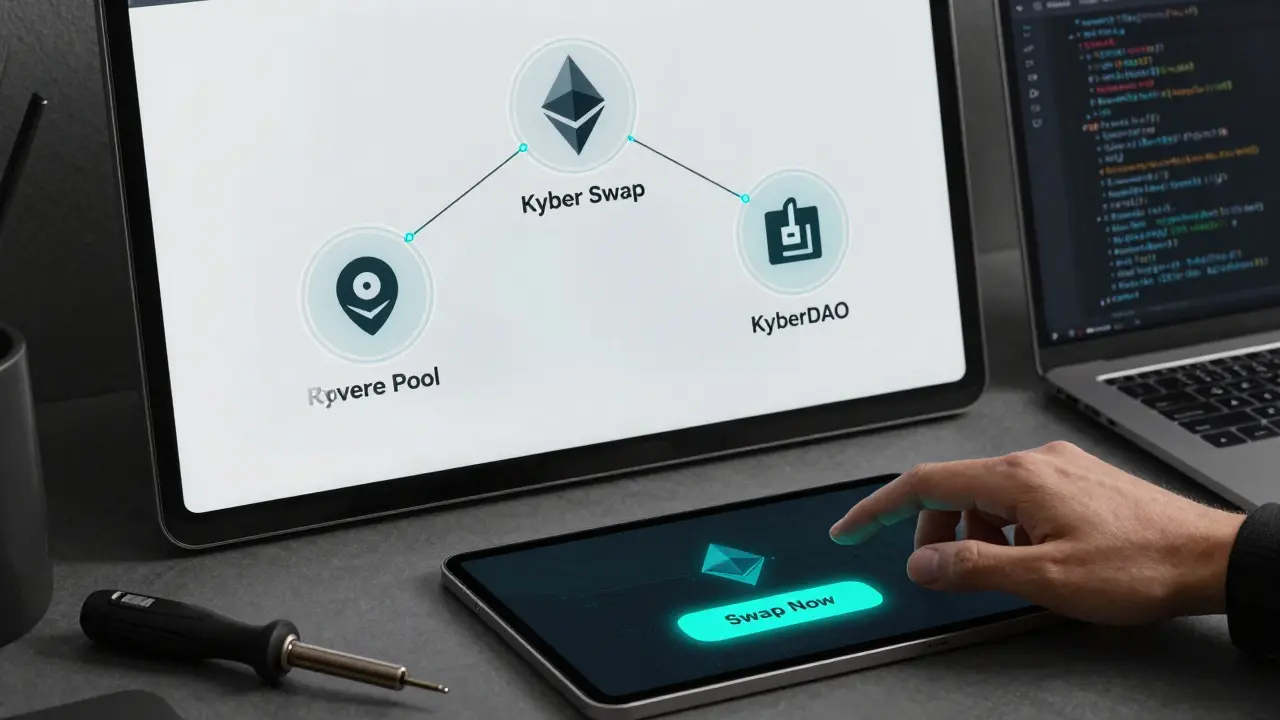
The system runs on three core parts: Kyber Swap (the user interface), Kyber Reserve (the liquidity sources), and KyberDAO (the governance engine). The Reserve system is what makes Kyber different. Third-party entities - not just random users - contribute tokens to specific pools. These aren’t just random liquidity pools like on Uniswap. These are managed by professionals who monitor prices, adjust spreads, and ensure tight rates. That’s why Kyber’s swaps are often more stable during market swings.
All trades happen on-chain. That means every swap is visible, verifiable, and final. There’s no intermediary that can delay, reverse, or freeze your transaction. If you’re running an e-commerce store and a customer pays in DAI, you get ETH or USDC in return - instantly. No waiting for confirmations. No risk of chargebacks. That’s why over 1,800 merchant platforms integrated Kyber by late 2025.
What Makes Kyber Different
Compared to Uniswap or SushiSwap, Kyber doesn’t rely on automated market makers (AMMs) that require users to provide liquidity in pairs. Instead, Kyber pulls liquidity from any source - even other DEXs - and gives you one clean price. This matters because:
- You don’t need to hold both tokens in a pair. Swap USDT to LINK? Done.
- Slippage is lower because liquidity is aggregated from multiple sources.
- There’s no impermanent loss risk for users - only for liquidity providers.
The protocol’s Katalyst upgrade in 2020 gave KNC token holders control over fee structures and revenue distribution. Now, liquidity providers can earn a share of trading fees, and governance votes decide how those fees are split. This turned KNC from a utility token into a real governance asset.
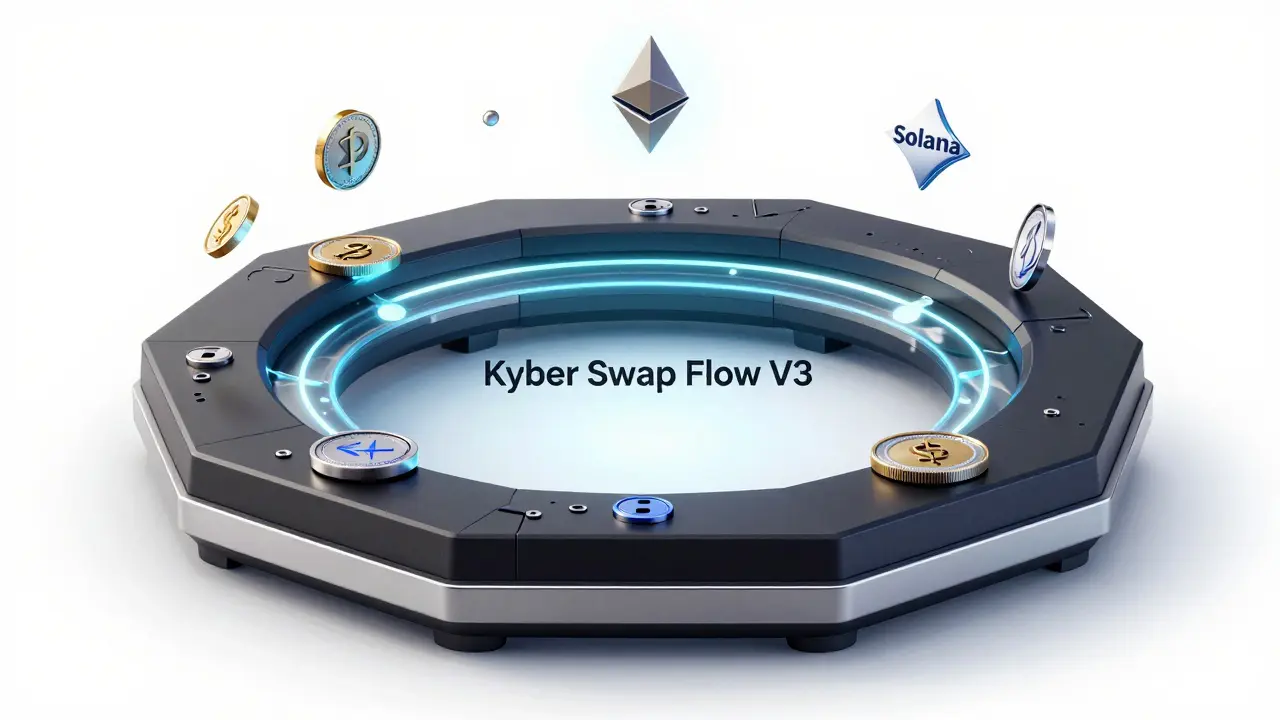
And in December 2025, Kyber rolled out Swap Flow V3. This update cut average swap time from 15.2 seconds to 8.7 seconds and reduced slippage by 37% during high volatility. That’s not a minor tweak. It’s a game-changer for real-time payments.
Who Kyber Is For - And Who It’s Not
Kyber isn’t built for day traders. You won’t find advanced charting tools, limit orders, stop-losses, or margin trading. There’s no mobile app with push notifications. No portfolio tracker. No complex order types. If you’re looking for a trading platform, look elsewhere.
Kyber is built for:
- Merchants who want to accept any ERC-20 token and get paid in stablecoins.
- Developers integrating crypto payments into apps, wallets, or dApps.
- DeFi users who need fast, low-slippage swaps without leaving their wallet.
One merchant on Reddit said they processed $250,000 in crypto payments in Q3 2025 with zero failed transactions. That’s not luck. That’s Kyber’s reliability in action.
But if you’re a retail investor trying to time the market, Kyber’s interface will feel barebones. It’s just a swap box. No charts. No news. No community features. It’s designed to do one thing - swap tokens - and do it fast.
Fees and Costs
Kyber’s fee structure is simple: 0.10% on successful limit orders. But here’s the catch - some reports say it’s 0%. That’s because Kyber doesn’t charge users directly. Instead, liquidity providers earn a portion of the fee. The protocol takes a flat cut, and the rest goes to those supplying liquidity.
No hidden fees. No withdrawal fees. You only pay Ethereum network gas costs. That’s competitive. On Uniswap, you pay gas plus potential slippage costs. On Kyber, slippage is minimized, and gas is your only variable.
For merchants, this means predictable costs. You know exactly how much you’ll lose per transaction. No surprises.
Security and Trust
Kyber is non-custodial. Your tokens never leave your wallet. All trades are executed via smart contracts audited by multiple third parties. The protocol has been live since 2018 with no major exploits.
All reserve manager actions are recorded on-chain. You can verify every trade. No black boxes. No opaque liquidity pools. If a reserve provider starts offering bad rates, the community can vote to remove them.
That said, Kyber doesn’t protect you from market risk. If ETH drops 20% while you’re swapping, you’ll feel it. That’s not Kyber’s fault - that’s crypto.
Integration and Developer Experience
Integrating Kyber into a dApp or payment system requires solid Ethereum knowledge. The documentation is thorough but not beginner-friendly. Developers report average integration times of 3-5 business days. Common challenges include gas optimization during Ethereum congestion and setting correct slippage tolerance.
But the payoff is real. One developer on Reddit said they saved $12,000 in unfavorable swaps during the October 2025 market crash by using Kyber’s rate monitoring tools. That’s not theoretical. That’s real money saved.
The support team responds to GitHub issues within 48 hours in 95% of cases. The community forum has over 1,200 active members. It’s not a massive ecosystem, but it’s reliable.
Market Position and Growth
As of December 2025, Kyber Network’s market cap sits at $53.4 million, with 170 million KNC tokens in circulation. That’s tiny compared to Uniswap’s $3.2 billion. But Kyber isn’t trying to be the biggest. It’s trying to be the most reliable for payments.
Transaction volume hit $1.24 billion in Q4 2025. That’s 2.3% year-over-year growth - modest, but steady. Meanwhile, Uniswap did $47.8 billion. The gap is huge, but the context matters: Kyber doesn’t compete on trading volume. It competes on settlement speed.
Its adoption in merchant payments is growing fast. 1,842 e-commerce platforms now use Kyber - up from 1,207 in 2024. That’s a 53% increase in one year.
What’s Next: Cross-Chain and 2026 Roadmap
Kyber’s biggest limitation today? It’s Ethereum-only. That’s changing. In Q2 2026, Kyber plans to launch cross-chain support, starting with Polkadot. By the end of 2026, they aim to support seven additional blockchains.
This is critical. If Kyber becomes the go-to liquidity layer across chains, its value could explode. Right now, it’s a single-chain solution. In 2026, it could become the plumbing behind decentralized payments everywhere.
Pros and Cons Summary
| Pros | Cons |
|---|---|
| Instant, one-click swaps on-chain | No advanced trading tools |
| Low slippage due to aggregated liquidity | Interface is barebones - not user-friendly for beginners |
| 0% direct fees - only pay gas | Only supports Ethereum and ERC-20 tokens |
| Proven reliability for merchant payments | Small community compared to Uniswap or SushiSwap |
| On-chain transparency and non-custodial | Requires technical knowledge to integrate |
Final Verdict
Kyber Network isn’t for everyone. If you’re a casual crypto holder who just wants to swap ETH for DAI, use MetaMask’s built-in swap or a simple DEX like 1inch. Kyber won’t feel worth the effort.
But if you’re a merchant, a developer, or a DeFi builder who needs fast, trustless, and reliable token swaps - Kyber is one of the best tools available. It’s not flashy. It’s not trendy. But it works. And in crypto, that’s more valuable than hype.
The real test? In 2026, when cross-chain support goes live. If Kyber can deliver seamless swaps across Ethereum, Polkadot, Solana, and others - it won’t just be a liquidity protocol. It’ll become the backbone of decentralized payments.
Is Kyber Network a centralized exchange?
No. Kyber Network is a decentralized protocol. It doesn’t hold your funds, doesn’t require KYC, and doesn’t control your wallet. All swaps happen directly on the Ethereum blockchain using smart contracts. You keep full control of your assets at all times.
Can I use Kyber Network on mobile?
Kyber doesn’t have a standalone mobile app. But you can access it through any Ethereum-compatible wallet that supports DApp browsing - like MetaMask, Rabby, or Trust Wallet. Just open the Kyber Swap interface in your wallet’s browser.
What tokens can I swap on Kyber?
Kyber supports all ERC-20 tokens on Ethereum. This includes major coins like USDT, DAI, LINK, UNI, and hundreds of others. It does not support non-Ethereum tokens like SOL, ADA, or BTC unless they’re wrapped. Cross-chain support is coming in 2026.
How does Kyber compare to Uniswap?
Uniswap uses automated market makers (AMMs) that require liquidity pools in token pairs. Kyber aggregates liquidity from multiple sources - including Uniswap - and gives you one optimized rate. Kyber’s swaps are faster and have lower slippage, especially for large trades. But Uniswap has more tokens, deeper liquidity, and better UI for traders. Kyber wins for payments; Uniswap wins for trading.
Is Kyber Network safe?
Yes, Kyber is one of the most secure DeFi protocols. It’s been live since 2018 with no major exploits. All transactions are on-chain, and liquidity providers are transparently managed. However, like all DeFi, you’re exposed to smart contract risk and market volatility. Always double-check token addresses and slippage settings.
What’s the future of KNC token?
KNC is the governance token of Kyber Network. Holders vote on fee structures, reserve approvals, and protocol upgrades. Its value is tied to adoption. With cross-chain expansion planned for 2026, KNC could see increased demand if Kyber becomes the standard for decentralized payments. But it’s not a speculative asset - it’s a utility token.


