
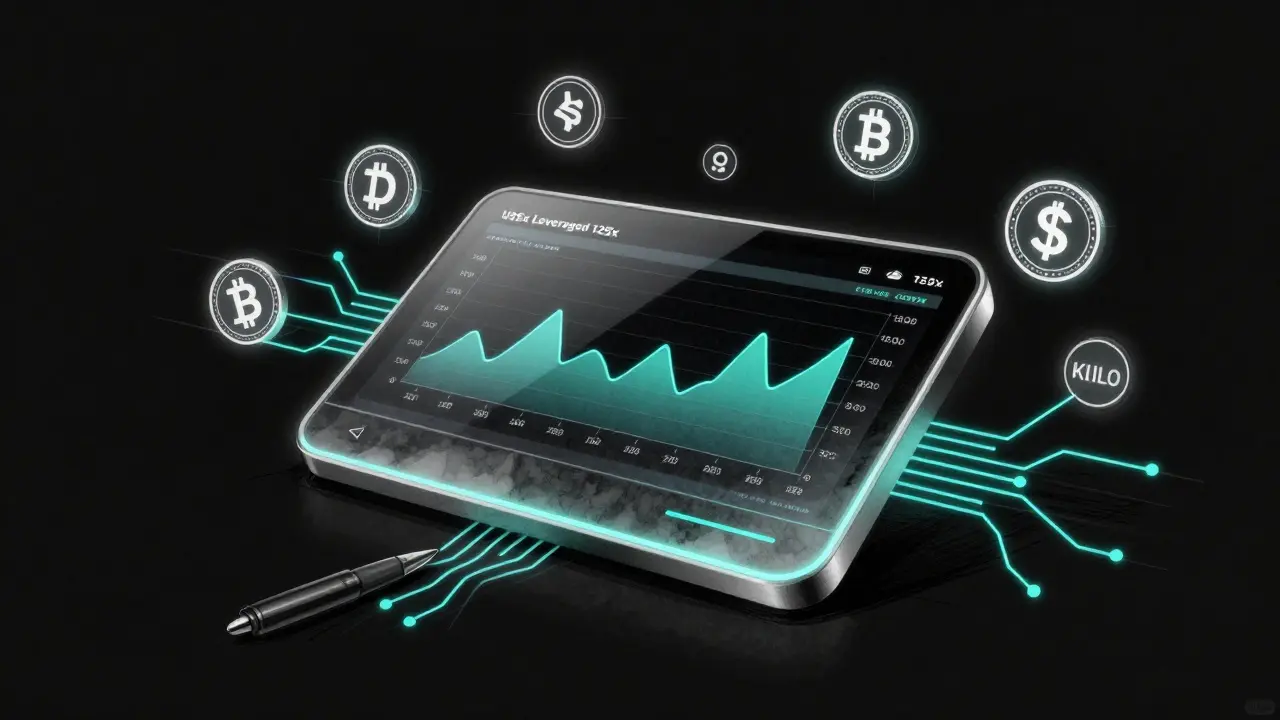
KiloEx Leverage Calculator
Calculate Your Position
Results
High risk warning: KiloEx allows up to 125x leverage. This can lead to rapid liquidation during price volatility.
Remember: 27% of new traders open positions too large and get liquidated in minor price swings.
When you're trading crypto derivatives, control over your funds isn't just nice to have-it's everything. That’s where KiloEx steps in. Unlike centralized exchanges that hold your assets, KiloEx lets you trade perpetual contracts with up to 125x leverage while keeping your crypto in your own wallet. No deposits. No withdrawals. No custodial risk. Sounds ideal? Maybe. But there’s a catch.
What Is KiloEx Exactly?
KiloEx is a decentralized perpetual contracts exchange built for traders who want CEX-like speed with DEX-level security. Launched in August 2023, it’s backed by Binance Labs and funded by YZi Labs and Manta Network. It doesn’t use order books. Instead, it uses a liquidity pool model where trades happen directly against a pool of USDT and USDC. That’s what lets it offer near-zero slippage-even on 125x leveraged BTC trades.
It’s not just on one chain. KiloEx runs on opBNB, BSC, Manta Network, and Taiko. As of late 2024, it held around $40 million in Total Value Locked (TVL), making it the top derivatives protocol on opBNB. Since launch, users have traded over $34 billion across its networks. Daily volume regularly hits $100-200 million.
How KiloEx Works: The Hybrid Vault System
The core of KiloEx is its Hybrid Vault system. Liquidity providers (LPs) deposit USDT or USDC into vaults. These funds back all trades. Traders don’t interact with other traders-they trade against the pool. That means no matching engine, no order book delays, no front-running.
For LPs, the reward is attractive: up to 30% of trading fees plus a 5.67% APY within 30 days. That’s higher and more predictable than GMX’s GLP pool, which averages 15-20% APY but with wild volatility. But here’s the trade-off: if the oracle feeding price data gets manipulated, the vaults get drained. That’s exactly what happened in July 2025, when a $7.5 million exploit wiped out a portion of LP deposits.
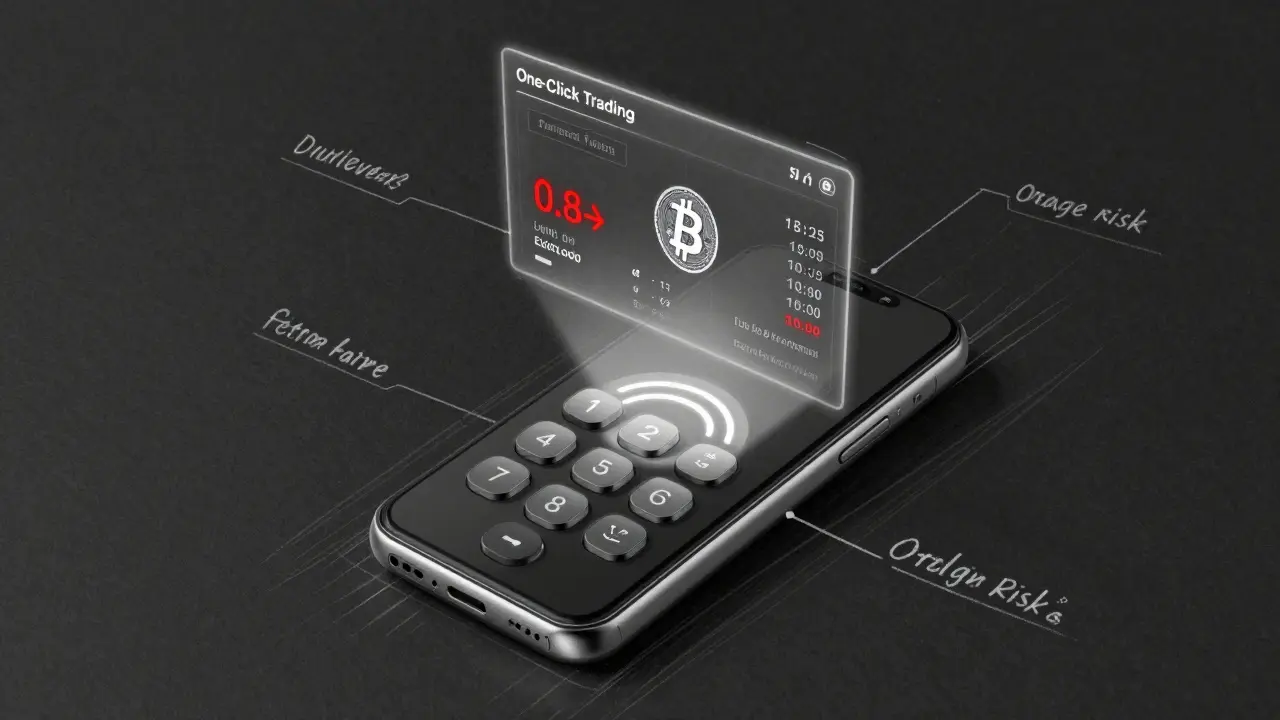
For traders, the standout feature is One-Click Trading (1CT). You deposit $5 worth of BNB once as a gas fee, then trade across any device using just a PIN. No wallet signing every time. No MetaMask pop-ups mid-trade. During a flash crash in October 2024, one user on Telegram reported executing a 125x BTC long in 0.8 seconds-saving $3,200 in slippage compared to GMX.
Why KiloEx Beats GMX and dYdX (And Where It Falls Short)
Compared to GMX, KiloEx offers more leverage (125x vs. 50x), more chains (7+ vs. 2), and better execution speed. Unlike dYdX, which still uses centralized order matching for some functions, KiloEx is fully on-chain. Every trade, every liquidation, every funding rate adjustment happens on the blockchain. Your assets never leave your wallet.
But KiloEx isn’t flawless. Its multi-chain approach creates fragmentation. If you’re on Manta Network, you can’t easily move liquidity to opBNB. dYdX’s single-chain focus makes it simpler for beginners. Also, KiloEx’s user base is shrinking in number-even as volume stays high. Xangle Research found that 80% of trading activity comes from just 5% of users: whale accounts with over $1 million in positions. New traders are leaving because the funding rates turn against them in low-volatility markets.
And then there’s the security issue. The $7.5 million oracle exploit in July 2025 shook confidence. While KiloEx responded with a $3.5 million compensation fund and is integrating Chainlink’s CCIP for cross-chain oracle security, trust takes longer to rebuild than money to lose.

Who Should Use KiloEx?
KiloEx isn’t for beginners. It’s for experienced traders who:
- Understand how funding rates work (they’re adjusted every 8 hours)
- Know how to size positions with 125x leverage without blowing up
- Prefer full custody over convenience
- Trade during high-volatility events-like Bitcoin halvings or major macro news
- Are comfortable with multi-chain complexity
If you’re looking to casually trade ETH with 10x leverage and sleep well at night, stick with a regulated CEX. If you’re a high-frequency, high-leverage trader who hates slippage and trusts blockchain over institutions, KiloEx might be your best tool.
Getting Started: Onboarding and Learning Curve
Setting up KiloEx takes about 2-3 hours for most users. Here’s the flow:
- Connect a Web3 wallet (MetaMask, Trust Wallet, or OKX Wallet)
- Complete a 5-minute risk education module (mandatory)
- Deposit USDT or USDC into a Hybrid Vault (you choose which chain)
- Deposit $5 in BNB for gas (one-time, for One-Click Trading)
- Start trading
The interface is clean. You pick your asset (BTC, ETH, meme coins, even forex pairs), set your leverage (5x to 125x), and click “Open Position.” No confusing charts. No order types to learn. Just price, size, and leverage.
Most new users struggle with two things: understanding funding rates and position sizing. Thirty-two percent of new traders don’t realize that long positions pay short positions when funding is positive-and vice versa. Twenty-seven percent open positions too large and get liquidated in minor price swings. YouTube tutorials by CryptoWithChris and DeFi Explained have over 140,000 combined views for a reason.
The $KILO Token and Tokenomics
KiloEx has two tokens: $KILO (utility) and $xKILO (staked, escrowed). $KILO is used for fee discounts and governance. $xKILO gives you a share of protocol revenue-40% of all trading fees go to stakers. The token’s price has been volatile, with CoinLore predicting $0.1000 by end of 2025 (a 614% jump from current levels). But token price doesn’t reflect protocol health. The real value is in the trading volume and LP yields.
Don’t buy $KILO hoping to get rich. Buy it if you’re already trading on KiloEx and want to reduce fees. Staking $xKILO makes sense only if you’re already providing liquidity. Don’t stake to speculate.
What’s Next for KiloEx?
In September 2025, KiloEx launched a beta Spot DEX, letting users buy and sell assets directly-no leverage. That’s a big move beyond perpetuals. They’re also building institutional-grade APIs and planning to expand to 15 more blockchains. Real World Asset (RWA) perpetuals are on the roadmap, meaning you could soon trade leveraged contracts on gold, stocks, or bonds-all on-chain.
Their recovery plan after the oracle exploit is solid: compensation fund, Chainlink integration, and improved monitoring. But execution matters more than announcements. If they deliver, KiloEx could become the backbone of on-chain derivatives. If they don’t, they’ll join the graveyard of once-promising DeFi protocols.
Final Verdict: High Reward, High Risk
KiloEx is one of the most technically advanced decentralized exchanges for derivatives. It solves real problems: slippage, custody, and slow execution. Its Hybrid Vault system and One-Click Trading are genuinely innovative.
But it’s not safe. The $7.5 million exploit wasn’t a glitch-it was a design flaw in oracle reliance. The whale-dominated user base suggests it’s not built for mass adoption. And the funding rate structure punishes long-term holders in calm markets.
If you’re an experienced trader with a high risk tolerance, KiloEx is worth trying. Start small. Use only what you can afford to lose. Monitor funding rates. Watch for oracle updates. And never assume “decentralized” means “secure.”
For everyone else? Wait. Let the protocol prove it can stay secure, attract real users, and deliver on its roadmap. Then come back.
Is KiloEx safe to use?
KiloEx is technically decentralized-your funds stay in your wallet-but it’s not risk-free. In July 2025, a $7.5 million exploit occurred due to oracle manipulation. The protocol has since added Chainlink’s CCIP for better price feeds and launched a $3.5 million compensation fund. Still, the exploit exposed a critical vulnerability. Only use KiloEx if you understand the risks and can afford to lose your capital.
Can I lose more than I deposit on KiloEx?
No. KiloEx has a liquidation system that closes your position before your balance goes negative. However, if you’re a liquidity provider (LP) in the Hybrid Vault and the oracle is manipulated, you can lose part of your deposited USDT or USDC. Traders can’t lose more than their margin, but LPs can.
What’s the difference between KiloEx and GMX?
KiloEx offers higher leverage (125x vs. 50x), more chains (7+ vs. 2), and faster execution via One-Click Trading. GMX is simpler and more established, with better long-term LP returns in stable markets. KiloEx excels in volatile conditions; GMX is more reliable during calm periods. KiloEx also has a higher TVL on opBNB, but GMX has broader adoption across Arbitrum and Avalanche.
Do I need to know how to use MetaMask to trade on KiloEx?
Yes, for setup. You need a Web3 wallet like MetaMask, Trust Wallet, or OKX Wallet to connect and deposit funds. But after that, KiloEx’s One-Click Trading lets you trade using just a PIN-no repeated wallet approvals. So once you’re in, you don’t need to be a Web3 expert to execute trades.
Is KiloEx available on mobile?
Yes. KiloEx works on mobile browsers and has a dedicated Telegram interface with 1.1 million active users. You can connect your wallet via mobile MetaMask or Trust Wallet, then trade through the browser or Telegram bot. The One-Click Trading feature is optimized for mobile use.
What assets can I trade on KiloEx?
You can trade perpetual contracts on over 70 assets: Bitcoin, Ethereum, major DeFi tokens, meme coins like DOGE and SHIB, AI-themed tokens, and even forex pairs like EUR/USD and USD/JPY. All trades are settled in USDT or USDC. Spot trading for these assets is now in beta.
How do funding rates work on KiloEx?
Funding rates are adjusted every 8 hours to keep the perpetual contract price close to the underlying asset’s spot price. If longs pay shorts, the rate is positive. If shorts pay longs, it’s negative. High leverage makes funding rates more volatile. In low-volatility markets, long positions often pay large funding fees, making them costly to hold overnight.
Can I withdraw my liquidity from the Hybrid Vault anytime?
Yes, you can withdraw your USDT or USDC from the Hybrid Vault at any time. However, there’s a 24-hour delay to prevent mass withdrawals during market stress. Also, if the oracle has been compromised (like in July 2025), your withdrawal may be partially or fully frozen until the protocol recovers.


