
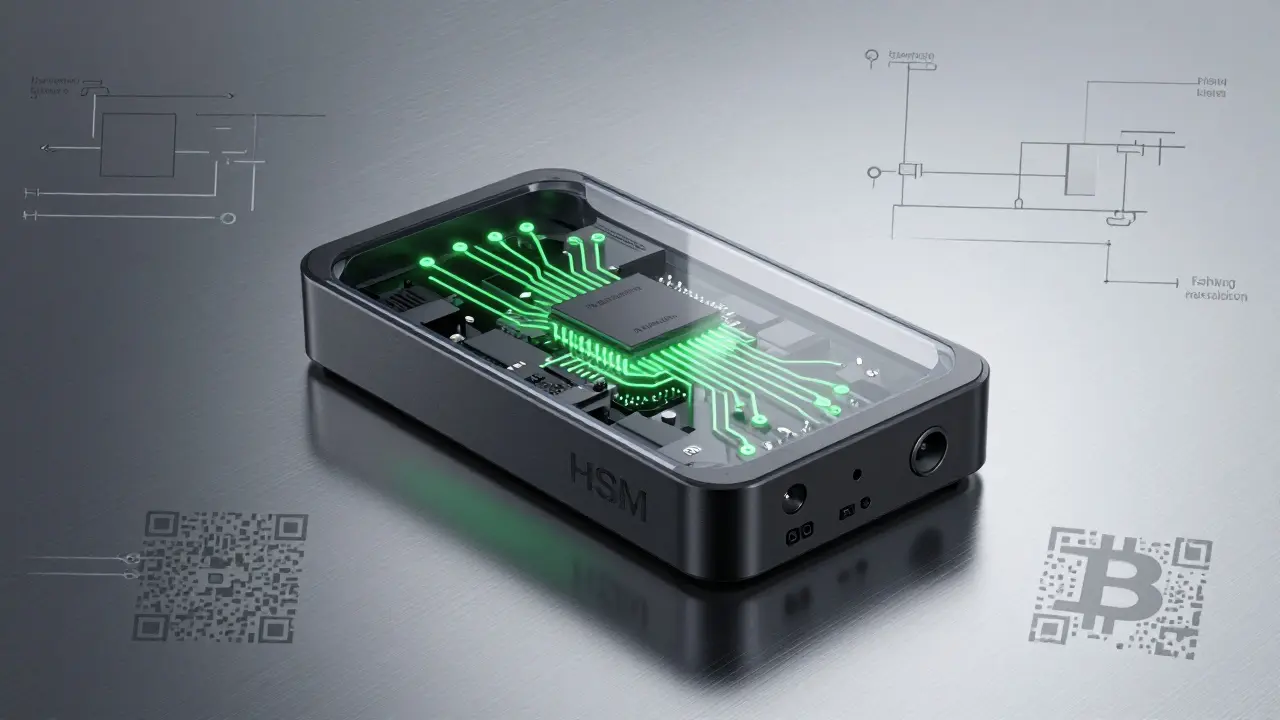
When you hold cryptocurrency, you don’t actually own coins in a wallet like cash in your pocket. You own a private key - a long string of numbers and letters that proves you control your funds. Lose that key, and your money is gone forever. Hack a server storing that key, and someone else can steal it. That’s why hardware security modules (HSMs) aren’t just useful for banks - they’re the only real defense against mass crypto theft.
Keys That Never Leave the Hardware
Most people think of crypto security as password strength or two-factor authentication. But those are software protections. Software can be hacked. Malware can log keystrokes. A compromised server can leak everything. HSMs change the game because they keep private keys locked inside a physical device - never exposed to the network, never sent over the internet, never stored on a hard drive.
Think of an HSM like a digital safe with built-in alarms. It’s a tamper-resistant box, often certified to FIPS 140-3 standards, that generates, stores, and uses cryptographic keys entirely inside its own hardened environment. Even if a hacker breaks into your server, they can’t get the key. The HSM doesn’t hand it over. It only performs operations - like signing a transaction - and returns the result. The key stays put. This is why exchanges like Coinbase and institutional investors like Grayscale use HSMs. It’s not a luxury. It’s the baseline.
How HSMs Generate Unbreakable Keys
Not all randomness is equal. Software tries to create random numbers using system timers or mouse movements. Attackers can predict those patterns. HSMs use physical noise - thermal fluctuations, electronic jitter, even quantum-level randomness - to generate truly unpredictable keys. This is called hardware entropy, and it’s the foundation of real cryptographic security.
When you create a Bitcoin address using an HSM, the private key isn’t generated on your laptop. It’s born inside the module. No copy is saved. No backup exists outside the device. Even if you try to export it, the HSM will refuse. The only way to move funds is to sign the transaction inside the HSM, then send the signed data out. That signed data can’t be reused. It’s useless without the original key, which is still locked away.
Performance That Actually Helps
Some assume HSMs are slow because they’re hardware. That’s backwards. HSMs are built for speed. They offload encryption, signing, and decryption tasks from your main servers. A single high-end HSM can handle tens of thousands of digital signatures per second. That’s critical for crypto exchanges, DeFi protocols, and wallet providers that process thousands of transactions every minute.
Without an HSM, your server has to run cryptographic operations using CPU cycles meant for other tasks. That slows everything down. With an HSM, your server focuses on user interfaces and APIs. The HSM handles the heavy lifting. You get faster transactions, lower latency, and better uptime. It’s not just security - it’s efficiency.
Compliance Isn’t Optional
Regulators don’t just recommend HSMs - they require them. The PCI DSS standard demands hardware-based key protection for any business handling payment data. The same logic applies to crypto. If you’re managing funds for others, auditors will ask: Where are the keys stored? If you say "on a cloud server," you fail. If you say "inside a FIPS-certified HSM," you pass.
Even governments are moving this way. The U.S. Treasury, the European Central Bank, and New Zealand’s Reserve Bank all use HSMs to secure digital assets. Why? Because software-only key storage has been breached too many times. The 2022 Poly Network hack lost $600 million. The 2024 Binance breach exposed 100,000 private keys - all because they weren’t stored in hardware. HSMs prevent those mistakes.
What HSMs Can’t Fix
HSMs aren’t magic. They don’t stop phishing. They don’t prevent insider theft if someone has physical access. They don’t protect you from sending funds to the wrong address. They only protect the key. That’s still the biggest win.
One real downside is cost. A single enterprise HSM can run $5,000 to $20,000. Updates aren’t as simple as installing a patch. If a new attack method emerges - like a quantum computing breakthrough - you might need to replace the entire unit. But that’s still cheaper than losing millions.
Another issue is transparency. Most HSM vendors don’t let you open the device or audit their random number generators. You have to trust their certifications. That’s why reputable providers like Thales, Entrust, and YubiKey are preferred. They’ve been tested by independent labs for years.
Why Software Wallets Still Lose
Mobile wallets, desktop wallets, browser extensions - they all store keys in software. That means they’re vulnerable to malware, OS exploits, and memory scraping. In 2025, over 70% of crypto thefts came from software wallets, according to Chainalysis. Not because users were careless. Because software can’t compete with hardware.
HSMs remove the attack surface. No exposed key. No memory dump. No API endpoint to exploit. Just a sealed box that says "no" to every attempt to steal the key. That’s why the biggest players in crypto - from institutional custodians to decentralized governance protocols - all use HSMs. It’s not hype. It’s math.
Real-World Use Cases
- A crypto exchange uses an HSM cluster to sign withdrawal requests. Every transaction requires dual approval, and the signing happens only inside the HSM.
- A DeFi protocol uses HSMs to sign smart contract upgrades. Without it, a hacker could forge a signature and take over the protocol.
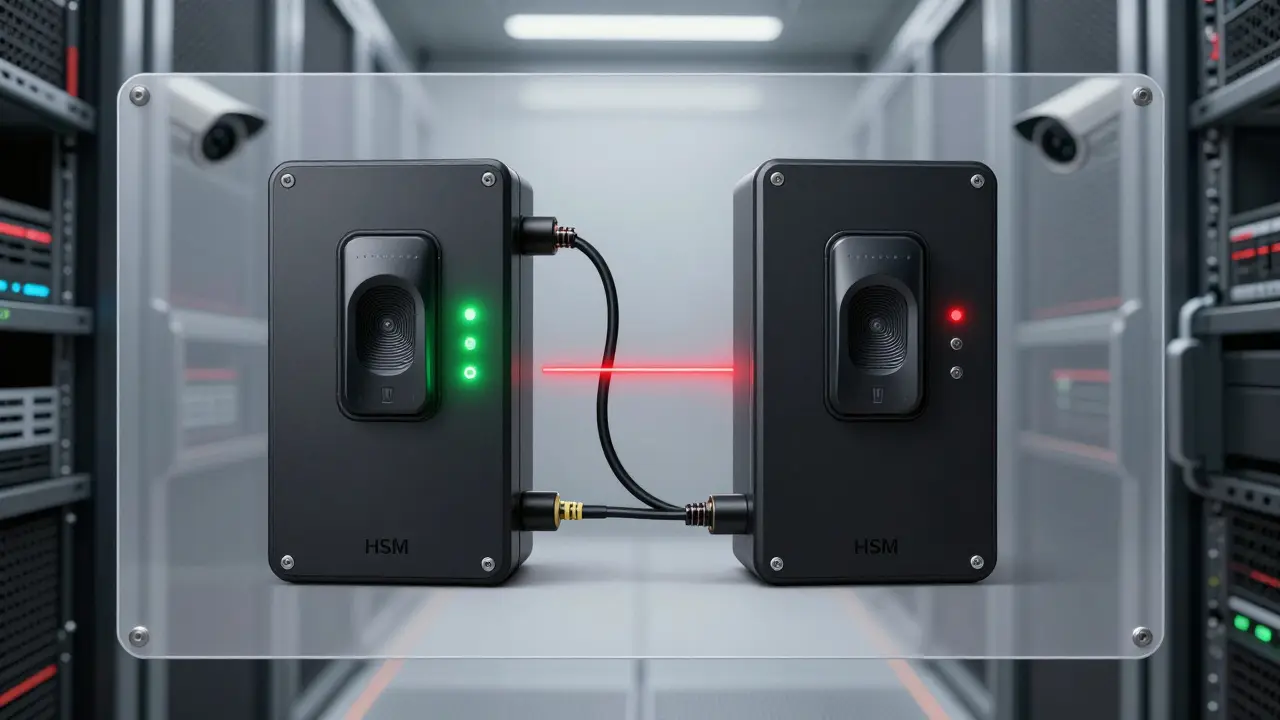
- A family office holding $50M in Bitcoin stores keys in two geographically separated HSMs. One is offline. The other is air-gapped. Both require physical access and biometric authentication.
- A blockchain validator node uses an HSM to sign blocks. If the node is compromised, the attacker can’t forge a new block because the private key never left the HSM.
These aren’t theoretical setups. They’re standard practice. And they work.
The Bottom Line
If you’re serious about crypto security, you don’t need a fancy wallet app. You don’t need a mnemonic phrase written on paper. You need hardware that keeps your keys locked away from every possible digital attack. That’s what an HSM does. It’s not the only tool - but it’s the one that makes everything else possible.
Software keeps failing. Hardware doesn’t. That’s why HSMs are the gold standard - and why they’ll stay that way for as long as crypto exists.
Can I use an HSM for personal crypto holdings?
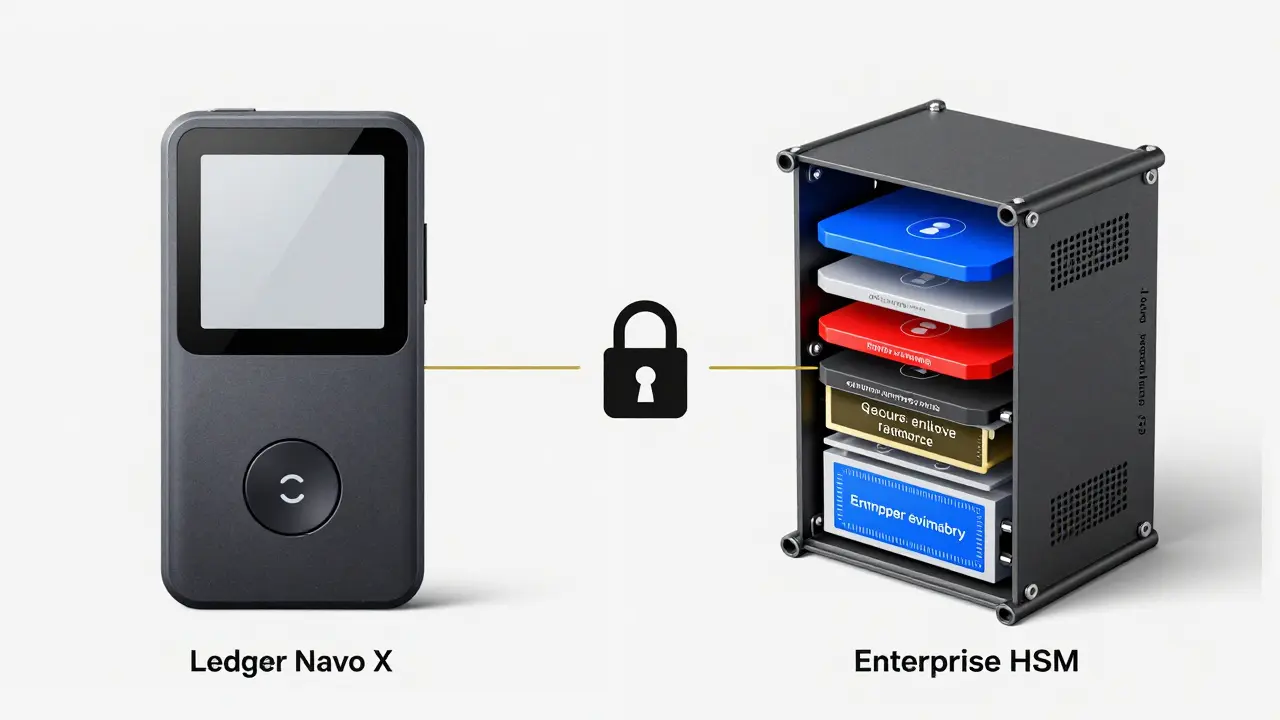
Yes - but not in the way most people think. Consumer-grade HSMs like YubiKey or Ledger’s hardware wallets use similar principles. They’re not enterprise HSMs, but they still keep keys isolated from your phone or computer. For personal use, a Ledger Nano X or Trezor Model T is the closest you can get to an HSM without spending $10,000. They’re not perfect, but they’re far safer than software wallets.
Are HSMs immune to quantum computing attacks?
No - but they’re future-proofed better than software. HSMs can be updated with new cryptographic algorithms. Many modern HSMs already support post-quantum key exchange protocols like CRYSTALS-Kyber. The hardware itself doesn’t change, but the firmware does. Software wallets can’t update as easily. HSMs give you a path to upgrade without replacing your entire infrastructure.
Do I need multiple HSMs for redundancy?
For institutional use, absolutely. Single points of failure are dangerous. Best practice is to use at least two HSMs in different locations, with one kept offline. Transactions require signatures from both. If one fails, the other still works. This is called multi-party computation (MPC), and it’s how major custodians avoid total loss.
Can I build my own HSM?
Technically, yes - but you shouldn’t. Building a true HSM requires certified tamper detection, secure boot, and hardware-based random number generation. Even companies like Google and Amazon buy HSMs instead of building them. The risk of a flaw in your own design is too high. Stick with certified vendors.
What’s the difference between an HSM and a hardware wallet?
Hardware wallets are simplified HSMs. Both store keys in hardware. But enterprise HSMs support advanced features: key rotation, certificate management, multi-user access controls, audit logs, and integration with enterprise systems. Hardware wallets are for individuals. HSMs are for institutions. The security principle is the same - but the scale and control are very different.


