

When you open an audit report, it might look like a dense wall of legal jargon. But if you know what to look for, it’s one of the clearest signals you’ll ever get about a company’s financial health. This isn’t just for accountants. If you’re investing in a blockchain startup, evaluating a crypto exchange, or even considering a partnership with a Web3 company, audit report interpretation can save you from costly mistakes. Most people skip past the report, assuming it’s just a formality. That’s a mistake. In 2023, nearly 20% of financial fraud cases involved audit reports that were ignored - not because they were hidden, but because no one knew how to read them.
What an Audit Report Actually Tells You
An audit report is not a guarantee that everything is perfect. It’s an independent opinion on whether a company’s financial statements are accurate and follow accepted accounting rules. For blockchain companies, this matters more than ever. Crypto firms handle digital assets, smart contracts, and tokenomics - all of which are harder to value than traditional cash or inventory. That’s why auditors have to be extra careful. They don’t just check bank statements. They look at wallet balances, transaction logs, proof of reserves, and whether the company’s accounting matches its actual blockchain activity.
The report starts with a simple question: Did the company present its financial position fairly? The answer comes in one of four forms. These aren’t just labels - they’re red flags or green lights.
The Four Types of Audit Opinions
Over 82% of public companies get an unqualified opinion - also called a "clean" opinion. This means the auditor found no major errors. The financial statements match reality. For a crypto company, this suggests their reserves are real, their revenue is properly recorded, and their accounting follows GAAP or IFRS. It’s the best-case scenario.
But what if the report says "qualified"? That’s the next level. About 12% of audits fall here. A qualified opinion means something went wrong - but only in one area. Maybe the company didn’t properly account for staking rewards. Or their cold wallet balances weren’t independently verified. The rest of the report might be solid. The key? Look at the explanation. A qualified opinion isn’t a disaster. But it’s a warning. If a blockchain firm has a qualified opinion because they can’t prove 10% of their token holdings, that’s a big deal. That’s not a rounding error. That’s potential fraud.
An adverse opinion is rare - only 0.8% of audits - but devastating. It means the financial statements are misleading. The company didn’t just make a mistake. They got it wrong in a way that changes how you see their entire business. If a crypto exchange says it has $2 billion in assets but the auditor says it’s actually $500 million? That’s an adverse opinion. Investors should walk away immediately.
Then there’s the disclaimer of opinion. This happens in about 5% of cases. The auditor didn’t have enough information. Maybe they couldn’t access key wallet keys. Or the company refused to share transaction data. A disclaimer isn’t an accusation. But it’s a red flag. If a company won’t let auditors verify its core assets, why should you trust it?

The 5 C’s: How to Decode Audit Findings
Most audit reports don’t just say "we found an issue." They break it down using what experts call the "5 C’s" framework. If you understand this, you can turn a confusing paragraph into actionable insight.
- Condition: What’s the problem? "The company did not maintain documentation for 15% of its digital asset transfers."
- Criteria: What rule did they break? "According to GAAP, all asset transfers must be supported by immutable blockchain records and signed off by two authorized personnel."
- Cause: Why did it happen? "The internal team used a custom script to batch transactions and failed to log them properly."
- Consequence: What’s the impact? "Without proper logs, it’s impossible to verify if funds were stolen, misused, or double-spent. This creates a material risk to the company’s solvency."
- Corrective Action: What should be fixed? "Implement an automated logging system tied directly to the blockchain, with multi-signature approval for all transfers."
Here’s the truth: most audit reports skip the last two C’s. That’s where the danger lies. If the report says "there’s a problem with documentation" but doesn’t say how much it matters or how to fix it, you’re being left in the dark. According to the PCAOB, 67% of audit deficiencies come from weak consequence and corrective action explanations.
What to Watch For: Hidden Red Flags
There are three sections in every audit report that most people overlook - and they’re the most important.
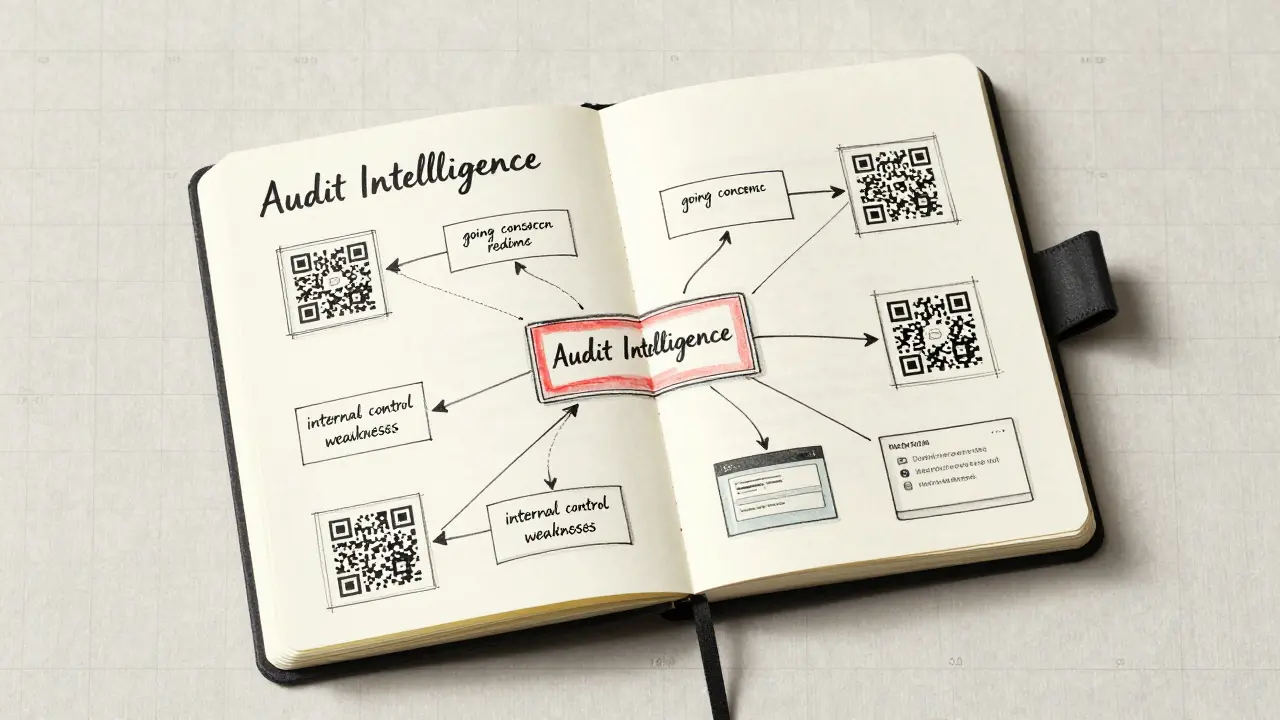
First: Explanatory Paragraphs. These are added when something unusual happened. Maybe the company had a hack. Maybe they changed accounting methods. Or maybe they’re running out of cash. In 2023, 76.5% of audit reports with going concern warnings included this paragraph. If you see "substantial doubt about the entity’s ability to continue as a going concern," that means the auditors think the company might not survive the next year. For a crypto project, that’s a death sentence.
Second: Emphasis of Matter. This is where auditors say, "Hey, this isn’t a problem, but you should know." For example: "The company holds $300 million in Bitcoin, which is subject to extreme price volatility." Sounds harmless? Until you realize that volatility wiped out 60% of its net worth in six months. That’s not just context - it’s a risk you need to price in.
Third: Internal Control Weaknesses. If the report says the company has "significant deficiencies" in its controls, that’s a huge red flag. For blockchain firms, this could mean no multi-sig wallets, no audit trails, or employees with too much access. In 2023, 38% of qualified audits cited internal control failures. That’s not a glitch. It’s a vulnerability waiting to be exploited.
Tools and Trends Making Audit Reports Easier to Read
Thankfully, things are changing. In 2023, only 28% of audit reports used any visual aids. By 2026, Gartner predicts that number will jump to 65%. Think charts showing asset distribution, timelines of transactions, or heat maps of wallet activity. That’s a game-changer.
Also, the PCAOB now requires auditors to highlight "Critical Audit Matters" - the toughest, most judgment-heavy parts of the audit. If a company uses complex DeFi protocols to book revenue, the auditor must explain exactly how they verified it. No more hiding behind vague language.
And then there’s XBRL - digital tagging. By 2026, EU regulations will require all audit reports to be machine-readable. That means software can scan thousands of reports and flag anomalies instantly. Tools like DataSnipper’s Audit Intelligence Platform already analyze 50,000 reports a month, spotting patterns humans miss. One user found a crypto firm that claimed "zero liabilities" - but the digital tags revealed $1.2 billion in unreported debt.
What You Should Do Next
You don’t need to be an accountant to read an audit report. You just need to know where to look.
- Start with the opinion. Is it unqualified? Qualified? Adverse? Disclaimer?
- Scan for explanatory paragraphs. Look for "going concern," "material uncertainty," or "change in accounting policy."
- Check for emphasis of matter. What are they trying to tell you that they don’t want to scare you about?
- Find the internal controls section. Are there weaknesses? What kind?
- Use the 5 C’s to break down any finding. If the report doesn’t include consequence and corrective action, demand more detail.
And if you’re still unsure? Use the AICPA’s free "Audit Report Decoder" tool. Over 250,000 people have used it since 2021. It turns legalese into plain English.
The bottom line: an audit report isn’t a stamp of approval. It’s a conversation. And if you don’t know how to listen, you’re leaving money on the table - or worse, losing it.
What does an unqualified audit opinion mean for a crypto company?
An unqualified opinion means the auditor found no material errors in the financial statements. For a crypto company, this suggests their asset holdings (like Bitcoin or Ethereum) are properly recorded, their revenue is accurately reported, and they follow accounting standards. It’s the strongest signal that the company’s financial reporting is trustworthy. But it doesn’t guarantee the business model is sound - just that the numbers are clean.
Can a company still be legitimate if it has a qualified audit opinion?
Yes, absolutely. A qualified opinion means the auditor found a specific issue - like a lack of documentation for one type of transaction - but the rest of the financials are fine. Many crypto startups get qualified opinions early on because they’re still building internal controls. The key is to read the explanation. If the issue is minor, fixable, and not related to core assets, the company may still be viable. But if it’s about reserves or revenue recognition, take it seriously.
Why do some audit reports mention "going concern"?
"Going concern" means the auditor has serious doubts the company can stay open for the next 12 months. This often appears when a company is burning cash, can’t raise funds, or has large debts due soon. In crypto, this is common after market crashes. If you see this in an audit report, it doesn’t mean the company is dead - but it does mean you should treat any investment or partnership with extreme caution.
Are blockchain audits different from regular financial audits?
Yes. Blockchain audits require specialized knowledge. Auditors must verify on-chain data, understand smart contracts, and assess proof-of-reserves. They can’t just look at bank statements - they need to check wallet addresses, transaction hashes, and whether funds are truly under the company’s control. Many traditional auditors lack this expertise, which is why specialized firms now handle crypto audits. Look for auditors who have experience with DeFi, NFTs, or tokenomics.
How can I tell if an audit report is trustworthy?
Check three things: First, who performed the audit? Reputable firms include Big Four (Deloitte, PwC, EY, KPMG) or specialized crypto auditors like CertiK or Hacken. Second, does the report reference specific standards like GAAS or ISA? Third, does it name the exact financial statements audited? If the report is vague, lacks a signature, or comes from an unknown firm, treat it as unreliable. The SEC requires audits to come from registered firms - if the auditor isn’t registered with the PCAOB or equivalent, the report has no legal weight.


