
Imagine you put money in a savings account and get interest. Now imagine that same money earns you not just interest, but also shares of the bank itself. That is essentially what Liquidity Mining is an incentive mechanism in decentralized finance (DeFi) where users earn token rewards for providing capital to trading pools. It sounds too good to be true, and honestly, it can be if you don’t understand the risks. But when done right, it remains one of the most powerful ways to generate passive income in the crypto world.
If you have been hearing terms like "yield farming," "LP tokens," or "impermanent loss" thrown around online, you are likely confused about how the pieces fit together. You want to know if this is a legitimate way to grow your portfolio or just another complex scheme designed to drain your funds. The truth lies somewhere in the middle. Liquidity mining is a fundamental engine of DeFi, but it requires active management and a clear understanding of how value is created and destroyed in these protocols.
The Core Mechanism: How Liquidity Pools Function
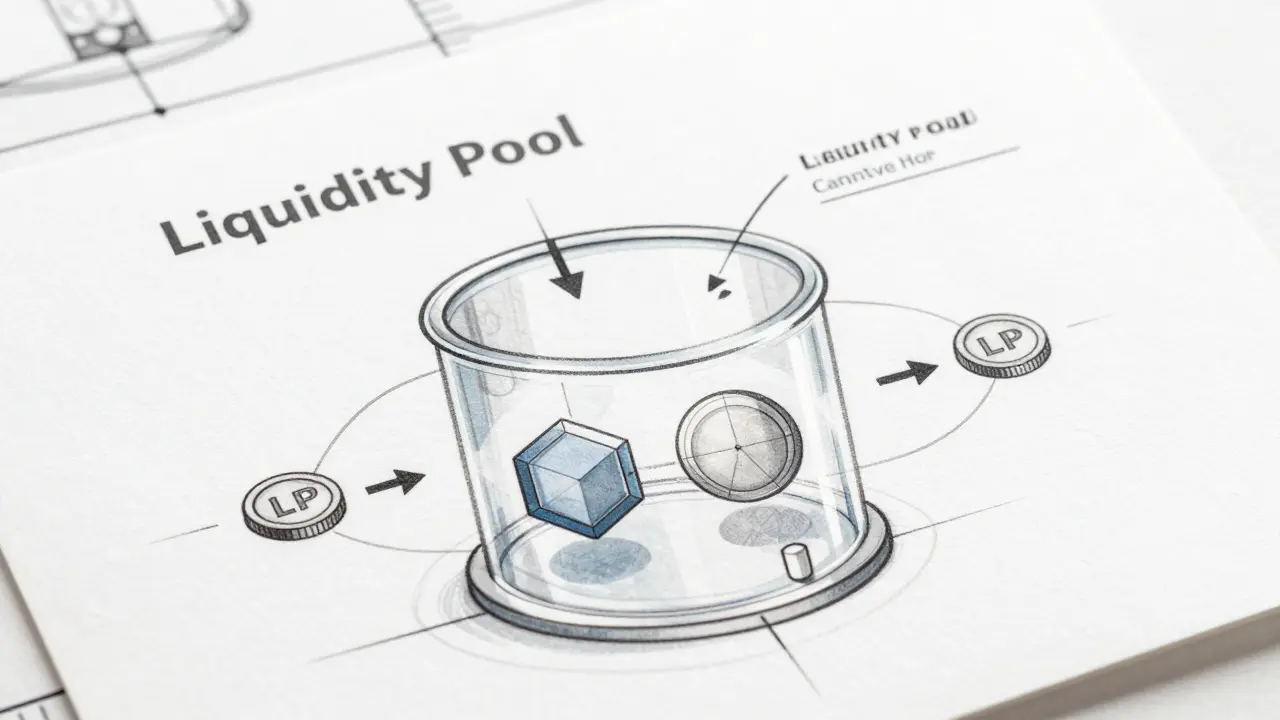
To understand liquidity mining, you first need to understand the problem it solves. Traditional stock exchanges use a central order book where buyers and sellers match orders. In decentralized finance, there is no central authority. Instead, platforms rely on Liquidity Pools smart contracts holding pairs of cryptocurrencies that allow users to trade without intermediaries.
Think of a liquidity pool as a communal piggy bank. For every pair of tokens traded-say, Ethereum (ETH) and USD Coin (USDC)-there is a pool containing both assets. When you want to trade ETH for USDC, you do not wait for someone else to sell; you take USDC from the pool and deposit ETH into it. The price adjusts automatically based on the ratio of assets in the pool.
But who puts the money in? That is where you come in. As a liquidity provider, you deposit equal values of two tokens into the pool. If you deposit $1,000 worth of ETH and $1,000 worth of USDC, you receive LP Tokens digital receipts representing your proportional share of the liquidity pool and entitlement to fees. These LP tokens are your proof of ownership. They allow you to withdraw your original deposit plus any accrued earnings at any time. Without liquidity providers, these decentralized exchanges would be empty shells with nothing to trade against.
The Two Sources of Reward Income
When people talk about liquidity mining rewards, they often confuse two distinct types of income. Understanding the difference between them is crucial for calculating your actual returns.
The first source is straightforward: Trading Fees. Every time someone trades against your pool, they pay a small fee, typically ranging from 0.05% to 0.3%. This fee is distributed pro-rata to all liquidity providers. If you hold 1% of the total pool, you earn 1% of the daily trading fees. This is similar to earning rent on a property-it is steady, predictable, and tied directly to usage.
The second source is the "mining" part: Protocol Token Emissions. This is where the high yields come from. Protocols want to attract liquidity quickly. To do this, they create new tokens and distribute them to liquidity providers as a bonus. This process is often called Yield Farming the practice of staking LP tokens or crypto assets in DeFi protocols to earn additional token rewards. Unlike trading fees, which depend on market activity, these emissions are usually fixed by the protocol’s code. You might earn 50% APY in trading fees, but another 200% APY in new tokens. While the latter looks impressive on paper, its real value depends entirely on whether those new tokens actually increase in price.
| Feature | Trading Fees | Token Emissions |
|---|---|---|
| Source of Value | User activity (trades) | Protocol inflation (new supply) |
| Predictability | Variable, depends on volume | Fixed schedule set by code |
| Risk Level | Low (value is immediate) | High (token price may drop) |
| Sustainability | Long-term viable | Often temporary/incentivized |
The Hidden Danger: Impermanent Loss Explained
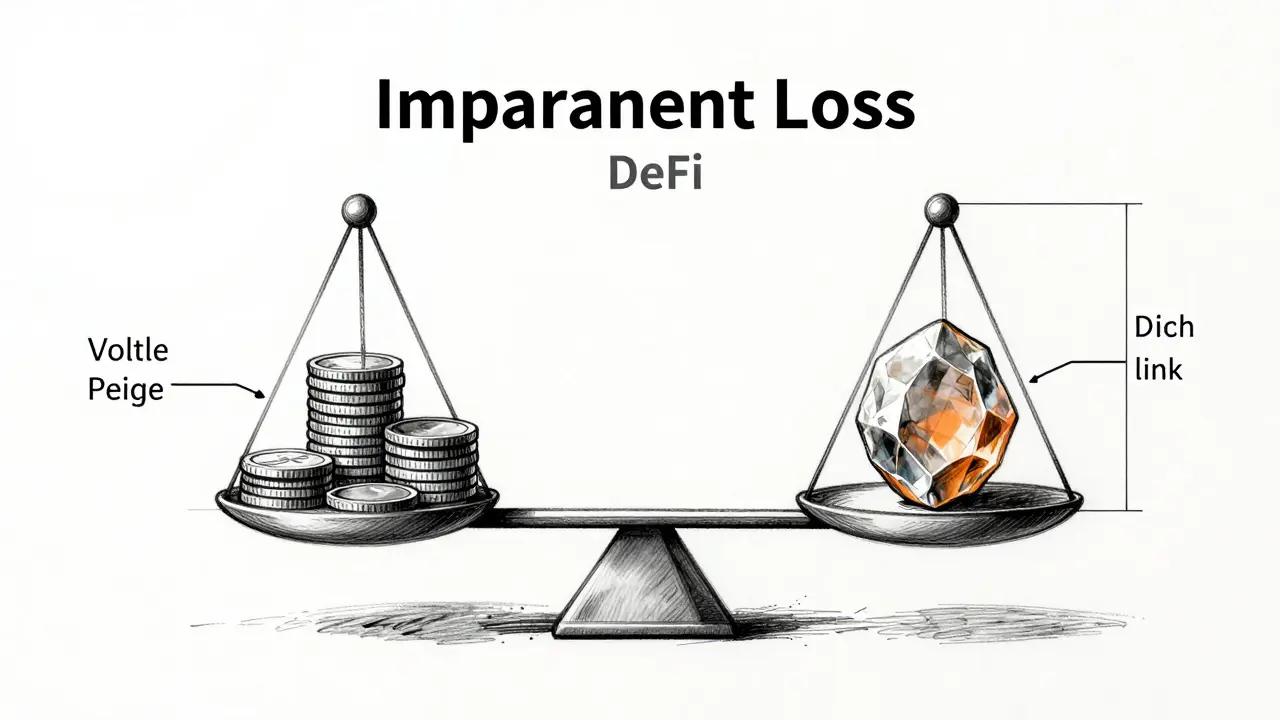
If liquidity mining were risk-free, everyone would do it. The biggest risk you face is not hackers or scams, but a mathematical phenomenon called Impermanent Loss a temporary reduction in value compared to simply holding the assets, caused by price divergence between paired tokens.
Here is how it works. Let’s say you provide liquidity to an ETH/USDC pool when ETH is priced at $2,000. You deposit $1,000 of ETH and $1,000 of USDC. A month later, ETH skyrockets to $4,000. Because the pool must maintain a balanced ratio of assets, arbitrage traders will buy cheap ETH from your pool and sell expensive ETH into it. Your pool now holds less ETH and more USDC than before.
When you withdraw your funds, you will have more USDC and less ETH than you started with. Compared to simply holding the ETH in your wallet, you have lost value. This is impermanent loss. It is "impermanent" because if the price of ETH returns to $2,000, the loss disappears. However, if ETH stays high or goes even higher, that loss becomes permanent unless offset by your trading fees and token rewards.
This is why stablecoin pairs (like USDC/DAI) are safer-they rarely experience significant price divergence. Volatile pairs (like ETH/SOL) offer higher potential rewards but carry much higher impermanent loss risk. Always calculate whether the APY offered is enough to cover the potential loss from price swings.
Who Gets Paid and Why?
Not all participants in a DeFi protocol are treated equally. Research from firms like Multicoin Capital highlights that liquidity mining design revolves around three groups: makers, takers, and service providers.
- Makers: These are you-the liquidity providers. You are paid for supplying capital. Your reward is usually based on the amount of liquidity provided and the duration it remains in the pool.
- Takers: These are the traders using the platform. Some protocols incentivize takers to boost volume, paying them tokens for every trade executed. This helps drive the activity that generates fees for makers.
- Service Providers: These include liquidators and keepers who maintain the health of the protocol. They ensure loans are repaid and systems function smoothly, earning rewards for their operational work.
Most beginner-focused campaigns target makers. However, savvy investors look for protocols that align incentives properly. A protocol that pays takers too little may suffer from low volume, meaning your trading fee earnings will be minimal. Conversely, a protocol that over-pays takers may drain its treasury quickly, leading to unsustainable token emissions for you.
Evolution of Strategies: From Simple Farms to Concentrated Liquidity
Liquidity mining has evolved significantly since its boom in 2020. Early protocols used simple models where you deposited assets and waited for rewards. Today, strategies are far more sophisticated.
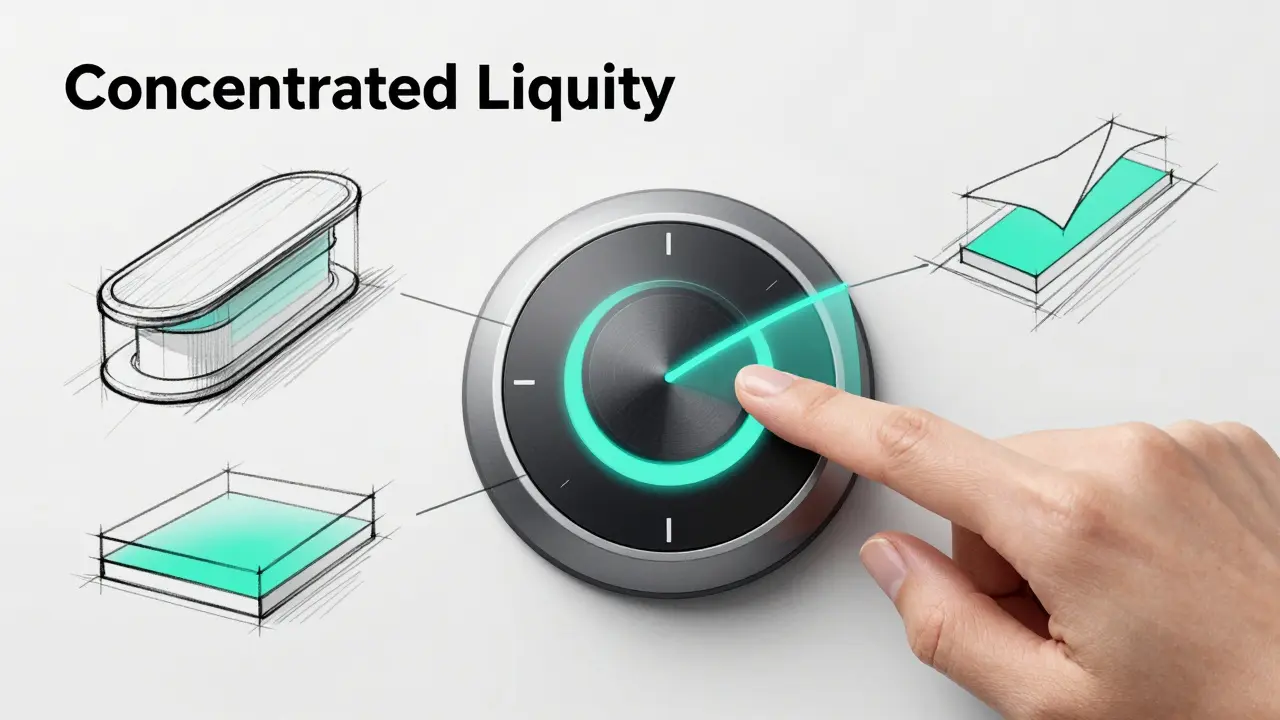
The introduction of Concentrated Liquidity a model allowing providers to allocate capital within specific price ranges to maximize fee efficiency, popularized by Uniswap V3, changed the game. Instead of spreading your capital across all possible prices, you can focus it on a narrow range where you expect the price to stay. This increases your exposure to trading fees dramatically-sometimes by 10x or more-but requires active management. If the price moves out of your range, you stop earning fees and face higher impermanent loss risk.
Another major development is vote-escrowed tokenomics, pioneered by Curve Finance. Here, users lock their tokens for long periods to gain voting power and boosted rewards. This mechanism fights against "mercenary capital"-users who jump from one farm to another chasing the highest yield and leaving as soon as rewards drop. By locking tokens, protocols encourage long-term commitment and stability.
Practical Steps to Start Liquidity Mining
Ready to try it yourself? Here is a realistic checklist to get started safely.
- Choose Established Platforms: Stick to audited, well-known protocols like Uniswap the largest decentralized exchange on Ethereum known for its AMM model and governance token UNI, PancakeSwap a leading DEX on the BNB Chain offering lower transaction fees and diverse farming opportunities, or Curve Finance a specialized DEX focused on stablecoin swaps with low slippage and veCRV tokenomics. Avoid new, untested projects promising unrealistic yields.
- Connect Your Wallet: Use a reputable non-custodial wallet like MetaMask. Ensure you have enough native currency (ETH for Ethereum, MATIC for Polygon) to pay gas fees.
- Select a Pool: Look for pools with high volume and reasonable APY. Check if the rewards are in established tokens or obscure project tokens.
- Provide Liquidity: Deposit equal values of the paired tokens. Review the transaction carefully before signing.
- Monitor and Harvest: Track your impermanent loss and reward accrual. Rebalance your position if the price moves significantly out of your expected range.
Remember, liquidity mining is not "set and forget." It requires regular monitoring. Market conditions change rapidly, and a profitable pool today can become a losing one tomorrow due to volatility or changes in emission rates.
Common Pitfalls to Avoid
Even experienced investors make mistakes. Here are the most common traps:
- Chasing High APYs Blindly: A 1,000% APY sounds amazing, but it often means the token reward is highly inflated and will crash soon. Focus on sustainable yields backed by real trading volume.
- Ignoring Gas Fees: On networks like Ethereum, transaction fees can exceed $50 during peak times. If you are mining small amounts, fees will eat your profits. Consider Layer 2 solutions like Arbitrum or Optimizer for lower costs.
- Underestimating Smart Contract Risk: No code is perfect. Even top protocols have had vulnerabilities. Never invest more than you can afford to lose, and diversify across multiple platforms.
- Failing to Tax Plan: In many jurisdictions, receiving token rewards is a taxable event. Keep detailed records of your deposits, withdrawals, and reward claims.
Liquidity mining is a powerful tool in the DeFi arsenal, but it demands respect and knowledge. By understanding the mechanics of liquidity pools, the dual nature of rewards, and the ever-present risk of impermanent loss, you can navigate this space with confidence. Start small, stick to trusted protocols, and always prioritize capital preservation over chasing fleeting high yields.
Is liquidity mining safe?
Liquidity mining carries inherent risks, including smart contract vulnerabilities, impermanent loss, and token price volatility. While established protocols like Uniswap and Curve are relatively secure, no investment is guaranteed. Always research the protocol's audit history and never invest more than you can afford to lose.
What is the difference between yield farming and liquidity mining?
The terms are often used interchangeably. Technically, liquidity mining refers specifically to earning rewards for providing liquidity to a pool, while yield farming is a broader term encompassing any strategy to earn high yields in DeFi, including lending, borrowing, and complex multi-step transactions.
How do I minimize impermanent loss?
You can minimize impermanent loss by providing liquidity to correlated asset pairs, such as stablecoins (e.g., USDC/DAI) or wrapped versions of the same asset (e.g., wBTC/renBTC). Additionally, using concentrated liquidity models allows you to adjust your price range to reduce exposure to volatile movements.
Do I need to pay taxes on liquidity mining rewards?
In most countries, yes. Receiving token rewards is typically considered ordinary income at the fair market value of the tokens at the time of receipt. Subsequent sales or swaps may trigger capital gains tax. Consult a local tax professional for advice specific to your jurisdiction.
Which blockchain is best for liquidity mining?
Ethereum offers the deepest liquidity and most established protocols but has high gas fees. Layer 2 solutions like Arbitrum and Optimizer, as well as alternative chains like Solana and Binance Smart Chain, offer lower fees and faster transactions, making them attractive for smaller positions and frequent rebalancing.


