
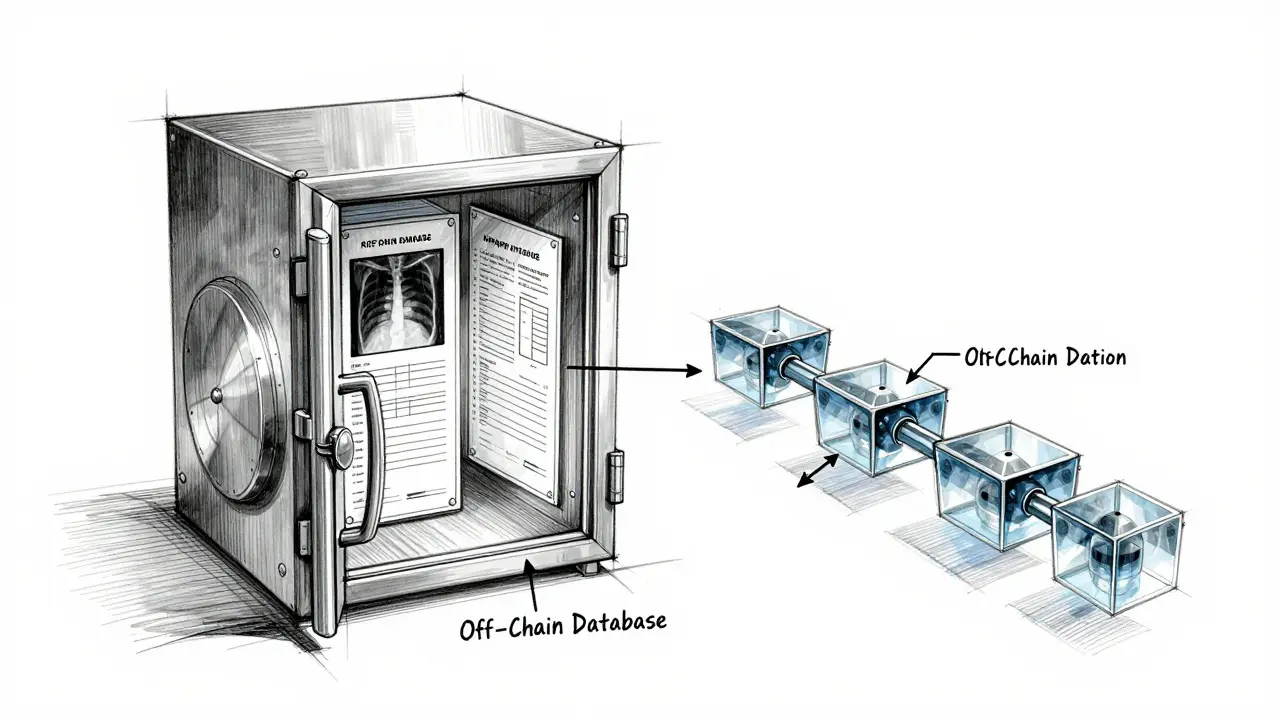
Imagine handing over a patient’s entire medical history to a system that cannot be changed, deleted, or hidden. That is the promise of blockchain, a distributed ledger technology that records transactions in an immutable, decentralized manner. But now imagine doing that while breaking federal law. For healthcare providers, this isn’t just a technical puzzle; it is a legal minefield. The Health Insurance Portability and Accountability Act (HIPAA), U.S. legislation enacted in 1996 to protect sensitive patient health information from being disclosed without the patient's consent or knowledge, demands strict control over who sees what. Blockchain demands transparency and permanence. These two forces seem like oil and water. So, how do you make them mix? You don’t put the patient data on the chain. You put the receipt for the data on the chain.
The Core Conflict: Immutability vs. The Right to Be Forgotten
The biggest hurdle in combining HIPAA and blockchain is a fundamental clash of principles. HIPAA requires that Protected Health Information (PHI), any demographic, clinical, medical, or billing information that can identify a specific individual, be accessible only to authorized users. It also allows patients to request corrections or amendments to their records under certain conditions. Blockchain, by design, is immutable. Once a block is added to the chain, it cannot be altered or deleted. If you write a patient’s diagnosis directly onto a public ledger, you have created a permanent, unchangeable record that violates the spirit of data correction rights and potentially exposes PHI to anyone with access to the network.
This creates a critical rule for developers and healthcare administrators: Never store raw PHI on the blockchain. Instead, use a hybrid architecture. Store the actual medical records-X-rays, lab results, doctor’s notes-in a traditional, secure, HIPAA-compliant database (off-chain). Then, store only a cryptographic hash of that file on the blockchain. This hash acts as a digital fingerprint. If someone changes even a single comma in the off-chain document, the hash will change, and the blockchain will immediately flag the discrepancy. This satisfies HIPAA’s requirement for data integrity without violating privacy rules by exposing the actual content.
Choosing the Right Ledger: Permissioned vs. Public
Not all blockchains are created equal, especially when dealing with regulated industries. Using a public blockchain like Bitcoin or Ethereum for healthcare data is generally a bad idea. Public ledgers are open to anyone, which makes controlling access to PHI nearly impossible. Instead, healthcare organizations must use permissioned blockchains, private networks where participants are known and access is restricted to authorized entities. Platforms like Hyperledger Fabric or Corda allow organizations to create private networks where only vetted doctors, hospitals, and insurers can participate.
In a permissioned environment, you can implement Role-Based Access Control (RBAC), a method of regulating access to computer or network resources based on the roles of individual users within an enterprise. This aligns perfectly with HIPAA’s "Minimum Necessary Rule," which states that you should only access the amount of PHI needed to do your job. A receptionist might need to see a patient’s name and insurance details, but not their HIV status. RBAC ensures that the smart contracts governing the blockchain enforce these limits automatically. If a user tries to access data outside their role, the transaction is rejected before it ever touches the ledger.
| Feature | Public Blockchain | Permissioned Blockchain |
|---|---|---|
| Access Control | Open to anyone | Restricted to invited nodes |
| HIPAA Suitability | Poor (High risk of PHI exposure) | Good (Controlled access) |
| Transaction Speed | Slower (Consensus overhead) | Faster (Fewer validators) |
| Audit Trail | Transparent but anonymous | Transparent and identifiable |

Encryption and Key Management: The Real Lock and Key
Storing hashes on-chain is only half the battle. The data itself must be encrypted both at rest and in transit. When a doctor updates a patient’s record in the off-chain database, that data travels over the internet. It must be wrapped in strong TLS/SSL encryption. Once it sits in the server, it must be encrypted again using standards like AES-256. The blockchain does not hold the keys to this encryption; it holds the proof that the data exists and hasn’t been tampered with.
This brings us to the most dangerous part of any blockchain system: key management. In a blockchain world, losing your private key means losing access to your data forever. There is no "forgot password" button. For healthcare providers, this is unacceptable. If a nurse loses her access key, patient care stops. Therefore, robust key management protocols are essential. Organizations must use multi-party computation (MPC) or threshold signatures, where the decryption key is split among several trusted parties. No single person holds the full key. This prevents insider threats and ensures that even if one device is stolen, the patient data remains safe. Regular key rotation policies must also be enforced to minimize the window of vulnerability if a key is compromised.
Audit Trails and Smart Contracts
HIPAA requires detailed audit controls. Healthcare organizations must know who accessed a patient’s record, when they accessed it, and why. Traditional databases can log this, but logs can be hacked or deleted by malicious insiders. Blockchain solves this elegantly. Every time a user accesses a record, a transaction is written to the ledger. This transaction includes a timestamp, the user’s ID, and the hash of the action taken. Because the ledger is immutable, this audit trail cannot be forged. An auditor can trace every interaction back to its origin, providing a level of accountability that legacy systems struggle to match.
Smart contracts, self-executing contracts with the terms of the agreement between buyer and seller being directly written into lines of code, take this further. They can automate consent management. Imagine a patient signing a digital consent form that triggers a smart contract. This contract grants a specific specialist temporary access to their records for exactly 48 hours. After that time, the access rights automatically revoke. No manual intervention is needed. This reduces human error and ensures that consent is always current and verifiable. It also helps manage Business Associate Agreements (BAAs) by clearly defining the scope of data access for third-party vendors involved in the supply chain or billing processes.

Implementation Challenges and Pitfalls
Despite the benefits, implementing HIPAA-compliant blockchain is not plug-and-play. Scalability remains a significant issue. Healthcare generates massive amounts of data. If every heartbeat monitor reading or lab result creates a blockchain transaction, the network could clog up quickly. Solutions often involve batching transactions or using layer-2 scaling technologies to handle high throughput without sacrificing security.
Interoperability is another headache. Most hospitals run on different Electronic Health Record (EHR) systems like Epic or Cerner. Getting these legacy systems to talk to a new blockchain infrastructure requires complex middleware and API integrations. Data standards like HL7 FHIR must be used to ensure that information flows smoothly between the old and new systems. Without careful planning, you end up with a blockchain that no one can easily connect to, rendering it useless.
Regulatory uncertainty also looms large. While HIPAA provides a framework, it doesn’t explicitly mention blockchain. The Office for Civil Rights (OCR) enforces HIPAA, and they look at outcomes, not just technology. If your blockchain implementation leads to a breach, you will be penalized regardless of how cool the tech is. Organizations must conduct regular risk assessments and work with legal experts to ensure their architecture meets the letter and spirit of the law. State-level privacy laws, such as California’s CCPA, add another layer of complexity, requiring additional opt-in mechanisms for data sharing.
Best Practices for a Secure Launch
To successfully integrate blockchain into your healthcare operations, follow these steps. First, start small. Pilot the technology with non-critical data, such as supply chain tracking for pharmaceuticals, before moving to patient records. This allows you to test the system’s resilience and compliance posture without risking patient safety. Second, engage your workforce early. Doctors and nurses need to understand how the new system works. Training on digital hygiene and key management is crucial. Third, establish clear governance. Define who owns the blockchain network, who can add nodes, and how disputes are resolved. Finally, maintain a disaster recovery plan. Even though blockchain is resilient, the off-chain storage systems are not. Ensure you have backups and failover procedures in place to meet HIPAA’s availability requirements.
Blockchain offers a powerful tool for securing healthcare data, but it is not a magic bullet. It requires a thoughtful, hybrid approach that respects the boundaries of HIPAA. By keeping PHI off-chain, using permissioned networks, and leveraging smart contracts for access control, healthcare organizations can build systems that are both secure and compliant. The future of healthcare data lies not in choosing between tradition and innovation, but in blending them wisely.
Can I store patient names on a blockchain?
No, storing raw patient names or any Protected Health Information (PHI) directly on a blockchain is risky and likely non-compliant with HIPAA. Instead, you should store an encrypted reference or a hash of the data on the blockchain, while keeping the actual personal information in a secure, off-chain database that meets HIPAA security standards.
What is the difference between a public and permissioned blockchain in healthcare?
A public blockchain is open to anyone, making it unsuitable for sensitive health data due to lack of access control. A permissioned blockchain restricts participation to authorized users only, allowing for Role-Based Access Control (RBAC) and better alignment with HIPAA’s privacy requirements.
How does blockchain help with HIPAA audit trails?
Blockchain creates an immutable, timestamped record of every transaction. This means that every time a user accesses or modifies a patient record, it is logged permanently. This provides a tamper-proof audit trail that simplifies compliance reporting and helps detect unauthorized access attempts.
Are smart contracts legally binding under HIPAA?
Smart contracts themselves are code, not laws, but they can enforce the terms of legally binding agreements like Business Associate Agreements (BAAs). They automate access controls and consent management, ensuring that data usage adheres to the agreed-upon rules, thereby supporting HIPAA compliance.
What happens if a healthcare provider loses their blockchain private key?
Losing a private key can result in permanent loss of access to data. To mitigate this, healthcare organizations should use advanced key management solutions like Multi-Party Computation (MPC) or threshold signatures, which split the key among multiple trusted parties so that no single point of failure exists.


