

Imagine a fortress protected not by walls or guards, but by millions of computers solving math problems every second. That is the essence of Hash Rate, which serves as the primary security indicator for proof-of-work blockchain networks like Bitcoin. When you hear that Bitcoin’s hash rate has hit a new all-time high, it doesn’t just mean miners are making more money. It means the network is exponentially harder to hack. But why does computational power equal security? And how can you use this metric to judge the health of a cryptocurrency?
Understanding hash rate is crucial for anyone looking beyond price charts. It reveals the true strength of the underlying infrastructure. A high hash rate signals investor confidence, robust decentralization, and resistance to malicious attacks. Conversely, a dropping hash rate can warn of centralization risks or miner exodus. Let’s break down exactly how this works, what the numbers mean, and why it remains the gold standard for blockchain security.
What Is Hash Rate and How Is It Measured?
At its core, hash rate represents the total computational power of a blockchain network. It measures the number of hash calculations performed per second by all miners collectively. In simple terms, it is the speed at which the network solves complex mathematical puzzles to validate transactions and add new blocks to the ledger.
The unit of measurement is hashes per second (H/s). Because these numbers are astronomical, we use larger prefixes:
- Terahashes per second (TH/s): Trillions of hashes per second. Typical for individual ASIC miners in 2026.
- Petahashes per second (PH/s): Quadrillions of hashes per second. Often seen in large mining farms.
- Exahashes per second (EH/s): Quintillions of hashes per second. This is the scale of the entire Bitcoin network.
As of mid-2026, the Bitcoin network operates at approximately 400 EH/s. To put that in perspective, that is 400 quintillion attempts every single second to find the next valid block. If you were to count one number per second, it would take billions of years to reach that figure. This sheer volume of computation creates a barrier that is economically prohibitive for attackers to overcome.
The Mechanics: Proof of Work and Difficulty Adjustment
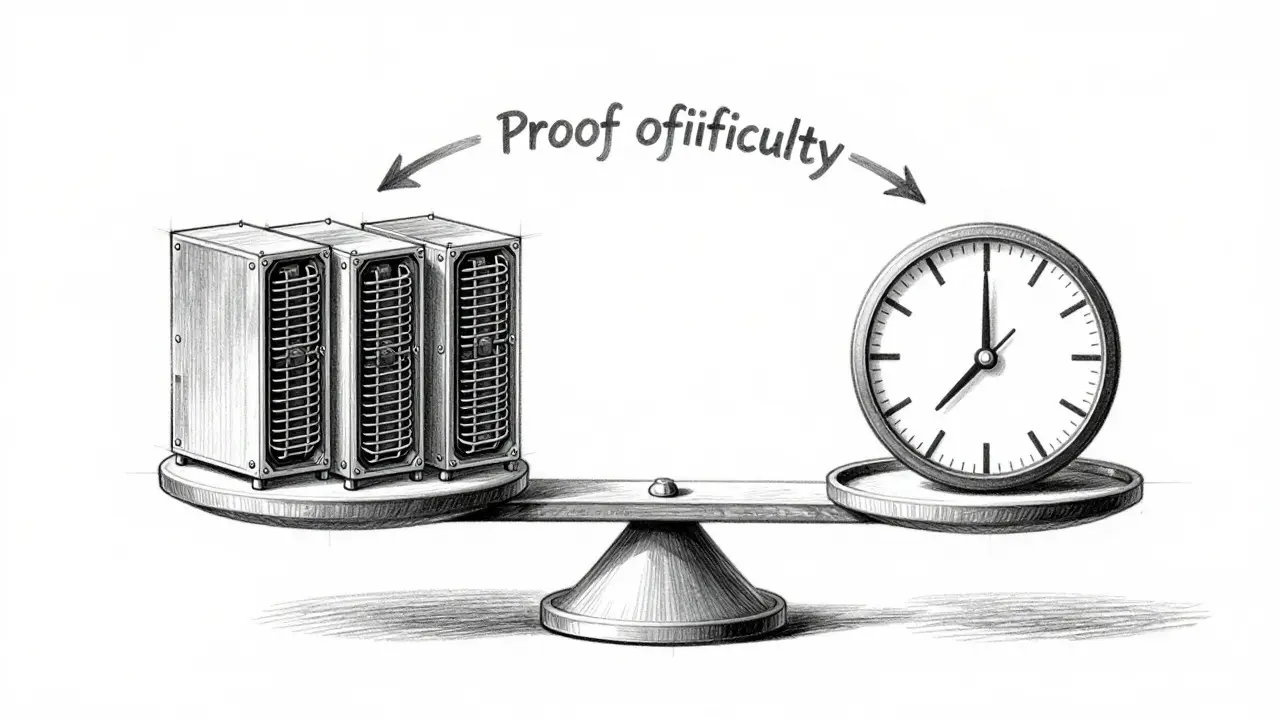
Hash rate isn’t static; it fluctuates based on how many miners join or leave the network. However, the blockchain needs stability. This is where Mining Difficulty comes into play. The Bitcoin protocol automatically adjusts the difficulty of the mathematical puzzles every 2,016 blocks, which takes roughly two weeks.
The goal is to maintain a consistent block time of ten minutes. Here is how the feedback loop works:
- If more miners join, the total network hash rate increases.
- Blocks are found faster than every ten minutes.
- The protocol detects this and increases the difficulty, making the puzzles harder.
- Conversely, if miners leave, blocks take longer to find, so the difficulty decreases.
This mechanism ensures that the security level (hash rate) and the reward distribution remain predictable. For an observer, watching the difficulty adjustment is a direct way to see how the hash rate has changed over the previous two weeks. A rising difficulty confirms a rising hash rate, indicating growing participation.
Why Hash Rate Equals Security
The most critical question is: why does more computing power make the network safer? The answer lies in the threat model known as a 51% Attack.
In a proof-of-work system, the longest chain is considered the truth. To rewrite history or double-spend coins, an attacker needs to control more than 50% of the network’s total hash rate. They must out-compute all honest miners combined to create a longer, fraudulent chain.
Here is why high hash rate deters this:
- Economic Cost: To attack Bitcoin, an attacker would need to acquire enough ASIC hardware to exceed 200 EH/s. This costs billions of dollars in equipment alone, not counting the massive electricity bills.
- Diminishing Returns: As the attacker buys more hardware, the market price of the hardware rises, and the network difficulty adjusts upward, reducing their potential profit from legitimate mining.
- Detection: A sudden shift in hash rate distribution is visible to analysts. Exchanges and users would likely pause deposits, rendering the stolen funds difficult to cash out.
Compare this to a smaller altcoin with a hash rate of 1 TH/s. An attacker could rent sufficient computing power for a few thousand dollars to launch a successful 51% attack. Therefore, hash rate is a direct proxy for the cost of attacking the network. Higher hash rate equals higher attack cost.
| Network Type | Approximate Hash Rate | Attack Feasibility | Security Model |
|---|---|---|---|
| Bitcoin (BTC) | > 400 EH/s | Nearly Impossible | Proof of Work (PoW) |
| Litecoin (LTC) | ~ 800 PH/s | Very Difficult | Proof of Work (PoW) |
| Small Altcoin | < 1 TH/s | Easy / Cheap | Proof of Work (PoW) |
| Ethereum (ETH) | N/A (PoS) | Dependent on Stake Value | Proof of Stake (PoS) |
Hash Rate vs. Other Security Metrics
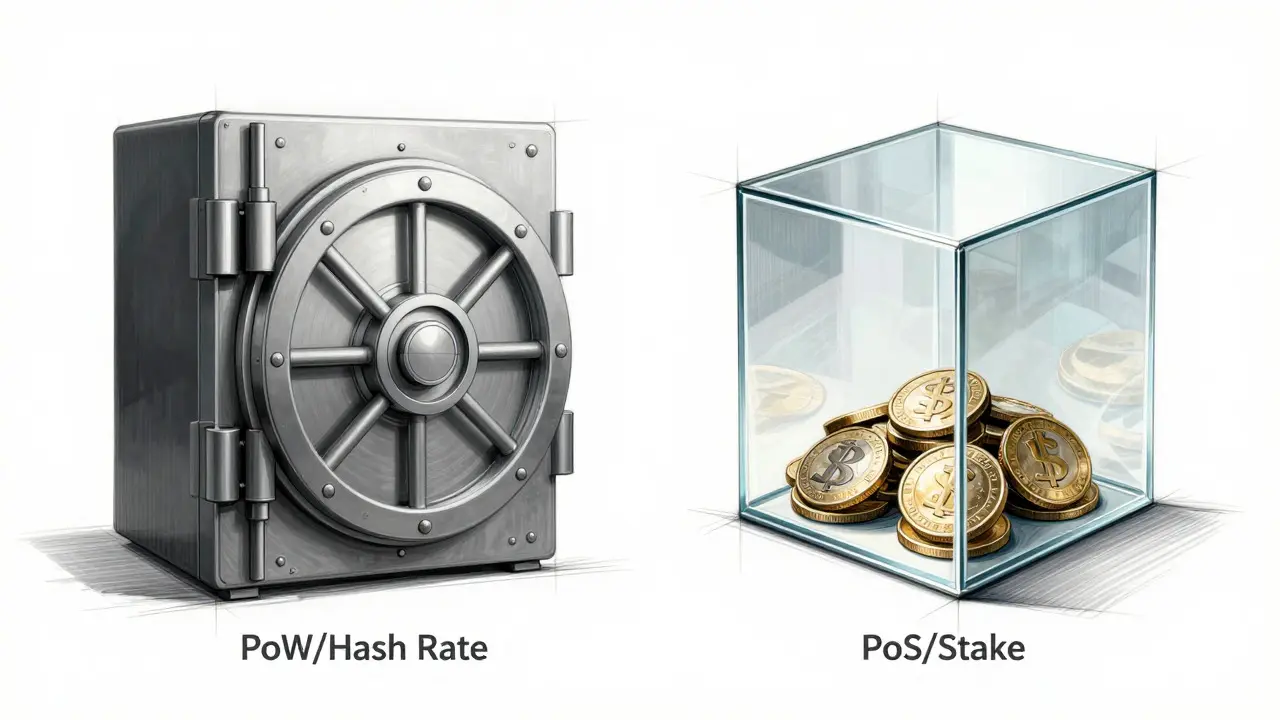
Not all blockchains use hash rate. Since Ethereum’s transition to Proof of Stake (PoS), it no longer relies on miners. Instead, security is measured by the total value of ETH staked as collateral. In PoS, validators lock up their coins, and if they act maliciously, those coins are "slashed" (destroyed).
So, how do we compare them?
- Proof of Work (Hash Rate): Security is backed by physical energy and hardware. It is objective and measurable. You can verify the hash rate independently without trusting any central entity. It represents "energy security."
- Proof of Stake (Stake Value): Security is backed by economic capital. It is cheaper to run but relies on the assumption that validators will protect their financial investment. It represents "economic security."
For purists, hash rate offers a unique advantage: it is censorship-resistant. No government can easily shut down thousands of distributed miners worldwide. While PoS is efficient, PoW’s reliance on raw computational power makes it exceptionally resilient against coordinated shutdowns or regulatory pressure, provided the hash rate remains decentralized.
Interpreting Hash Rate Trends
Monitoring hash rate provides insights into market sentiment and network health. You can track real-time data on platforms like Blockchain.com or CryptoCompare. Here is what different trends usually signal:
Rising Hash Rate: This typically indicates growing confidence. Miners are buying more hardware and staying online because they expect future profitability. It often correlates with bull markets or periods of institutional adoption. It suggests that the network is becoming more secure and decentralized.
Falling Hash Rate: A drop can be alarming but isn’t always bad. Short-term dips might result from scheduled maintenance, power outages in major mining regions, or temporary unprofitability due to a price crash. However, a sustained decline over months can signal a "miner exodus," where operators give up and sell their equipment. This reduces security and may indicate waning interest in the asset.
Volatile Hash Rate: High volatility can suggest a lack of mature infrastructure. Networks that rely heavily on cloud mining or small, unstable operations may see erratic swings. Stable, gradual growth is generally healthier than jagged spikes and drops.
Centralization Risks and Miner Pools
A common misconception is that a high total hash rate guarantees decentralization. It does not. If 90% of the hash rate is controlled by three mining pools, the network is highly centralized, even if the total EH/s is high.
Mining pools allow individual miners to combine their hash rate to receive more consistent rewards. While beneficial for small players, dominance by a few pools poses a risk. If one pool controls more than 30-40% of the hash rate, it gains significant influence over transaction ordering and fee setting.
To assess true security, look beyond the total hash rate. Check the distribution among top pools. Tools like MiningPoolStats provide this breakdown. A healthy network has no single pool exceeding 30% of the total hash rate. In 2026, the Bitcoin ecosystem has largely stabilized around several major pools, but vigilance is still required to prevent monopolistic behavior.
Practical Steps for Investors and Users
How should you use this information? Here is a practical checklist for evaluating a proof-of-work cryptocurrency:
- Check the Trend: Is the hash rate trending up over the last 6-12 months? Upward trends are positive.
- Assess the Scale: Is the hash rate high enough to make a 51% attack economically irrational? For serious stores of value, look for at least hundreds of TH/s, preferably PH/s or EH/s.
- Review Pool Distribution: Are there too many miners concentrated in one location or pool? Diversification is key.
- Monitor Difficulty Adjustments: Frequent large downward adjustments can indicate instability or miner capitulation.
Remember, hash rate is a lagging indicator of price but a leading indicator of long-term viability. Price can spike due to speculation, but hash rate only grows when real capital is invested in hardware. When both align, it signals strong fundamental health.
Does a higher hash rate guarantee a higher coin price?
No, not directly. A higher hash rate increases security and miner costs, which can support the price floor, but the market price is determined by supply and demand. However, historically, sustained hash rate growth often precedes long-term price appreciation because it reflects genuine network adoption and investment.
Can hash rate be faked?
It is very difficult to fake hash rate on a proof-of-work network. To inflate the number, someone must actually perform the computations, which requires expensive hardware and electricity. Unlike social media followers, hash rate represents real-world energy expenditure, making it a trustworthy metric.
What happens if the Bitcoin hash rate drops to zero?
If the hash rate dropped to zero, it would mean no miners are operating. The network would stop producing blocks, and transactions would cease to confirm. This scenario is considered extremely unlikely due to the vast amount of sunk capital in mining hardware globally. Even if prices crashed, some miners would continue operating to cover marginal costs.
How does energy consumption relate to hash rate?
Hash rate and energy consumption are directly proportional. More hash rate requires more electricity. As mining hardware becomes more efficient (more hashes per watt), the energy cost per hash decreases. This efficiency drives competition, allowing networks to increase security without proportionally increasing energy waste.
Is hash rate relevant for Ethereum now?
No. Ethereum moved to Proof of Stake in 2022. It no longer uses miners or hash rate for consensus. Its security is now measured by the total amount of ETH staked by validators. Comparing Ethereum’s security using hash rate is obsolete; instead, look at the staking ratio and validator count.


