
Remember the panic of November 2022? If you were trading cryptocurrency in Turkey, you likely remember it vividly. One day, FTX Turkey was a bustling platform where thousands moved their life savings to escape inflation. The next, it was frozen. This isn't just a story about a failed company; it is a cautionary tale that reshaped how we understand safety in digital finance.
Today, in 2026, looking back at FTX Turkey provides crucial lessons. You might be asking if your funds are safe on other platforms, or perhaps you are still waiting for a payout from the U.S. bankruptcy process. This review cuts through the noise. We will look at why FTX Turkey failed, what the Turkish authorities (MASAK and SPK) did, and most importantly, which exchanges actually follow the rules today.
The Rise and Fall of FTX Turkey
To understand the crash, you have to understand the appeal. In 2021 and early 2022, Turkey faced hyperinflation. Official figures cited by the Financial Crimes Investigation Board (MASAK) showed annual inflation exceeding 85%. People needed a way to protect their purchasing power. Enter FTX Turkey (operating via ftxtr.com).
Founded by Sam Bankman-Fried, FTX marketed itself as a global giant with local convenience. It offered:
- Turkish Lira (TRY) deposits via bank transfer.
- A fully localized interface in Turkish.
- Access to complex products like leveraged tokens and futures.
At its peak, KPMG’s January 2023 report estimated that over 500,000 Turkish users had accounts on the platform. For many, it felt like a lifeline. But there was a massive red flag that most ignored: regulatory status.
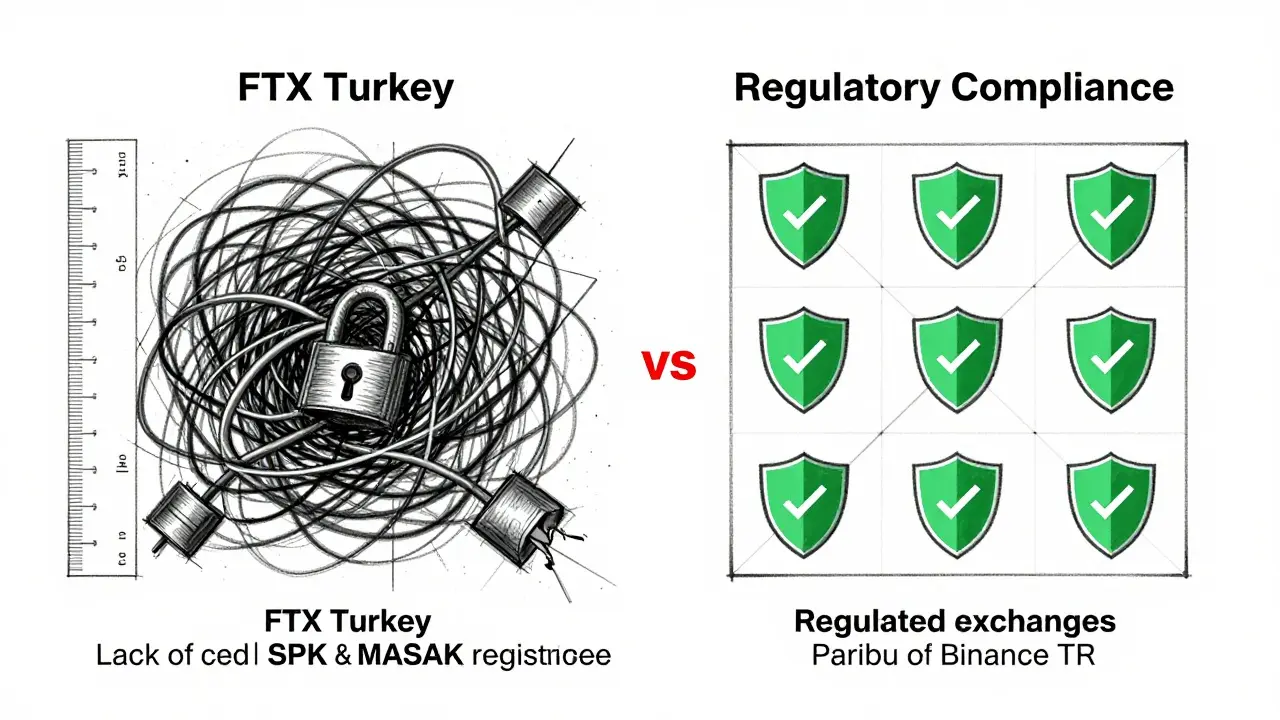
Unlike Binance, which partnered with local entity Bgator, or Thodex, which had registered locally before its own collapse, FTX Turkey operated without full approval from Turkey's Capital Markets Board (SPK). It relied on its parent company’s registration in the Bahamas. This "regulatory arbitrage" meant that while the app looked local, the legal protections were nonexistent for Turkish citizens.
Why FTX Turkey Was Risky: The Regulatory Gap
Let’s be clear about one thing: FTX Turkey was not illegal because it was a crypto exchange. It was risky because it bypassed local oversight. Under Turkey’s Law on the Prevention of Laundering Proceeds of Crime, any entity handling customer funds must register as a 'liable organization' with MASAK.
MASAK confirmed in November 2022 that FTX Turkey had not done this. Professor Levent Gökdemir of Boğaziçi University called it a "textbook example of regulatory arbitrage." What does that mean for you? It means when things went wrong, there was no Turkish law forcing them to return your money. There was no local escrow account holding your assets separately from the company’s operating cash. When FTX Global collapsed under the weight of mismanaged funds, FTX Turkey fell with it.
| Feature | FTX Turkey | Paribu / Binance TR |
|---|---|---|
| SPK Registration | No | Yes |
| MASAK Compliance | Non-compliant | Compliant |
| Trading Fees (Maker) | 0.05% - 0.07% | 0.10% - 0.25% |
| Cryptocurrency Pairs | ~45 pairs | 100+ pairs |
| User Protection Fund | None | Required by Law |
You see the trade-off clearly now. FTX offered lower fees and slick technology. But Paribu and Binance TR offered something far more valuable: legal recourse. When FTX froze withdrawals, users had nowhere to turn. On regulated platforms, customer funds are legally segregated from company assets. That segregation didn’t exist for FTX Turkey users.
The Collapse: What Happened to User Funds?
On November 11, 2022, FTX filed for Chapter 11 bankruptcy in Delaware. Within hours, FTX Turkey shut down. The order book depth collapsed by 92% in the three days leading up to the filing, according to Kaiko data. Panic set in.
For Turkish users, the aftermath was brutal. A survey by Istanbul University’s Center for Financial Studies found that 83% of FTX Turkey users held balances below 5,000 TRY. These were retail investors-teachers, students, small business owners-not institutional whales. Yet, they bore the brunt of the loss.
MASAK launched a criminal investigation immediately. Director General Mehmet Hakan Atilla stated that FTX Turkey violated Article 7 of the Anti-Money Laundering Law. But an investigation doesn’t put money back in your pocket. It establishes guilt, not restitution.
Here is the hard truth: Most individual users never got their money back directly from FTX. Instead, they became claimants in a U.S. bankruptcy case. As of September 2023, Turkish claimants represented about 2.3% of all claims (roughly 18,000 people), with an average claim of $2,147. The process required submitting identification, transaction screenshots, and bank details in English to U.S. courts. For non-English speakers, this barrier was immense. MASAK reported that 68% of affected users who provided info never received funds through direct channels.
Lessons Learned: How to Spot a Safe Exchange in 2026
The FTX collapse changed everything. Before 2022, many Turks used offshore exchanges because they offered better rates or more coins. Today, the landscape is different. The SPK implemented stricter custodial requirements in mid-2023, mandating 100% reserve backing for licensed entities.
If you are trading crypto in Turkey today, you must prioritize regulation over low fees. Here is your checklist for safety:
- Check the SPK Registry: Go to the Capital Markets Board website. Look for the official list of licensed cryptocurrency asset service providers. If the exchange isn’t there, do not deposit Turkish Lira.
- Verify MASAK Status: Ensure the platform is registered with MASAK as a liable organization. This ensures they perform KYC (Know Your Customer) checks and report suspicious activity, keeping the ecosystem clean and monitored.
- Avoid Unregulated Leverage: FTX Turkey lured users with high-leverage tokens. 78% of Turkish FTX users held leveraged positions. These complex products led to total losses for 63% of those users, according to post-collapse surveys. Stick to spot trading if you are new.
- Diversify Platforms: Never keep more than 3 days’ worth of trading capital on any single exchange. Use hardware wallets for long-term storage.
In 2026, platforms like Binance TR, Paribu, and Bitfenom dominate because they survived the regulatory crackdown. They pay higher fees, yes. But you are paying for insurance against another FTX-style disaster.
Current Status: Is FTX Turkey Coming Back?
No. FTX Turkey is defunct. There is no operational revival possible. The brand is toxic, and the legal structures are dismantled. Any website claiming to be "FTX Turkey" today is a scam designed to steal your credentials.
The U.S. bankruptcy court continues to process claims, but payouts are slow and partial. KPMG’s analysis concluded that trust in centralized exchanges among Turkish retail investors dropped permanently. Only 28% of former FTX users said they would use a similar unregulated platform again. The market has shifted toward transparency.
The Turkish government also responded by launching a national digital lira pilot program in late 2023. Finance Minister Mehmet Şimşek framed this as a regulated alternative to volatile cryptocurrencies. While this doesn’t replace Bitcoin or Ethereum, it shows the state’s intent to bring all digital value transfers under strict oversight.
Conclusion: Safety Over Speed
FTX Turkey promised speed, low fees, and global access. It delivered none of that when it mattered. It delivered silence, frozen assets, and years of legal limbo. The lesson is simple: In crypto, the cheapest option is often the most expensive in the long run.
As you navigate the markets in 2026, let the FTX collapse be your guide. Choose platforms that are visible, accountable, and regulated within your jurisdiction. Your financial security depends on it.
Is FTX Turkey still operational in 2026?
No, FTX Turkey ceased operations abruptly in November 2022 following the global FTX bankruptcy. It remains defunct, and any site using this name today is fraudulent.
How can Turkish users recover funds lost to FTX?
Recovery is difficult. Users had to file claims through the U.S. Bankruptcy Court proceedings. Turkish authorities (MASAK) investigated the illegal operation, but direct restitution to individuals has been minimal. Most users rely on the pro-rata distribution from the U.S. bankruptcy estate, which is a slow process.
Was FTX Turkey regulated by the Turkish government?
No. MASAK confirmed that FTX Turkey operated without proper registration as a 'liable organization' under Turkish anti-money laundering laws. It lacked approval from the Capital Markets Board (SPK), unlike competitors such as Paribu or Binance TR.
What are the safest crypto exchanges for Turkish users in 2026?
The safest options are those licensed by the SPK and registered with MASAK. Examples include Binance TR, Paribu, and Bitfenom. These platforms comply with local laws, segregate customer funds, and offer legal recourse in case of issues.
Why did so many Turkish users lose money on FTX?
Many users were attracted by low fees and easy TRY deposits. However, a significant portion (78%) engaged in high-risk leveraged trading. When the platform collapsed, these leveraged positions were wiped out instantly, and the lack of regulatory oversight meant there was no safety net for their remaining balances.


