
Divergence (DIVER) Airdrop: What’s Real and What’s Not in 2025

Divergence (DIVER) Airdrop: What’s Real and What’s Not in 2025
20 Comments

Dutch Auction Simulator

Learn how Divergence Protocol distributed DIVER tokens through a Dutch auction. This tool demonstrates how the price drops over time and how tokens are sold at different price points.

How Dutch Auctions Work

Unlike airdrops that give tokens for free to specific wallets, Dutch auctions start at a high price and gradually drop until all tokens sell. This ensures fair market pricing.

For DIVER tokens: Started at $0.10, ended at $0.05, with 20 million tokens sold over time.

There’s a lot of noise online about a Divergence airdrop. You’ve probably seen posts claiming you can claim free DIVER tokens just by signing up, connecting your wallet, or sharing a tweet. But here’s the truth: Divergence never ran a traditional airdrop. Not one. Not even a small one.

What you’re seeing is confusion. People are mixing up the project’s Initial DEX Offering (IDO) with an airdrop. They’re seeing people trade DIVER tokens and assuming those tokens were given away for free. That’s not how it happened.

How DIVER Tokens Were Actually Distributed

Divergence Protocol launched its DIVER token through a Dutch auction, not an airdrop. This isn’t just semantics-it’s a major difference in how value is assigned.

The auction started at $0.10 per DIVER token, with a total of 20 million tokens available. The price dropped over time until all tokens were sold. The lowest price reached was $0.05. That means the first buyers paid $0.10. The last buyers paid $0.05. Everyone paid what the market said was fair at the time they bought.

This system was designed to be fair. No insiders got special access. No early whales bought at a discount. No wallets were pre-selected. Anyone with an internet connection and a crypto wallet could participate. And that’s the opposite of an airdrop, where tokens are handed out to a pre-chosen group.

After the auction ended, the proceeds went into a liquidity pool on SushiSwap. That’s where DIVER started trading. Today, as of November 2025, DIVER trades around $0.010686-far below the original auction price. That’s normal for early DeFi projects. It doesn’t mean the token is worthless. It just means the market has moved on.

So Where Do People Get DIVER Tokens Now?

If you want DIVER tokens today, you buy them. On SushiSwap. Or wherever else they’re listed. There’s no free claim page. No wallet connect button. No countdown timer.

But here’s where things get interesting. Divergence does reward people-but not with a one-time airdrop. It rewards them with ongoing token distributions for participating in the ecosystem.

If you provide liquidity to Divergence’s options markets, you earn DIVER tokens over time. If you trade synthetic binary options on the platform, you can earn rewards based on volume and activity. If you hold DIVER tokens and vote on governance proposals, you’re also part of the reward system.

This isn’t a giveaway. It’s a user incentive. It’s how the protocol keeps people engaged. It’s how it grows organically. You don’t get tokens for doing nothing. You get them for doing something that helps the platform work better.

Why People Still Think There’s an Airdrop

There are three big reasons this myth keeps spreading.

First, most people don’t understand Dutch auctions. They hear “token sale” and think “free tokens.” They see someone holding DIVER and assume they got it for free.

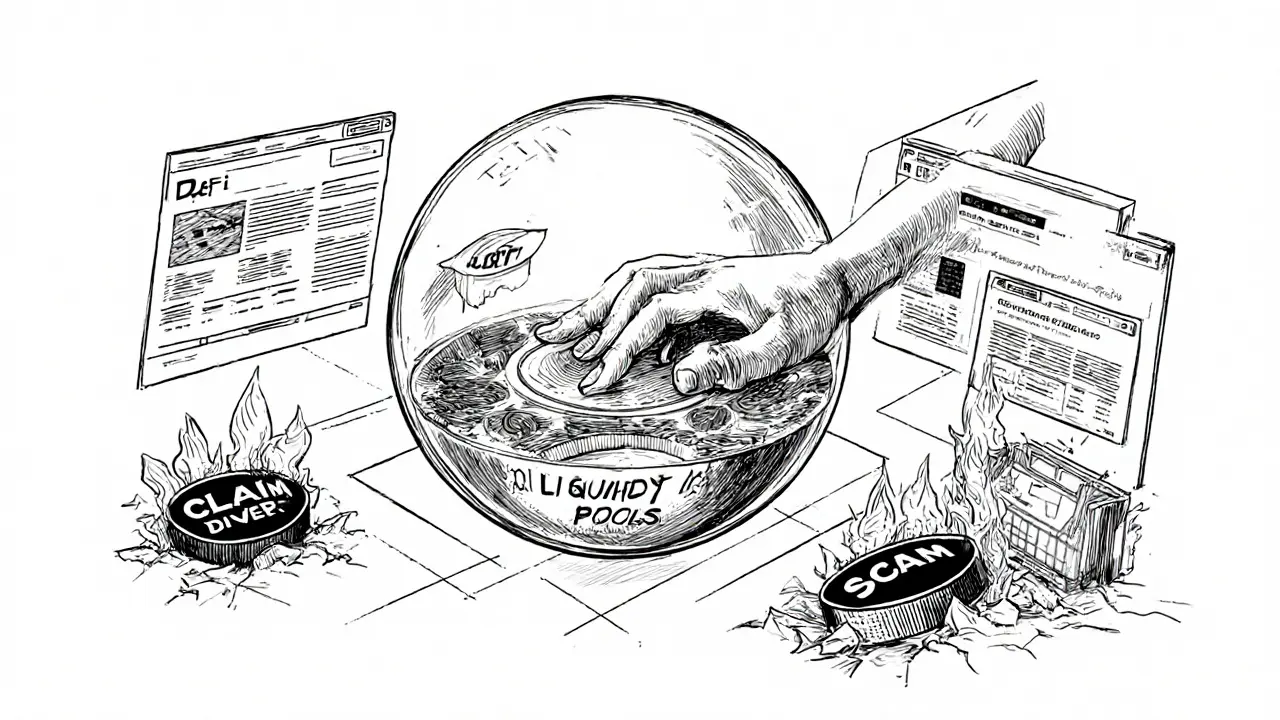
Second, scam sites are everywhere. You’ll find fake Divergence airdrop pages that ask you to connect your wallet, approve a transaction, or send a small amount of ETH to “unlock” your tokens. These are phishing traps. They steal your private keys or drain your wallet. If a site asks you to pay anything to claim DIVER, it’s a scam.

Third, some influencers and YouTube channels still promote “DIVER airdrop” as if it’s real. They’re either misinformed or deliberately misleading people to drive traffic. Always check the official source: divergence.finance. If it’s not there, it’s not real.
Abstract trading dashboard with binary options and DIVER token icon, no text

What Divergence Actually Does

Divergence isn’t just another DeFi token. It’s a protocol built for hedging volatility in crypto. Think of it like insurance for your DeFi positions.

Let’s say you’re holding ETH in a liquidity pool. You’re worried the price might crash next week. Instead of selling, you can buy a synthetic binary option on Divergence. You bet that ETH will drop below $3,000 by Friday. If you’re right, you get paid. If you’re wrong, you lose your premium. It’s like options trading on Wall Street, but fully decentralized.

This is useful for DeFi users who can’t just sell their assets without breaking their yield farming positions. Divergence gives them a way to protect themselves without leaving the ecosystem.

The DIVER token powers everything: governance, rewards, and fees. Holders vote on upgrades, fee structures, and new asset listings. Liquidity providers earn a share of trading fees. Traders pay fees in DIVER or other tokens. It’s a self-sustaining system.

Should You Still Care About DIVER in 2025?

Maybe. But not because of a fake airdrop.

If you’re into DeFi derivatives, Divergence is one of the few protocols focused purely on volatility trading. Most other platforms offer perpetual swaps or futures. Divergence offers binary options-something much simpler and more intuitive for new users.

It’s also one of the few DeFi projects that didn’t raise venture capital. All funding came from the public auction. That means no VCs are calling the shots. The community owns it.

But here’s the reality: trading volume is low. Liquidity is thin. You won’t find DIVER on Binance or Coinbase. It’s still a niche product. If you’re looking for a quick flip, skip it. If you’re looking to understand how DeFi hedging works, it’s worth exploring.
Glass sphere ecosystem with liquidity and governance, scam sites destroyed outside

How to Stay Safe and Avoid Scams

If you’re looking for DIVER tokens, follow these rules:

  1. Never connect your wallet to a site that says “Claim DIVER Airdrop.”
  2. Only buy DIVER on SushiSwap or verified DEXs linked from divergence.finance.
  3. Never send ETH, USDC, or any token to claim free DIVER.
  4. Check the official Twitter and Discord for updates. No official channel ever mentions an airdrop.
  5. If it sounds too good to be true, it is. Free crypto is almost always a trap.

The only legitimate way to earn DIVER is by using the platform: providing liquidity, trading options, or participating in governance. No shortcuts. No magic links. Just work.

What Comes Next for Divergence?

The team has said they’re working on listings on larger exchanges. That could bring more attention and liquidity. But there’s no timeline. No announcement. No date.

They’re also exploring new asset pairs for binary options-maybe Bitcoin, Solana, or stablecoin volatility. But again, nothing concrete.

If you’re interested, keep an eye on their official channels. But don’t wait for a free token. Build something useful on the platform instead. That’s how real value is made in DeFi.

Final Thoughts

Divergence isn’t a get-rich-quick scheme. It’s a tool for experienced DeFi users who want to hedge risk. The DIVER token isn’t a lottery ticket. It’s a utility token with a clear role in the protocol.

There was no airdrop. There won’t be one. And chasing one will only cost you money.

Want DIVER? Buy it. Earn it by using the platform. Or leave it alone. But don’t fall for the myth.

Angel RYAN
Angel RYAN 27 Nov

Divergence never did an airdrop. That’s it. Stop clicking random links. You’re not getting free tokens. Just buy them on SushiSwap if you care.
End of story.

SHASHI SHEKHAR
SHASHI SHEKHAR 27 Nov

Bro seriously? 😅 I saw a TikTok ad saying 'claim 5000 DIVER for free' and I almost connected my wallet... then I remembered this post. The Dutch auction thing makes so much more sense than some random airdrop. At least you know the people who bought in actually believed in it. Not just rug-pull hunters. Also, the binary options thing? That’s actually genius for DeFi newbies. Like, imagine hedging your ETH position without selling it. That’s not hype, that’s utility. 🤯 I’ve been using it for 3 months now and it’s saved me twice when the market crashed. No free tokens, but real protection? Worth it.

Joel Christian
Joel Christian 27 Nov

i tought there was an airdrop too lol i lost 0.05 eth on some scam site then i found this post and felt dumb. why do people still fall for this? its 2025.

Vijay Kumar
Vijay Kumar 27 Nov

Airdrop chasers are the reason crypto is a joke.

Puspendu Roy Karmakar
Puspendu Roy Karmakar 27 Nov

This is the kind of post that saves people from getting scammed. Seriously, thank you. I’ve seen so many people in my Telegram group trying to claim DIVER ‘free tokens’ - I just send them this link now. No drama. No fluff. Just facts. That’s how you help.

Evelyn Gu
Evelyn Gu 27 Nov

I remember when I first heard about Divergence - I thought, 'Oh, another airdrop.' I spent like three days digging into it, checking whitepapers, Discord archives, and even looking at the original auction contract on Etherscan. And you know what? You’re 100% right. There was no airdrop. No pre-sale. No team allocation. Just a Dutch auction where anyone could jump in. That’s rare. Most projects are rigged from the start. Divergence actually let the market decide. And now? The token’s down to $0.01, but the protocol? Still running. Still growing. Still useful. That’s the difference between a pump-and-dump and something real. I’m not holding for a moon, I’m holding because I use it. And that’s enough.

Wilma Inmenzo
Wilma Inmenzo 27 Nov

Wait… so you’re telling me the entire 'DIVER airdrop' thing is just a coordinated scam by the same 5 people who run 200 fake websites? And the 'official' Twitter account? Also fake? And the YouTube videos? All bots? And the people who 'got their DIVER' from the airdrop? They’re just bots too? 🤔 I think this is all a psyop to make people think DeFi is safe so they keep investing… and then… BOOM… the real rug pull happens. They’re using this post to lull us into a false sense of security. I’ve seen this before. I’m not falling for it.

jeff aza
jeff aza 27 Nov

The Dutch auction mechanism is a textbook example of efficient price discovery in a permissionless environment - particularly notable given the absence of centralized order books or market makers. The fact that liquidity was bootstrapped via SushiSwap post-auction demonstrates a non-custodial, community-first approach to protocol inception, which is statistically rare among DeFi launches post-2022. The current trading price reflects neither intrinsic value nor protocol utility, but rather speculative discounting due to low velocity and lack of centralized exchange listings - a structural liquidity constraint, not a fundamental failure. Governance participation and LP incentives remain the only legitimate value accrual vectors. Any claim to the contrary is either ignorance or malice.

Shelley Fischer
Shelley Fischer 27 Nov

I appreciate the clarity here. As someone who teaches blockchain basics to non-tech folks, I’ve had to debunk this 'DIVER airdrop' myth at least a dozen times this month. People don’t understand auctions, they don’t understand DeFi incentives, and they’re desperate for free money. But this isn’t just about DIVER - it’s about the culture. We need more posts like this. Not just to inform, but to protect. Thank you for taking the time to write it.

imoleayo adebiyi
imoleayo adebiyi 27 Nov

I came here thinking I missed out on something. Now I’m just glad I didn’t fall for it. I’ve seen too many people lose everything chasing free crypto. This post didn’t just explain DIVER - it saved someone’s wallet. Maybe mine. Thank you.

Michael Labelle
Michael Labelle 27 Nov

I’ve been using Divergence for hedging my ETH positions since last year. It’s not glamorous. No big airdrop. No influencer hype. But when ETH dropped 30% last month and I didn’t have to sell my LP tokens? That was worth more than any free token ever could be. The interface is clunky. The volume is low. But it works. And that’s rare.

George Kakosouris
George Kakosouris 27 Nov

Let’s be real - Divergence is a dead project. Volume is trash, liquidity is microscopic, and the team hasn’t posted anything since June. The only reason this post even exists is because someone got scammed and is now trying to feel better about it. The token’s at $0.01 because it’s worthless. The 'utility' is a fantasy. You don’t get rewarded for trading on a platform with 50 daily users. This isn’t DeFi innovation - it’s a graveyard with a blog.

SHIVA SHANKAR PAMUNDALAR
SHIVA SHANKAR PAMUNDALAR 27 Nov

They say 'no airdrop' like it’s a virtue. But let’s be honest - if they had done a real airdrop to early adopters, maybe this thing would have legs. Now it’s just a ghost town with a fancy whitepaper. The Dutch auction was noble. But noble doesn’t pay bills. And nobody cares about your 'utility' when the price is $0.01. You don’t get to call it 'fair' when it’s also dead.

Tina Detelj
Tina Detelj 27 Nov

There’s something beautiful about a project that doesn’t beg for attention. No hype. No airdrop. No influencer shilling. Just a quiet, functional tool for people who actually understand risk. I used to think DeFi had to explode to matter. Now I see that the quiet ones - the ones that don’t scream for your attention - are the ones that last. Divergence doesn’t need to be on Coinbase. It just needs to work. And it does. And that’s more than I can say for 90% of the projects I’ve seen.

Michael Fitzgibbon
Michael Fitzgibbon 27 Nov

I used to think the same thing - that if a project didn’t give away free tokens, it wasn’t worth it. Then I started using Divergence to hedge my positions. No drama. No scam links. Just a simple way to protect what I already had. It’s not sexy. But it’s real. And honestly? That’s the most valuable thing in crypto right now.

stephen bullard
stephen bullard 27 Nov

You know what’s wild? The people who scream 'airdrop' are the same ones who complain about 'centralization' and 'wealth inequality' in crypto. But here’s the irony - an airdrop is the most centralized thing you can do. You pick who gets it. You decide who's 'worthy.' Divergence didn’t pick. It let everyone in. The first guy paid $0.10. The last guy paid $0.05. That’s not unfair. That’s fair. That’s the market. And if you can’t handle that? Maybe crypto isn’t for you.

Komal Choudhary
Komal Choudhary 27 Nov

i just want free crypto 😭 why is everything so complicated? i just want to connect my wallet and get tokens. why do i have to trade options? why do i have to understand liquidity? why can't it just be easy?

Tony spart
Tony spart 27 Nov

America built the internet. China built AI. But we? We built the greatest scam artistry the world has ever seen. Airdrops? Please. This is just the latest flavor of the same old con. You think Divergence is the victim? Nah. They’re the ones who knew the game. They let the fools chase free tokens so they could quietly build something real. And now? The fools are broke. And the builders? They’re still here. That’s not luck. That’s strategy.

priyanka subbaraj
priyanka subbaraj 27 Nov

I cried when I realized I lost $80 on a fake DIVER airdrop. I thought I was smart. I wasn’t. I’m not even mad anymore. Just disappointed. In myself. In crypto. In the world.

Vaibhav Jaiswal
Vaibhav Jaiswal 27 Nov

This is the most useful post I’ve seen all year. I showed it to my uncle. He’s 68. He didn’t understand half of it. But he got the part about 'if it says free, it’s a scam.' He closed his browser. He didn’t lose money. That’s a win.

20 Comments