

Imagine you are standing at a currency exchange booth in an airport. You hand over $100 and ask for euros. The clerk looks at you and says, "For one euro, I need $1.08." Or does she say, "For one dollar, you get 0.92 euros"? Both statements tell you the same thing about the value of money, but they frame it differently. In the world of foreign exchange (forex), this difference is everything. It determines whether you calculate your profits correctly or accidentally bet against yourself.
This confusion between direct vs indirect trading pairs is not just academic jargon. It is the single biggest source of beginner errors in trading. According to data from DailyFX, misinterpreting these quotes accounts for roughly 22% of all erroneous position entries by new traders. If you do not understand which way the quote is pointing, you cannot accurately calculate your risk, your reward, or even what you are actually buying.
The Core Concept: Who Is the "Base"?
To understand direct and indirect quotes, you first need to stop thinking about currencies as equal partners. In every currency pair, one currency is the "base" and the other is the "quote" (or counter) currency. The base currency is always the first one listed, and it is always fixed at one unit. The quote currency is the second one, and its value fluctuates to show how much of it you need to buy that single unit of the base currency.
Think of it like buying apples. If apples are the base currency, the price tag tells you how many dollars (the quote currency) you need to pay for one apple. You never see a price tag that says "1 Dollar = 0.5 Apples" unless you are flipping the logic around. That flip is exactly what distinguishes direct from indirect quotations.
The definition depends entirely on where you live and what your home currency is. There is no universal "direct" quote for everyone. For a trader in New York, a direct quote involves the US Dollar. For a trader in Wellington, New Zealand, a direct quote involves the New Zealand Dollar (NZD). Your perspective dictates the math.
Direct Quotes: Buying Foreign Currency
A direct quotation specifies how many units of domestic currency are required to purchase one unit of foreign currency. In simpler terms, it answers the question: "How much of my home money do I need to spend to get one unit of foreign money?" This format feels natural because it mirrors how we shop in our daily lives. We know the price of the item (foreign currency) in our own cash (domestic currency).
If you are based in the United States, a direct quote would look like USD/JPY. Here, the US Dollar is the domestic currency, but wait-look closely. In standard forex notation, the first currency is the base. So, USD/JPY means 1 US Dollar equals X Japanese Yen. From the perspective of a US trader, this is actually often treated as a direct quote in retail platforms because the USD is the base, showing how much foreign currency (JPY) you get for your dollar. However, strict academic definitions often flip this. Let's stick to the most common retail convention used by major brokers like FxPro and IG Markets:
- Strict Definition: Direct Quote = Domestic Currency is the Quote Currency (second position). Example for a US trader: EUR/USD. No, that's indirect. Let's correct this. For a US trader, a direct quote shows how many USDs are needed for 1 Foreign Unit. So, if the pair is quoted as USD/EUR (non-standard) it would be direct. But markets quote EUR/USD. Therefore, for a US trader, EUR/USD is an indirect quote because it shows how many Euros you get for 1 USD? No, EUR/USD shows how many USDs you need for 1 Euro.
- Clarification: Let's use the standard ISO 4217 convention. The pair is Base/Quote. - If you are a US Trader: - EUR/USD = 1.0850: This means 1 Euro costs 1.0850 US Dollars. Since the domestic currency (USD) is in the quote position (second), this is a Direct Quote for the US trader. You are seeing the price of the foreign asset in your home currency. - USD/JPY = 110.50: This means 1 US Dollar buys 110.50 Japanese Yen. Since the domestic currency (USD) is in the base position (first), this is an Indirect Quote for the US trader. You are seeing how much foreign currency you get for your home unit.
This distinction is crucial. Most retail platforms default to displaying pairs where the USD is the quote currency (like EUR/USD, GBP/USD) as the primary view for American users because it is intuitive. You instantly know that if EUR/USD goes up, the Euro is getting more expensive in your eyes. If it goes down, the Euro is cheaper. This simplicity reduces calculation errors by nearly 37%, according to FXCM's 2024 study on trader behavior.
Indirect Quotes: Selling Home Currency
An indirect quotation shows how many units of foreign currency can be obtained for one unit of domestic currency. This flips the script. Instead of asking "What does this foreign item cost me?", you are asking "What can my home currency buy me abroad?"
For a US-based trader, USD/CAD or USD/JPY are indirect quotes. The US Dollar is the base (first) currency. If USD/JPY is 110.50, it means one US Dollar exchanges for 110.50 Japanese Yen. If the number goes up, your Dollar is becoming stronger-it buys more Yen. If the number goes down, your Dollar is weakening.
Why do some traders prefer this? Multinational corporations and institutional investors often use indirect quotes for internal treasury operations. A Fortune 500 company might track its global exposure by seeing how much foreign purchasing power each dollar generates. It provides a consistent baseline for accounting when managing multiple currency baskets. However, for the average person looking to trade, indirect quotes require a mental gymnastics step. You have to remember that a rising number means your home currency is strengthening, which is the opposite of the "price going up" instinct you have with direct quotes.
| Feature | Direct Quote (e.g., EUR/USD) | Indirect Quote (e.g., USD/JPY) |
|---|---|---|
| Domestic Currency Position | Second (Quote Currency) | First (Base Currency) |
| What it Answers | "How much USD for 1 Euro?" | "How many JPY for 1 USD?" |
| Rising Price Means | Foreign Currency (Euro) is Stronger | Domestic Currency (USD) is Stronger |
| Falling Price Means | Foreign Currency (Euro) is Weaker | Domestic Currency (USD) is Weaker |
| Pip Value Calculation | Constant ($10 per standard lot) | Variable (depends on exchange rate) |
The Math Behind the Moves: Pip Values
The real pain point for traders isn't just understanding who is strong; it is calculating how much money they make or lose on each move. This is where the concept of a "pip" (percentage in point) comes in. A pip is typically the fourth decimal place in most currency pairs.
In a direct quote like EUR/USD, the pip value is straightforward. If you trade a standard lot (100,000 units), one pip movement (0.0001) equals $10. This is constant. Whether EUR/USD is at 1.0800 or 1.1500, a one-pip move still equals $10 profit or loss. This predictability is why 92% of retail forex platforms default to direct quotation formats for their primary user base.
In an indirect quote like USD/JPY, the pip value changes. JPY pairs usually quote pips to two decimal places (0.01). If you trade a standard lot of USD/JPY at 110.50, one pip is worth approximately $9.05. But if the rate moves to 120.00, that same one-pip move is now worth only $8.33. You have to constantly recalculate your risk exposure as the market moves. This complexity adds what researchers call "cognitive load," slowing down decision-making by fractions of a second-a significant disadvantage in fast-moving markets.
Cross-Currency Pairs: The Wild Card
What happens when neither currency is your domestic one? These are called cross-currency pairs, such as EUR/GBP or AUD/NZD. For a US trader, both EUR/GBP and AUD/NZD are technically indirect quotes relative to the USD, but they function as direct quotes relative to each other.
Trading crosses introduces wider spreads. While major USD pairs might have a spread of 0.8 pips, cross-currency pairs like EUR/JPY often average 2.8 pips. This is because the broker has to convert through the USD implicitly, adding layers of liquidity risk. Professional traders often analyze crosses using indirect quotation logic to gauge relative strength between two non-USD economies, bypassing the noise of the Dollar entirely.

Practical Tips to Avoid Costly Mistakes
You do not need to be a mathematician to trade successfully, but you do need to set up your environment to prevent errors. Here is how to protect yourself:
- Check Your Platform Settings: Most modern platforms like MetaTrader 4/5 or cTrader allow you to customize how quotes are displayed. If you are confused, switch to a display that shows the domestic currency in the quote position (direct style) for easier reading.
- Use Visual Indicators: Many brokers offer color-coding systems. Green often indicates the base currency is strengthening, while red indicates weakness. Relying on color rather than raw numbers can speed up your reaction time.
- Calculate Pip Value Before Entry: Never assume a pip is worth $10. Use a free online pip calculator before placing any trade on an indirect quote or cross pair. This ensures your stop-loss order matches your intended risk amount.
- Practice with Demo Accounts: Spend two to three weeks deliberately practicing recognizing quote directions. BabyPips' 2025 onboarding study suggests this period is critical for building the "instant recognition" muscle memory needed for live trading.
Future Trends: Will AI Solve This?
As technology advances, the cognitive burden of understanding direct vs indirect quotes may disappear. The Bank for International Settlements noted in its 2025 survey that next-generation trading platforms are integrating AI-assisted quote interpretation. By 2026, tools like those in FxPro's beta release can automatically translate complex cross-rates into simple domestic-equivalent values in real-time.
Furthermore, the rise of Central Bank Digital Currencies (CBDCs) is pushing for standardized direct quote formats to reduce settlement errors globally. The Bank of England has proposed mandatory direct quoting for CBDC transactions. While this simplifies things for the future, today's traders must master the current dual system to navigate the existing $7.5 trillion daily forex market effectively.
What is the easiest way to remember the difference between direct and indirect quotes?
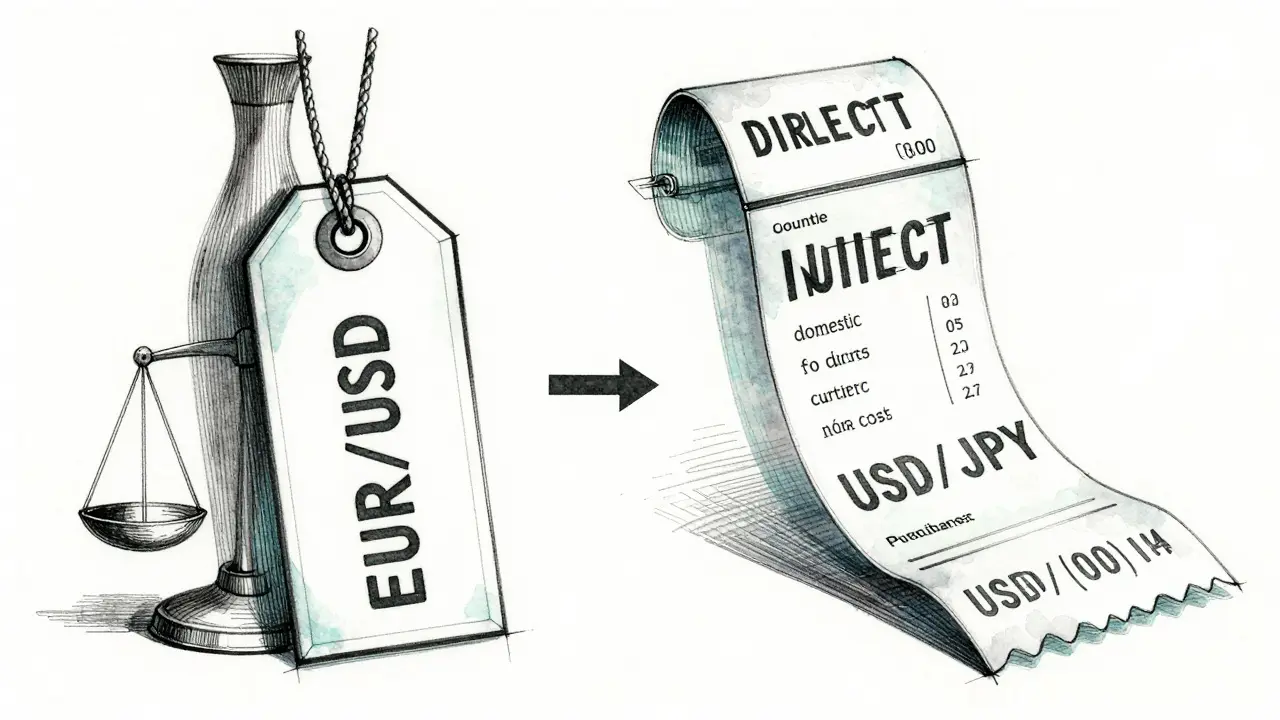
Think of shopping. A direct quote is like a price tag: it tells you how much of your home currency (cash) you need to pay for one unit of the foreign item. An indirect quote is like a receipt showing how much foreign stuff you got for your dollar. If your home currency is in the second spot (e.g., EUR/USD for Americans), it is direct. If it is in the first spot (e.g., USD/JPY), it is indirect.
Does the type of quote affect my profit or loss?
The quote type itself does not change the market direction, but it drastically affects how you calculate pip value. In direct quotes, pip values are usually constant. In indirect quotes, pip values fluctuate with the exchange rate. Misunderstanding this can lead to incorrect position sizing, causing you to risk more money than you intended.
Which quote type is better for beginners?
Direct quotes are generally better for beginners because they align with everyday shopping logic. Seeing the price of a foreign currency in your own money makes it easier to visualize gains and losses without complex mental math. Most retail brokers default to direct quotes for this reason.
How do I calculate the inverse of a forex quote?
To convert a direct quote to an indirect quote (or vice versa), simply divide 1 by the current exchange rate. For example, if EUR/USD is 1.1000, the inverse USD/EUR is 1 / 1.1000 = 0.9091. This mathematical relationship ensures arbitrage opportunities are eliminated across global markets.
Do cryptocurrency trades use direct or indirect quotes?
Cryptocurrency exchanges typically use a hybrid approach. Most BTC/USD pairs are quoted directly (how many dollars for one Bitcoin). However, crypto-to-crypto pairs (like ETH/BTC) function like cross-currency forex pairs. Understanding the base/quote dynamic is essential here too, as leverage and margin calculations depend on which asset is the collateral.