
When it comes to cryptocurrency, Ecuador sits in a strange place. You can buy Bitcoin. You can hold Ethereum. You can even trade crypto peer-to-peer with cash in Guayaquil. But if you try to use your bank account to do any of it, your transaction will get blocked. Your account might even get frozen. That’s the reality in Ecuador today - a country where crypto isn’t illegal, but it’s also not allowed to exist within the formal financial system.
What’s Actually Banned?
The Central Bank of Ecuador (BCE) made it crystal clear in August 2024: cryptocurrencies are not legal tender and cannot be used as payment. This isn’t a new rule. It’s based on Article 94 of the Organic Monetary and Financial Code, which has kept the US dollar as the only official currency since 2000. The BCE doesn’t want competition. It doesn’t want volatility. And it doesn’t want people bypassing the banking system.
But here’s the twist: no law says you can’t own crypto. You won’t go to jail for buying Bitcoin on Binance. You won’t be fined for holding USDT in a wallet. The government isn’t raiding homes. Instead, they’ve built a wall around the financial system. Banks, insurers, payment processors - all are legally required to refuse any transaction tied to cryptocurrency. Credit cards? Blocked. Bank transfers? Rejected. Even mobile wallets like Dinero Electrónico, launched in 2015, barely got off the ground (only 0.5% adoption). So if you want crypto in Ecuador, you have to find a way around the system.
How Do People Even Buy Crypto?
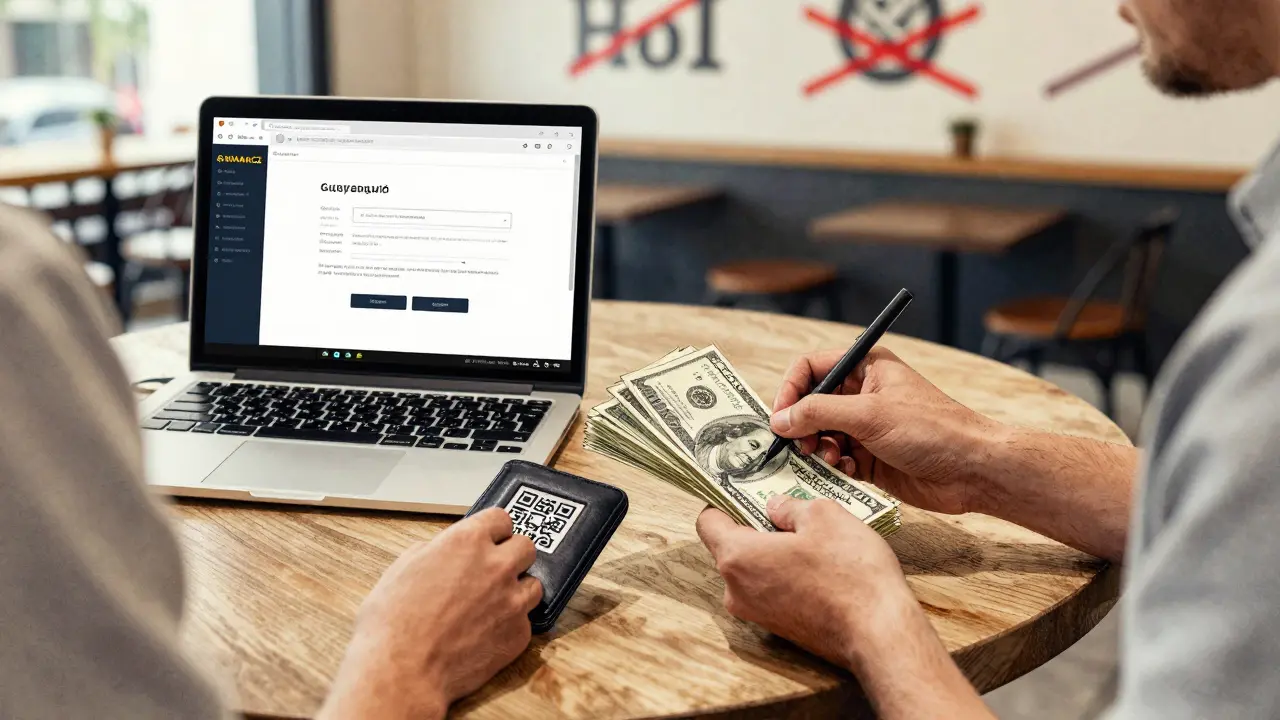
Most Ecuadorians who own crypto use peer-to-peer (P2P) platforms. Think Mercado Bitcoin, LocalBitcoins, or Telegram OTC desks. You find someone willing to sell. You meet in a mall, a café, or even a parking lot. You hand over cash. They send you the crypto. It’s risky, but it’s the only option for most.
Why? Because banks actively block anything that looks like crypto. A user on Reddit’s r/CryptoEcuador shared that their bank froze three accounts this year after trying to send money to Binance - totaling $850 in lost funds. International exchanges report Ecuador as one of the hardest markets to serve. Trustpilot reviews from Ecuadorian users average just 2.1 out of 5. Common complaints? Constant verification blocks, transaction rejections, and delays that last days.
And it’s expensive. Because of low liquidity and high risk, crypto prices in Ecuador often trade at an 8-12% premium over global rates. That means if Bitcoin is $70,000 elsewhere, you’ll pay $75,600 in cash to get it here. Plus, OTC sellers charge 5-7% just to handle the cash exchange. You’re not just paying for crypto - you’re paying for the lack of infrastructure.
Who’s Using Crypto - And Why?
Only 2.73% of Ecuador’s population owns cryptocurrency, according to OWNR Wallet’s 2023 study. That’s far below the Latin American average of 10.9%. But that number is misleading. The real users aren’t investors. They’re remittance receivers.
Ecuador gets $3.8 billion in remittances every year - about 8.5% of its entire GDP. The average fee to send money here? 6.3%. The UN target? 3%. That’s a huge tax on families. Many people abroad now send crypto instead of traditional wire transfers. A 2024 OWNR Wallet survey found that 68% of Ecuadorian crypto owners receive funds this way. They convert it to cash through local OTC traders. It’s faster. It’s cheaper. And it’s the only way for many unbanked families to get money from relatives in the US or Spain.
There’s also a growing group of young entrepreneurs and freelancers who use crypto to get paid. A designer in Quito might invoice a client in the US in USDT. A developer in Cuenca might accept Bitcoin for a website. But they have to cash out fast - because holding crypto means holding risk. No insurance. No legal recourse. No consumer protection.
Why Is the Government So Strict?
The BCE’s official line is simple: protect dollarization. Ecuador abandoned its own currency in 2000. The US dollar is everywhere - from gas stations to grocery stores. The government fears that if crypto becomes popular, people might start using it as money. That could destabilize the economy. It’s not a crazy fear. In 2023, the BCE reported $1.2 billion in unexplained capital outflows. Some analysts believe crypto played a role.
But critics say it’s more about control than stability. The UN Economic Commission for Latin America (ECLAC) called Ecuador’s approach “contrary to financial inclusion goals.” Half of Ecuador’s adult population doesn’t have a bank account. For them, crypto could be a lifeline. Instead, they’re pushed into risky, unregulated channels.
Carlos Rodriguez, founder of PayGo, a fintech startup in Quito, put it bluntly in a June 2024 CoinDesk interview: “The government’s reluctance stems from fear of capital flight - not legitimate regulation.”
What About Mining?
There’s no law banning crypto mining in Ecuador. But good luck doing it. Electricity costs $0.145 per kWh - 23% higher than the Latin American average. The power grid is unreliable, with outages averaging 14.7 hours per month. And importing mining rigs? You’ll pay a 35% import duty on top of the price. The result? No large-scale farms. Just a few hundred small setups in homes around Quito and Guayaquil. The total hash rate? Less than 0.0001% of the global network. It’s not worth the cost.
How Does Taxation Work?
The Internal Revenue Service (SRI) doesn’t ignore crypto. If you sell Bitcoin and make a profit, you owe taxes. Gains are treated as income. Individuals pay up to 35%. Companies pay 25%. There’s no official guidance on how to report it. No forms. No instructions. You’re on your own. Many users don’t report at all - not because they’re trying to cheat, but because they don’t know how.
How Does Ecuador Compare to Neighbors?
It’s one of the strictest in Latin America.
- Paraguay: Allows crypto payments and mining under a 2022 law - just register and follow AML rules.
- Mexico: Classifies crypto as virtual assets. Exchanges must be licensed.
- Peru: As of June 2025, all crypto services must register with the Financial Intelligence Unit.
- Ecuador: No licensing. No legal recognition. No pathway for businesses.
Ecuador isn’t trying to regulate. It’s trying to erase crypto from the financial system. That’s why no domestic exchange exists. All trading flows through offshore platforms. No local company can legally offer crypto services - not even a simple wallet app.

What’s Next?
Change is coming - but slowly.
In early 2025, new rules took effect for fintech startups. They now need to be incorporated as sociedades anónimas, have at least $200,000 in capital, carry liability insurance, and get special approval for any tech-based financial service. This doesn’t help crypto users - but it shows the government is starting to think about digital finance.
The BCE is also quietly working on a Central Bank Digital Currency (CBDC) - a digital version of the US dollar. It’s not Bitcoin. It’s not Ethereum. It’s a government-controlled digital dollar. If it launches, it could open the door for regulated crypto services later. But don’t expect that before 2027.
Industry analysts predict that if restrictions ease, Ecuador’s crypto market could grow from $135 million to $300 million in annual volume by 2026. But without policy change, it’ll stay stuck.
What Should You Do If You’re in Ecuador?
If you’re trying to use crypto here, here’s what works:
- Use P2P platforms like Mercado Bitcoin or Telegram OTC desks - not bank transfers.
- Always meet in public places for cash trades. Record the transaction if you can.
- Keep records of all buys and sells. Even if the government doesn’t require it, you’ll need proof for taxes.
- Don’t trust anyone who promises “guaranteed” crypto sales. Scams are common - 23% of users reported fraud attempts in 2024.
- Join local Telegram groups. They’re the only real source of updated info.
And if you’re thinking of starting a crypto business? Forget it. Until the government creates a licensing system, you’re operating in legal limbo. The risk isn’t worth it.
Final Thoughts
Ecuador’s crypto rules aren’t about safety. They’re about control. The government wants people to use dollars - and only dollars. But the people are finding ways around it. Remittances, freelancing, savings - crypto fills gaps the banking system refuses to. The problem isn’t that crypto is dangerous. It’s that the system refuses to let it work legally.
Until then, Ecuadorians will keep meeting in cafés with cash in hand, hoping the next transaction doesn’t get blocked - or worse, flagged.


