

Imagine you have money in one bank, but you need to pay someone who only accepts cash from a different bank. You can’t just walk from one to the other - they don’t talk to each other. That’s exactly what blockchains are like. Bitcoin doesn’t know how to talk to Ethereum. Solana can’t directly send tokens to Polygon. And that’s where cross-chain bridge technology comes in. It’s the digital equivalent of a currency exchange kiosk that lets you move value between isolated financial systems - but with far higher stakes.
Why Cross-Chain Bridges Exist
Blockchains were never meant to work together. Each one has its own rules, its own language, its own way of confirming transactions. Bitcoin uses Proof of Work. Solana uses Proof of History. Ethereum moved to Proof of Stake. Their smart contracts are written in different languages. Their security models vary wildly. Without bridges, you’d be stuck on one chain forever. If you owned ETH but wanted to use a DeFi app on Avalanche, you’d have to sell your ETH, buy AVAX, and hope the price didn’t swing against you in the process. That’s slow, expensive, and frustrating. Cross-chain bridges fix that. They let you lock your original asset on one chain and get a version of it on another. That version isn’t the real thing - it’s a tokenized copy. Think of it like a boarding pass for a flight. You don’t get to keep the original ticket, but you get something that lets you board. In crypto terms, that’s called a wrapped asset. The most famous example is wBTC - Bitcoin locked on Ethereum as a token. As of October 2023, over 185,000 BTC had been bridged into wBTC, making it one of the most valuable assets in DeFi.How Cross-Chain Bridges Work
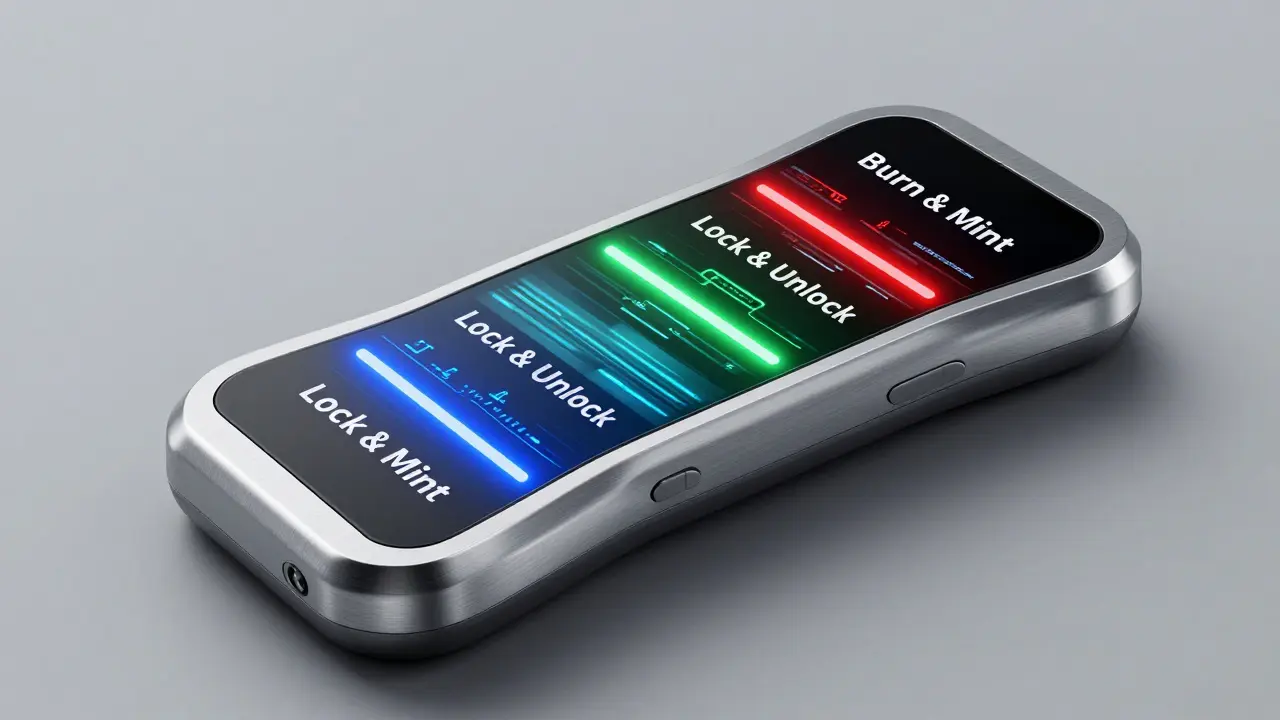
There are three main ways bridges move assets between chains. Each has trade-offs in speed, cost, and security.- Lock and Mint: You send your ETH to a smart contract on Ethereum. That contract locks it. Then, a bridge mints an equivalent amount of wETH on Polygon. To get your ETH back, you burn the wETH and the original ETH is unlocked. This is used by the Avalanche Bridge and Polygon PoS Bridge. It’s fast and efficient, but you’re trusting the bridge operator to not steal your locked funds.
- Lock and Unlock: Instead of minting new tokens, the bridge taps into a pool of native assets already sitting on the destination chain. You lock your ETH on Ethereum. Someone else unlocks the same amount of ETH from a liquidity pool on Solana. This is how THORChain works. It’s more decentralized because you’re getting the real asset, not a wrapped version. But it needs constant liquidity. If no one’s depositing ETH into the pool, your transfer gets stuck.
- Burn and Mint: You burn your original tokens on Chain A. That’s irreversible. Then, the bridge mints new tokens on Chain B. This avoids locking funds, but if something goes wrong - like a hacker tricks the system - there’s no undo button. The 2022 Harmony Horizon Bridge hack lost $100 million this way. The burned coins were gone forever.
Then there’s the newest type: programmable bridges. These don’t just move tokens. They move data. Chainlink’s CCIP lets you trigger a loan on Aave from a wallet on Arbitrum. You can send a message that says, “When this NFT sells, pay 5% to this wallet.” This is the future - bridges as communication channels, not just transfer tools.
Trusted vs. Trust-Minimized Bridges
Not all bridges are built the same. Some rely on a small group of validators. Others use complex cryptography to reduce trust.- Trusted (Federated) Bridges: These use 10 to 100 validators - often controlled by the project team. The Polygon PoS Bridge uses 100 validators run by Polygon Labs. It’s processed over 2.5 million transactions a day since 2021. It’s fast and reliable. But if those validators get hacked or collude, your money is gone. Multichain (formerly Anyswap), which uses 29 nodes, has had zero major hacks since 2020. That’s because they’re well-run. But they’re still centralized.
- Trust-Minimized Bridges: These try to eliminate trust by using cryptographic proofs. THORChain uses a decentralized network of nodes that require multiple signatures to move funds. Chainlink’s CCIP uses a decentralized oracle network to verify state across chains. These are slower and more complex, but they’re harder to hack. The problem? They’re still new. In 2022, Wormhole lost $320 million because a single private key was leaked. Nomad lost $190 million because of a bug that let anyone claim unlimited funds. Trust-minimized doesn’t mean foolproof. It just means fewer points of failure.
As of Q3 2023, decentralized bridges held 65% of the total value locked ($16.25 billion). But the top five bridges - Multichain, Polygon PoS, Avalanche Bridge, THORChain, and Synapse - controlled 78% of all volume. That’s not decentralization. That’s concentration.
The Security Crisis
Cross-chain bridges are the most hacked part of DeFi. In 2022, bridges were behind 69% of all major crypto hacks, costing users $2.4 billion, according to Chainalysis. That’s more than all other DeFi protocols combined. Why? Because bridges are complex. They’re software that connects two already complex systems. One small bug - a missing signature check, a misconfigured validator set - can let attackers drain millions. The most common attack? Validator collusion. Halborn Security found that 67% of bridges use fewer than 15 validators. That’s not a network. That’s a small team with keys to the vault. If one gets compromised, or if five of them decide to run off with the funds, the bridge collapses. Even the most advanced bridges aren’t immune. Chainlink’s CCIP, which promises proof-of-reserves and cryptographic verification, is still in alpha. It’s been tested on 1.2 million transactions without a breach - but it’s not live yet. Real-world pressure hasn’t been applied.Real-World Use Cases
Bridges aren’t just for speculators. They’re essential infrastructure.- DeFi Farmers: A user might earn yield on Ethereum, but the best APYs are on Base or zkSync. They bridge their ETH to access those pools.
- NFT Collectors: An NFT bought on Ethereum might be listed for sale on Solana. A bridge lets the buyer pay in SOL instead of ETH.
- Enterprise Users: Gartner reports 28 Fortune 500 companies now use private cross-chain bridges for supply chain tracking and settlement. One major bank uses a bridge to move tokenized bonds between its private Ethereum chain and a public Polygon chain for transparency.
- Developers: Building a dApp that needs to pull price data from Bitcoin and execute trades on Arbitrum? You need a programmable bridge like CCIP.
Over 42% of Ethereum users have used a bridge at least once. For DeFi power users, that number jumps to 78%. If you’re active in crypto, you’ve probably used one without even realizing it.

What’s Next for Cross-Chain Bridges
The market is crowded. Over 120 bridges are live. But most won’t survive. Delphi Digital predicts 90% of standalone bridge projects will fail by 2028. Why? Because the future belongs to integrated solutions. Polkadot’s XCMP lets parachains talk to each other natively. Cosmos IBC does the same for its ecosystem. LayerZero Labs is building a universal messaging protocol that could connect any chain without custom connectors. If you’re building a bridge today, you’re not just competing with other bridges. You’re competing with the next generation of blockchains that were built to talk from day one. Security budgets are another red flag. OtterSec found that most bridges spend only 12% of their revenue on security. Experts say they need 25-30%. Without that, you’re gambling with user funds. The winners will be the ones who combine decentralization with reliability. That means large validator sets, open-source code, third-party audits, and transparent governance. Chainlink CCIP, Polkadot XCMP, and Cosmos IBC are leading the charge. They’re not flashy. They’re not the fastest. But they’re built to last.What You Should Do
If you’re using a bridge:- Know which one you’re using. Check its TVL, validator count, and audit history.
- Avoid bridges with fewer than 15 validators unless they’re backed by a major team (like Polygon or Avalanche).
- Don’t bridge more than you can afford to lose. Even the safest bridges have failed.
- Use bridges that return native assets (lock/unlock) instead of wrapped tokens when possible.
- Watch for delays. If your transaction is stuck for more than 15 minutes, check the bridge’s status page or community forums. Stuck transactions are common.
If you’re a developer: Learn how bridges work under the hood. Study Solidity, Rust, and Chainlink’s CCIP documentation. Understand state synchronization and signature verification. The next great bridge might be built by someone who just learned this today.
The blockchain world isn’t one chain. It’s hundreds. And bridges are the highways between them. They’re messy, risky, and imperfect - but they’re necessary. The future of crypto isn’t about choosing one chain. It’s about moving freely between them. And that future depends on bridges that are secure, reliable, and open.
What is a cross-chain bridge in simple terms?
A cross-chain bridge is like a digital ferry that lets you move crypto from one blockchain to another. If you have Ethereum and want to use a DeFi app on Solana, the bridge locks your ETH and gives you a copy of it on Solana. You can move it back later, but you’re trusting the bridge to do it correctly.
Are cross-chain bridges safe?
Some are, most aren’t. Over $2.4 billion has been stolen from bridges in 2022 alone. Trusted bridges with large validator teams (like Polygon or Avalanche) are safer than small, decentralized ones. Always check the bridge’s audit history, TVL, and how many validators it uses. Never bridge more than you can afford to lose.
What’s the difference between wrapped assets and native assets on bridges?
Wrapped assets (like wBTC or wETH) are tokens created on the destination chain that represent the original asset. They’re not the real thing - they’re a promise. Native assets are the actual coins moved from one chain to another, usually through liquidity pools. Native transfers are more secure because you get the real token, not a copy. But they require more liquidity and are slower.
Why do some bridges cost more than others?
Fees come from three places: gas on the source chain, gas on the destination chain, and the bridge’s own service fee (usually 0.05%-0.5%). Bridges that use complex cryptography (like THORChain) or require liquidity pools may charge more. Fast bridges like Polygon’s often have lower fees because they’re optimized for high volume. Always check the total cost before sending.
Can I get my money back if a bridge fails?
Almost never. If a bridge gets hacked or shuts down, your funds are usually gone. There’s no FDIC for crypto. The 2022 Nomad hack let users claim unlimited funds - but when the exploit was fixed, the stolen money was never recovered. Always assume your funds are at risk. Use only well-established bridges and keep backups of your private keys.
What’s the future of cross-chain bridges?
The future is in integrated protocols, not standalone bridges. Projects like Chainlink CCIP, Polkadot XCMP, and Cosmos IBC are building native interoperability into blockchains themselves. Standalone bridges will fade as these become standard. By 2028, most bridges will be obsolete unless they’re part of a major ecosystem. The goal isn’t to connect chains - it’s to make chains work together from the start.


