
You’ve probably heard the big names by now-Binance, Coinbase, Kraken. They dominate the headlines and the rankings. But what about Counos Exchange, a platform that promises to bridge the gap between traditional banking and crypto through a unique ecosystem of stablecoins and escrow services? It’s not on your standard "top 10" lists. In fact, if you look at major data aggregators like CoinGecko or Kaiko as of mid-2026, you won’t find it there at all.
That silence is loud. For a crypto trader, missing from these rankings usually means one of two things: either the platform is so new it hasn't been indexed yet, or its trading volume is simply too low to register on global scales. Since Counos has been around since roughly 2019, we are likely looking at the latter. This raises a critical question for anyone considering moving funds there: Is this a hidden gem for niche enterprise users, or should you steer clear due to a lack of transparency? Let’s break down exactly what Counos offers, where the risks lie, and whether it fits into your portfolio strategy in 2026.
What Exactly Is Counos Exchange?
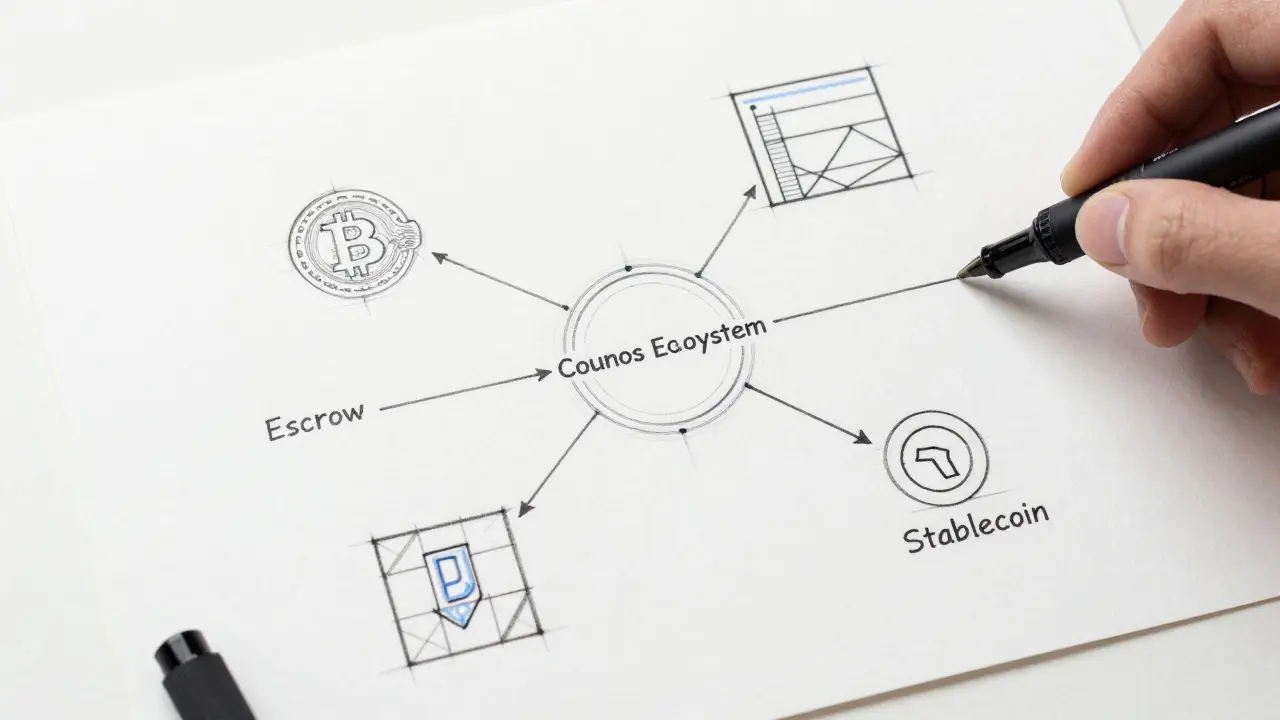
To understand the exchange, you first have to understand the ecosystem. Counos is a blockchain-based financial services provider headquartered in Switzerland (operating via Counos OÜ). Unlike typical exchanges that exist solely to match buyers and sellers, Counos positions itself as a comprehensive financial infrastructure. Their goal is to create a "European-Middle Eastern crypto-financial ecosystem."
The centralized exchange is just one pillar of this structure. It sits alongside several other products:
- Counos DEX: A decentralized exchange component using atomic swaps.
- Counos Payment Gateway: Allows merchants to accept crypto and settle in fiat.
- Counos Escrow System: Provides secure holding of funds for trades.
- Counos Wallet: A custodial wallet solution integrated with the platform.
The centralized exchange acts as the liquidity hub for this system. It allows you to trade major cryptocurrencies like Bitcoin (BTC) and Litecoin (LTC) against Counos’ proprietary assets. These include Counos Coin (CCA), Counos X (CCXX), and various fiat-pegged stablecoins like Counos USD, Counos EUR, and Counos CAD.
So, why would you use it? The main selling point isn't speed or low fees-it's integration. If you are a business operating in Europe or the Middle East and want to accept payments, hold them in escrow, and convert them to local currency seamlessly, Counos attempts to offer an all-in-one suite. For a retail trader just wanting to flip Bitcoin for profit, however, the value proposition is much thinner.
The Liquidity Problem: Why You Won't Find It on Rankings
Here is the hard truth that most marketing materials gloss over: Liquidity matters. Liquidity determines how easily you can buy or sell an asset without causing a massive price swing. High-volume exchanges like Binance or Coinbase process billions of dollars daily, ensuring tight spreads and instant execution.
Counos Exchange does not appear in the Q2 2026 rankings from CoinGecko or Kaiko. These platforms track trust scores, data transparency, and verified volume. When an exchange is absent from these indices, it signals that its reported trading volume is negligible compared to market leaders.
This creates a specific risk profile for users:
- Slippage Risk: Because the order book is shallow, placing a large market order could result in significant slippage. You might intend to buy BTC at $65,000, but end up paying $65,500 because there aren't enough sellers at the lower price points.
- Withdrawal Delays: Lower volume often correlates with less robust operational infrastructure. While Counos claims "world-class safety," the lack of high-frequency trading pressure means their systems haven't been stress-tested by millions of concurrent users in the same way major venues have.
- Asset Concentration: Most of the liquidity likely revolves around their own tokens (CCA and CCXX). If you try to trade obscure pairs, you may find yourself unable to exit the position quickly.
If you are looking for a place to park large sums of capital for day trading, this absence from major rankings is a red flag. If you are looking to utilize their specific stablecoins or escrow services for a B2B transaction, the liquidity concern is less relevant, provided the counterparty agrees to use the platform.
Security and Compliance: The Swiss Angle
Counos leans heavily on its European roots, specifically its connection to Switzerland, to build trust. They emphasize strict adherence to KYC (Know Your Customer) and AML (Anti-Money Laundering) regulations. They also claim compliance with GDPR and CFT (Counter-Financing of Terrorism) standards.
On paper, this sounds reassuring. In practice, you need to dig deeper. As of 2026, there are no public records of independent penetration tests, smart contract audits for their centralized engine, or bug bounty programs listed on major security aggregators. Major exchanges typically publish annual security reports or undergo audits by firms like CertiK or Hacken. Counos does not provide these specific technical validations publicly.
They do mention "multi-layer security," including cold storage separation and encryption, which is industry standard. However, without third-party verification, these remain self-reported claims. Furthermore, while they operate under Swiss corporate structures (Counos OÜ), a search of major regulatory registers like FINMA (Swiss Financial Market Supervisory Authority) does not prominently list Counos Exchange as a fully licensed securities or derivatives trading venue. They appear to operate in the gray area of spot crypto trading and payment facilitation, which is lightly regulated compared to traditional banking.
For a user, this means:
- High Friction Onboarding: Expect rigorous identity verification. You will need to upload ID documents and proof of address before accessing any fiat-linked features or higher withdrawal limits.
- Data Privacy: While GDPR compliance protects your data rights within the EU, it also means your personal information is stored and processed centrally. In a custodial model like Counos, you do not control your private keys.

Fees and Costs: What Will It Cost You?
Transparency in pricing is another area where Counos falls short of mainstream competitors. Exchanges like Coinbase or Kraken publish detailed fee schedules showing maker/taker rates based on your 30-day volume. For example, a top-tier user on Binance might pay 0.04% per trade.
Counos does not publish a clear, static fee table on neutral third-party sites. Their official documentation mentions "competitive fees" and hints at discounts for holders of the Counos X (CCXX) token. Some archived marketing materials suggest potential reductions, but exact percentages (e.g., 0.10% maker fee) are not consistently verifiable across independent sources in 2026.
Hidden costs can creep in elsewhere:
- Spread Costs: Due to low liquidity, the difference between the buy and sell price (the spread) might be wider than on larger exchanges, effectively acting as a hidden fee.
- Deposit/Withdrawal Fees: While crypto withdrawals usually incur network gas fees, fiat deposits via their payment gateway may carry processing charges that aren't immediately obvious during sign-up.
- Token Utility: To get the best rates, you may be pressured to hold CCXX. This introduces additional market risk-if the token's value drops, your "savings" on fees might be wiped out by the loss in asset value.
Before depositing, you must contact their support or read their latest terms of service carefully to confirm current rates. Never assume they match the low fees of giants like Bybit or OKX.
User Experience and Support
Since Counos is web-based and lacks a prominent standalone mobile app on major stores like the Apple App Store or Google Play, your experience will largely depend on their website's mobile responsiveness. The interface is designed to be functional rather than flashy, prioritizing the integration of their wallet, exchange, and payment tools.
Support channels are primarily limited to their official website FAQs and email/contact forms. There is no vibrant community presence on Reddit or Trustpilot. For context, even smaller exchanges often have hundreds of reviews on Trustpilot; Counos has virtually none. This makes it difficult to gauge customer service quality. Are they responsive when a withdrawal gets stuck? Do they resolve KYC issues quickly? Without user-generated content, you are flying blind.
For developers, the situation is similar. There is no widely adopted SDK or API documentation on GitHub. If you are an algorithmic trader looking to build bots, you will face a steep learning curve trying to reverse-engineer their endpoints, whereas connecting to Binance or Kraken takes minutes thanks to extensive community libraries.

Who Should Use Counos Exchange? (And Who Shouldn't)
Let’s cut through the noise. Is Counos Exchange right for you? Here is a breakdown based on user personas.
| User Type | Verdict | Reasoning |
|---|---|---|
| Retail Day Trader | Avoid | Low liquidity leads to slippage. Lack of advanced charting tools and API support. Better options exist (Binance, Kraken). |
| B2B Merchant (EU/Middle East) | Consider | If you need integrated escrow, stablecoin settlement, and fiat off-ramps in specific regions, their ecosystem adds value. |
| CCXX Token Holder | Use with Caution | You may need the exchange to swap your tokens. Be aware of the difficulty in exiting the ecosystem back to major cryptos. |
| Institutional Investor | Avoid | Lack of audited security reports, transparent volume data, and regulatory clarity makes it unsuitable for large institutional allocations. |
If you fall into the "Avoid" category, stick to platforms that are ranked, audited, and have thousands of user reviews. The convenience of an all-in-one ecosystem rarely outweighs the risks of illiquidity and opacity for pure trading purposes.
Alternatives to Consider
If you are looking for a regulated, secure, and liquid exchange, here are three alternatives that dominate the market in 2026:
- Kraken: Known for strong security, excellent customer support, and transparent fee structures. Great for both beginners and advanced traders. Fully compliant with US and EU regulations.
- Coinbase: The go-to for ease of use and fiat on-ramps. Publicly traded company, offering a layer of financial accountability. Ideal for long-term holders who prioritize safety over low fees.
- Binance: Offers the deepest liquidity and widest range of altcoins. While facing regulatory hurdles in some jurisdictions, it remains the volume leader globally. Best for active traders seeking low fees and high leverage options.
Each of these platforms appears in CoinGecko and Kaiko rankings, has published security audits, and boasts massive user communities. Switching from a niche platform like Counos to one of these giants reduces your counterparty risk significantly.
Final Thoughts on Counos Exchange
Counos Exchange is not a scam in the traditional sense-it is a legitimate part of a broader fintech project aiming to digitize payments and escrow services. However, as a standalone cryptocurrency exchange, it suffers from critical weaknesses: low liquidity, lack of independent security audits, opaque fee structures, and minimal user feedback.
Its value lies strictly within its own walled garden. If you are already deep in the Counos ecosystem-using their wallets, holding CCXX, or utilizing their merchant gateway-the exchange serves a necessary utility function. But for anyone else entering the crypto space in 2026, starting here is like buying a car from a dealer who doesn't let you see the mileage or the mechanic's report. Stick to the proven, transparent, and highly liquid alternatives unless you have a very specific business reason to engage with Counos.
Is Counos Exchange regulated?
Counos operates under Swiss corporate structures (Counos OÜ) and emphasizes KYC/AML compliance. However, it is not prominently listed as a fully licensed securities or derivatives trading venue by major regulators like FINMA. It operates primarily in the spot trading and payment facilitation space, which is less strictly regulated than traditional finance.
Why isn't Counos Exchange on CoinGecko or Kaiko?
These platforms rank exchanges based on verified trading volume, trust scores, and data transparency. Counos' absence suggests its trading volume is too low to meet the indexing thresholds of these major data aggregators, indicating it is a niche or low-liquidity venue compared to global leaders.
Can I trade Bitcoin on Counos?
Yes, Counos supports spot trading for Bitcoin (BTC) and Litecoin (LTC) against their proprietary tokens (CCA, CCXX) and stablecoins. However, due to low liquidity, you may experience higher slippage compared to larger exchanges.
Does Counos have a mobile app?
As of 2026, there is no prominent standalone "Counos Exchange" app on major app stores. Users typically access the platform via a mobile-friendly web browser or potentially through the integrated Counos Wallet application.
Are there independent security audits for Counos?
No publicly available, independent penetration test reports or smart contract audits for the centralized exchange are widely cited in mainstream security databases as of mid-2026. Security claims are currently self-reported by the company.