

Imagine getting paid for a damaged roof before the adjuster even shows up. No paperwork. No waiting weeks. Just a payout the moment weather sensors confirm hail hit your house. That’s not science fiction-it’s what blockchain insurance platforms are making real today.
Traditional insurance moves at the speed of bureaucracy. Claims take days. Fraud is rampant. Middlemen take 25% of your premium just to file forms. Meanwhile, blockchain insurance platforms cut through the noise with code. They use smart contracts-self-executing agreements on a public ledger-to automate everything from policy issuance to payouts. And it’s not just theory. By 2025, over 22% of large insurers have already launched at least one blockchain-based product, with property and casualty insurers leading the charge.
How Blockchain Insurance Actually Works
At its core, blockchain insurance replaces paper policies and human reviewers with code that runs on a distributed network. Think of it like a vending machine for insurance: you put in your premium, the machine checks the conditions, and if they’re met, it dispenses your payout-no clerk needed.
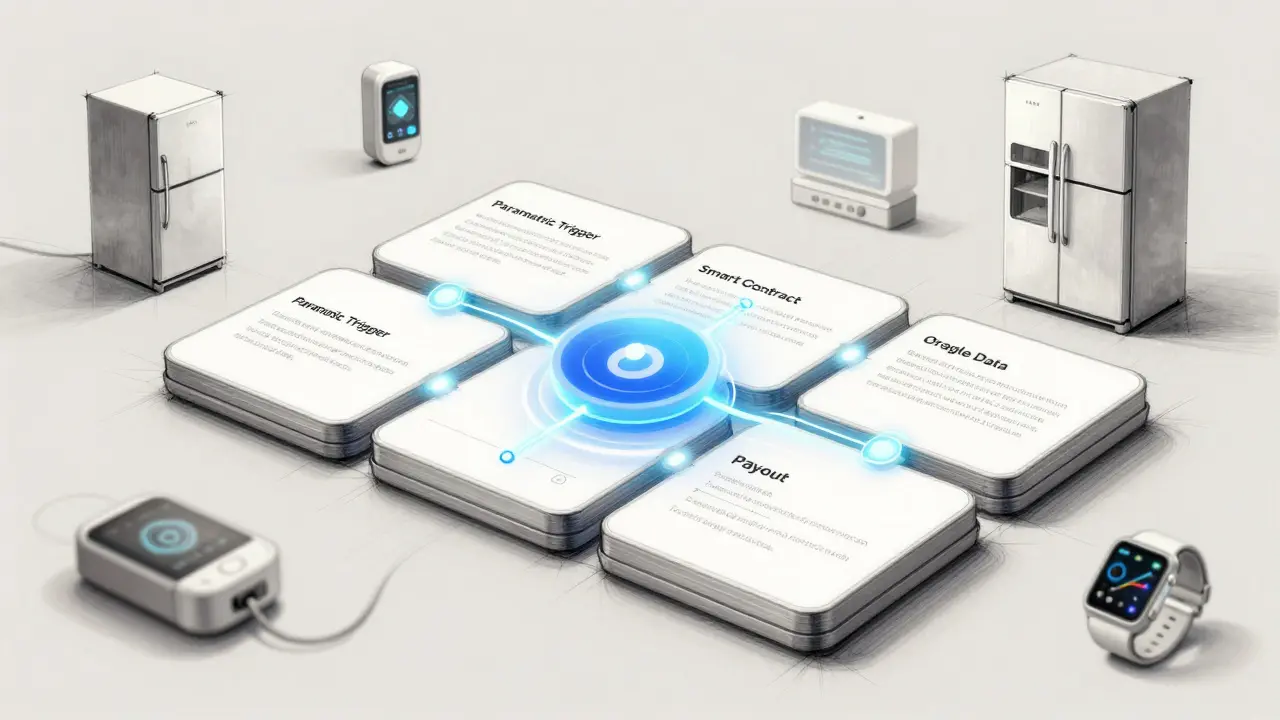
The magic happens through smart contracts, mostly built on Ethereum. These contracts are programmed with rules like: “If wind speed exceeds 120 km/h in Auckland, as verified by NOAA weather data, pay $5,000 to policyholder X.” The data comes from trusted external sources called oracles-like Chainlink-that feed real-world info into the blockchain. Once the trigger is confirmed, the payment is sent automatically to the wallet address linked to the policy.
This isn’t just faster-it’s tamper-proof. Every step is recorded on an immutable ledger. No one can alter a claim after the fact. That’s why fraud rates in blockchain-based insurance are estimated to be 30-40% lower than in traditional systems, according to Velvetech’s 2024 case studies.
Where It’s Making the Biggest Difference
Blockchain insurance doesn’t replace all types of coverage. It shines where rules are clear and outcomes are measurable. That’s why three use cases dominate:
- Cyber insurance for DeFi protocols: Traditional insurers won’t touch smart contract hacks. But Nexus Mutual, launched in 2017, lets users pool funds to cover losses from code exploits. If a protocol gets hacked and the community votes it’s valid, payouts happen in hours.
- Parametric weather insurance: Farmers in Southeast Asia and New Zealand use these policies to protect against drought or flooding. Sensors trigger payouts instantly-no crop inspection needed. In 2024, Uno Re rolled out a pilot in Fiji that paid out 97% of claims within 12 minutes.
- Smart contract coverage: Developers building on Ethereum or Solana can buy insurance against bugs or exploits in their own code. OpenCover lets them specify thresholds: “If my contract loses more than $100,000 due to a reentrancy attack, pay me up to $500,000.”
These aren’t niche experiments. The global market for blockchain insurance is expected to hit $82.56 billion by 2033, growing at over 53% per year, according to Intellivon’s 2024 analysis. And it’s not just startups-Allianz, AXA, and Zurich are all testing blockchain pilots.

Why It’s Still Not Everywhere
Despite the hype, blockchain insurance hasn’t replaced your local agent. Why? Because not every claim fits a binary rule.
Only about 15% of insurance claims today can be fully automated, according to KMS Technology’s 2025 report. What happens when someone slips on a wet floor in a store? Who’s at fault? Was the sign visible? Was the floor properly maintained? These require judgment, witnesses, legal review-things no smart contract can handle yet.
Then there’s the tech gap. Ethereum, the most popular platform, can only process 15-30 transactions per second. A major insurer handles millions of claims annually. That’s why most pilots use hybrid models-keeping core systems on legacy infrastructure and using blockchain only for specific automated triggers.
Regulation is another hurdle. As of Q1 2025, only 28 countries have clear rules for blockchain insurance. The EU’s MiCA framework is the most advanced, but in the U.S., each state sets its own rules. That makes it hard for a company to offer a nationwide product.
And integration? A nightmare. Most insurers still run on 20-year-old software. Connecting blockchain to those systems takes 35-40% of project time and cost, according to Accenture’s 2025 guide. That’s why many startups focus on greenfield markets-new insurance products built from scratch on-chain-rather than trying to retrofit old ones.
Who’s Leading the Pack
Several platforms are setting the standard:
- Nexus Mutual: The OG. Founded in 2017, it’s a decentralized mutual where members pool capital to cover DeFi losses. Members vote on claims. It’s handled over $1.2 billion in coverage since launch.
- InsurAce: Launched in 2021, it offers multi-chain coverage for DeFi, NFTs, and crypto wallets. It uses a risk pool model where users earn rewards for providing capital.
- Uno Re: Focuses on reinsurance. It connects traditional insurers with blockchain-based capital pools, helping them offload risk more efficiently. Their 2024 pilot with a Southeast Asian insurer cut claims processing from 14 days to 8 hours.
- Nayms: Not a direct insurer, but a platform that lets insurers build their own on-chain products. Think of it as Shopify for blockchain insurance.
These aren’t just tech demos. They’re live, functional systems with real money flowing through them. Nexus Mutual has over 150,000 members. InsurAce has insured over $3 billion in crypto assets.
The Future: AI, IoT, and Cross-Chain Networks
The next wave is already here. In October 2024, Ethereum’s Dencun upgrade slashed transaction fees by 90%. That made micro-insurance-like $0.50 coverage for a single ride-share trip-economically viable for the first time.
Now, insurers are teaming up with IoT. Imagine a smart fridge that detects a power outage and automatically triggers a food spoilage claim. Or a wearable that tracks a diabetic’s glucose levels and pays out if they’re hospitalized due to a spike. KMS Technology predicts that by 2025, parametric insurance will expand into 12 new lines-from pet health to equipment rental.
Cross-chain interoperability is the next big hurdle. Right now, if you have a policy on Ethereum and another on Solana, you can’t combine them. But InsurAce and Uno Re are testing bridges that let policies flow between chains. By mid-2026, this could unlock global, multi-chain insurance pools.
And AI? It’s not replacing smart contracts-it’s enhancing them. Instead of just “if wind speed > 120 km/h,” future contracts might say: “If wind speed > 120 km/h AND roof age > 15 years AND no recent maintenance records, pay 70% of claim.” That’s the future: smart contracts that understand context, not just triggers.
What This Means for You
If you’re a crypto user, you’re already in the crosshairs. DeFi hacks cost over $2 billion in 2024 alone. If you’re holding assets on a platform without insurance, you’re gambling. Nexus Mutual and similar platforms aren’t optional-they’re essential.
If you’re a small business owner, especially in agriculture or logistics, parametric insurance could save you from ruin. No more waiting for adjusters. No more disputes over damage estimates. Just data-driven payouts.
And if you’re in insurance? The writing’s on the wall. By 2027, 77% of insurers expect smart contracts to dominate policy issuance and settlement. The question isn’t whether to adopt blockchain-it’s how fast you can learn.
Training is still a barrier. Deloitte found staff need 80-120 hours to get up to speed. But for those who do, the payoff is huge: faster claims, lower fraud, and better customer trust.
Blockchain insurance isn’t about replacing humans. It’s about removing the friction that makes insurance feel broken. It’s about turning a system built on suspicion into one built on trust-verified by code, not contracts.
The future of insurance isn’t in boardrooms. It’s in blocks. And it’s already here.
Can blockchain insurance replace traditional insurance entirely?
No, not yet. Blockchain insurance excels at automating simple, rule-based claims like weather damage or DeFi hacks-but it can’t handle complex liability cases that need human judgment, like slip-and-fall accidents or medical malpractice. Most experts predict a hybrid future where blockchain handles 30-40% of claims automatically, while traditional systems manage the rest.
Is blockchain insurance safe?
It’s safer than traditional insurance in some ways-fraud is cut by 30-40% because claims can’t be altered once recorded. But smart contracts can have bugs. If code is flawed, funds can be lost permanently. That’s why platforms like Nexus Mutual use community voting to review claims and avoid automated exploits. Always check if a platform has been audited by a reputable firm like CertiK or Trail of Bits.
How do I buy blockchain insurance?
You buy it through decentralized platforms like Nexus Mutual, InsurAce, or Uno Re. Most require you to hold cryptocurrency (like ETH or USDC) in a wallet like MetaMask. You then stake funds to purchase coverage or pay a premium directly. Coverage details are shown on-chain, and payouts go straight to your wallet. Always read the terms-some policies only cover specific protocols or events.
What’s the difference between parametric and traditional insurance?
Traditional insurance pays based on actual damage assessed by an adjuster. Parametric insurance pays when a predefined trigger occurs-like wind speed, earthquake magnitude, or temperature. No inspection needed. It’s faster and cheaper, but you might get paid even if your property wasn’t damaged, or not get paid if damage was caused by something not covered by the trigger. It’s a trade-off between speed and precision.
Are blockchain insurance platforms regulated?
Only in 28 countries as of early 2025. The EU’s MiCA framework is the most comprehensive. In the U.S., regulation is patchy-each state has different rules. Most platforms operate in a gray zone, relying on decentralized governance and user consent rather than formal licensing. That’s why they’re often called “decentralized” or “community-based”-they avoid traditional regulatory oversight by design.
Can I use blockchain insurance if I don’t know how to use crypto?
Not easily. Most platforms require a crypto wallet and understanding of gas fees, private keys, and blockchain transactions. However, some companies are building fiat on-ramps-allowing you to pay with credit cards and receive payouts in bank accounts. These are still rare, but expect them to grow as adoption increases. For now, if you’re not comfortable with crypto, stick with traditional insurers.


