

When you send Bitcoin or Ethereum, how long do you wait for it to confirm? It’s not just about patience-it’s about design. Bitcoin takes 10 minutes per block. Ethereum takes 12 seconds. That’s not a glitch. It’s intentional. And it changes everything about how you use each network.
Why Bitcoin Stays at 10 Minutes
Bitcoin’s 10-minute block time wasn’t an accident. Satoshi Nakamoto chose it in 2008 to solve a real problem: network latency. Back then, internet connections were slow and uneven across the globe. If blocks came too fast, miners in different parts of the world would mine competing blocks at the same time. That creates forks-temporary splits in the blockchain. More forks mean more wasted work and less security. To prevent that, Bitcoin’s system waits 10 minutes between blocks. That gives every node, no matter where they are, enough time to hear about the new block before the next one is even mined. It’s like letting everyone in a large room hear the announcement before the next one starts. This design makes Bitcoin incredibly stable. Even today, with thousands of mining rigs spread across continents, the average block time is still 600 seconds. Chainspect’s data from late 2023 shows it’s actually 602.4 seconds-almost perfect. That consistency is why Bitcoin is trusted for high-value transfers. If you’re moving $100,000, you don’t want speed-you want certainty. Six confirmations (about an hour) means near-zero chance of reversal.Ethereum’s 12-Second Revolution
Ethereum launched in 2015 with a 15-second block time. But that wasn’t the end of the story. In September 2022, Ethereum switched from mining (Proof of Work) to staking (Proof of Stake). That change, called The Merge, didn’t just save energy-it changed the game for speed. Under Proof of Stake, blocks are produced by a scheduled list of validators, not by miners racing to solve puzzles. That means blocks come at predictable intervals. Today, Ethereum blocks land every 12 seconds, give or take a few. Chainspect recorded an average of 12.1 seconds in late 2023. That’s 50 times faster than Bitcoin. Why does this matter? Because Ethereum isn’t just digital gold. It’s a computer. It runs apps-DeFi platforms, NFT marketplaces, DAOs, games. These apps need fast feedback. If you’re swapping tokens on Uniswap, you don’t want to wait 10 minutes to see if your trade went through. You want it done in seconds. Ethereum’s block time makes that possible.Throughput: How Many Transactions Can Each Handle?
Block time directly affects how many transactions a network can process. Bitcoin’s 10-minute blocks can fit about 2,000 transactions each. That gives it a real-world throughput of 4.6 transactions per second (TPS). Even under peak conditions, it maxes out around 7.5 TPS. Ethereum, with 12-second blocks, fits fewer transactions per block-but it produces five times as many blocks per minute. That adds up. Ethereum handles 20.6 TPS on average, with peaks hitting 35.4 TPS. Theoretically, it could do up to 120 TPS. That’s why you see DeFi apps running smoothly on Ethereum while Bitcoin struggles with simple payments. But here’s the twist: neither network is built to handle millions of transactions per second. That’s why both use layer-two solutions. Bitcoin uses the Lightning Network-a second layer that settles transactions off-chain in milliseconds. Over 14,000 Lightning nodes are active as of late 2024. Ethereum uses rollups like Arbitrum and Optimism, which bundle hundreds of transactions into one Ethereum block. Together, these layer-2s process over 5 million daily transactions, making up 72% of Ethereum’s total volume.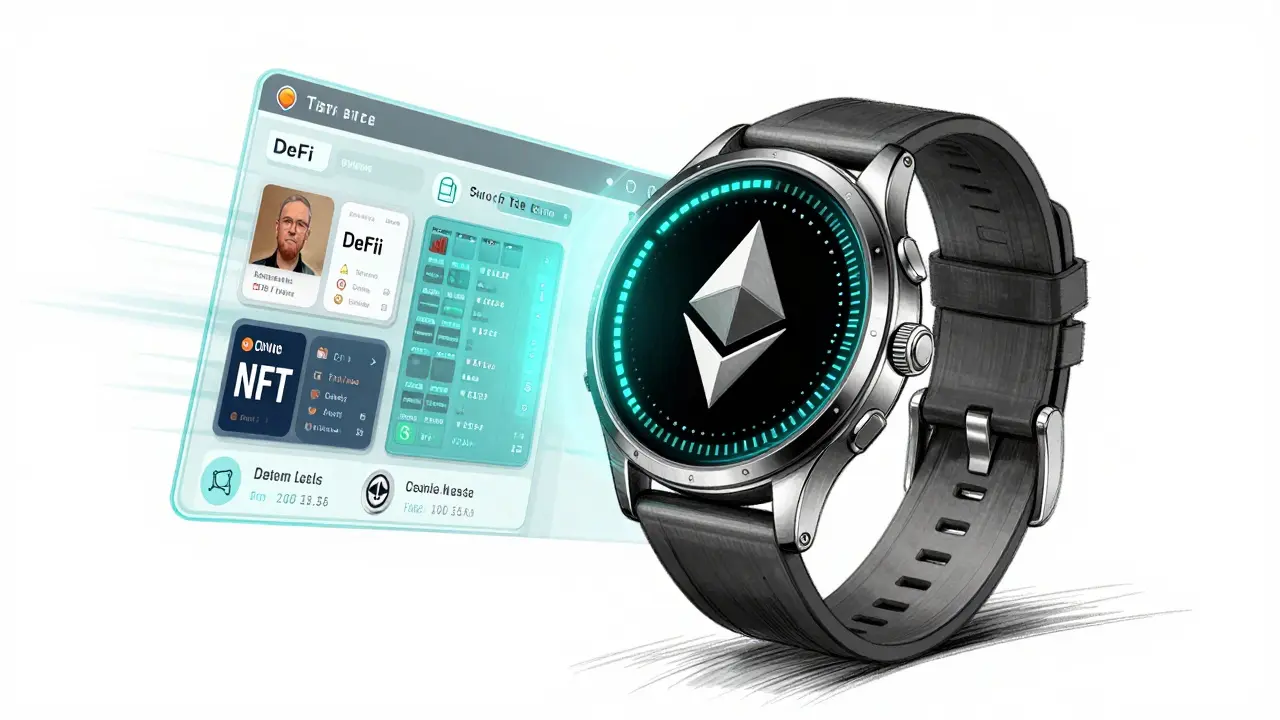
Finality: When Is a Transaction Really Done?
Speed isn’t just about how fast a block confirms-it’s about when you can trust it’s final. Bitcoin doesn’t guarantee finality after one block. Because of chain reorganizations (rare, but possible), exchanges and wallets wait for six confirmations. That’s 60 minutes. It’s slow, but it’s secure. Once six blocks are on top of yours, the cost to reverse it is astronomical. Ethereum’s finality is different. After The Merge, Ethereum added a feature called “finality” through its Casper protocol. Once a block is “justified” and “finalized,” it’s cryptographically irreversible. That happens every 15.36 minutes (64 blocks). But for most users, one confirmation is enough for confidence. Wallets like MetaMask show transactions as confirmed after just 12 seconds. Exchanges like Coinbase require only 2-6 confirmations, meaning 24-72 seconds. So while Bitcoin takes an hour to feel “done,” Ethereum feels done in under a minute. That’s why you’ll see DeFi apps auto-executing trades based on one confirmation, while Bitcoin transfers to exchanges still require 30-60 minutes.What Experts Say About the Trade-Offs
Andreas Antonopoulos, author of Mastering Bitcoin, says Bitcoin’s 10-minute block time is the sweet spot: “It balances security, decentralization, and reasonable confirmation times for a global settlement layer.” Vitalik Buterin, Ethereum’s founder, put it bluntly: “The transition to 12-second blocks under PoS was critical for enabling the user experience required by decentralized applications.” Dr. Gavin Andresen, former lead developer of Bitcoin Core, warns that shortening Bitcoin’s block time would be dangerous. His calculations show that if Bitcoin tried to match Ethereum’s 12-second pace, orphaned blocks would jump from 0.1% to nearly 45%. That means almost half the mining work would be wasted, and the network would become unstable. Danny Ryan, an Ethereum Foundation researcher, explains why Ethereum can afford to go faster: “Deterministic finality and proposer selection reduce the impact of network latency.” In other words, Ethereum doesn’t rely on luck-it relies on math.
How Real Users Experience the Difference
On Reddit’s r/Bitcoin, users talk about using Bitcoin for international payments. One user wrote: “I’ve been using Bitcoin for international wire replacements and the 10-minute block time is acceptable for settlements, but I wouldn’t use it for anything requiring speed.” On r/ethfinance, traders say something very different: “As a day trader on Uniswap, Ethereum’s 12-15 second blocks are still sometimes too slow during congestion, but it’s worlds better than waiting 10 minutes like on Bitcoin.” Trustpilot reviews of exchanges show 78% of users praise Ethereum’s speed. Coinbase’s 2024 report found Bitcoin transactions take an average of 18.7 minutes to confirm, while Ethereum takes just 1.3 minutes. But Bitcoin users push back. On Bitcointalk.org, someone wrote: “The 10-minute block time is a feature, not a bug-it creates natural batching that reduces fees and increases security for high-value transfers.” They’re right. Fewer blocks mean less fragmentation. That helps keep fees low during normal times.What’s Next? The Road Ahead
Bitcoin isn’t changing its block time. Not now, not ever. The Taproot upgrade in 2021 improved privacy and efficiency, but didn’t touch block speed. The next upgrades-Schnorr signatures and Tapscript-are about making each block more efficient, not more frequent. Ethereum’s next big step is Danksharding, expected in 2026. It won’t change the 12-second block time. Instead, it will let each block carry more data, helping layer-2s scale even further. Some analysts think Ethereum might drop to 8 seconds by 2027 as infrastructure improves, but that’s still speculative. Meanwhile, other chains are trying to beat both. Solana runs at 400 milliseconds per block-faster than Ethereum-but at the cost of centralization and downtime. Bitcoin sidechains like Liquid Network use 1-minute blocks, aiming for institutional use with faster settlement than Bitcoin but more security than Ethereum.Which One Should You Use?
If you’re storing value, sending large amounts, or want maximum security? Bitcoin. The 10-minute wait is the price of trust. If you’re swapping tokens, using DeFi, minting NFTs, or running a dApp? Ethereum. The 12-second blocks make interaction possible. They’re not competitors in the same space. Bitcoin is digital gold. Ethereum is a programmable economy. The block time difference isn’t a flaw-it’s the reason both exist.Why does Bitcoin take 10 minutes per block?
Bitcoin’s 10-minute block time was designed by Satoshi Nakamoto to give the network enough time to propagate blocks across the globe before the next one is mined. This reduces the risk of chain splits caused by network latency, making Bitcoin more secure and stable. It’s not about speed-it’s about trust.
How fast are Ethereum blocks now?
Since Ethereum’s transition to Proof of Stake in September 2022, blocks have been produced every 12 seconds on average. This is highly consistent because validators are scheduled in advance, unlike Bitcoin’s mining race. Real-time data from Chainspect shows an average of 12.1 seconds as of late 2023.
Which is faster: Bitcoin or Ethereum for sending money?
Ethereum is dramatically faster. A typical Ethereum transaction confirms in under a minute, often in under 15 seconds. Bitcoin requires about 60 minutes for six confirmations to be considered secure. For everyday transfers, Ethereum wins. For large settlements, Bitcoin’s slower speed is a feature, not a bug.
Can Bitcoin ever become as fast as Ethereum?
No, not by changing block time. Bitcoin’s core design prioritizes security and decentralization over speed. Reducing block time would cause massive chain splits and waste over 40% of mining power. Instead, Bitcoin uses the Lightning Network for fast, off-chain payments. It’s not about changing the base layer-it’s about building on top of it.
Why does Ethereum need faster blocks?
Ethereum isn’t just a currency-it’s a platform for apps. DeFi, NFTs, games, and DAOs need fast feedback. If a trade on Uniswap took 10 minutes, users would abandon it. Ethereum’s 12-second blocks make interactive applications possible. That’s why it’s built for speed, while Bitcoin is built for permanence.
Do layer-2 solutions make the block time difference irrelevant?
Not entirely. Layer-2s like Lightning and rollups solve speed issues, but they still rely on the base layer for security and finality. Bitcoin’s 10-minute blocks still govern how often Lightning channels settle. Ethereum’s 12-second blocks still anchor rollups. So while layer-2s hide the delay from users, the underlying block time still shapes the entire system’s architecture and trust model.


