
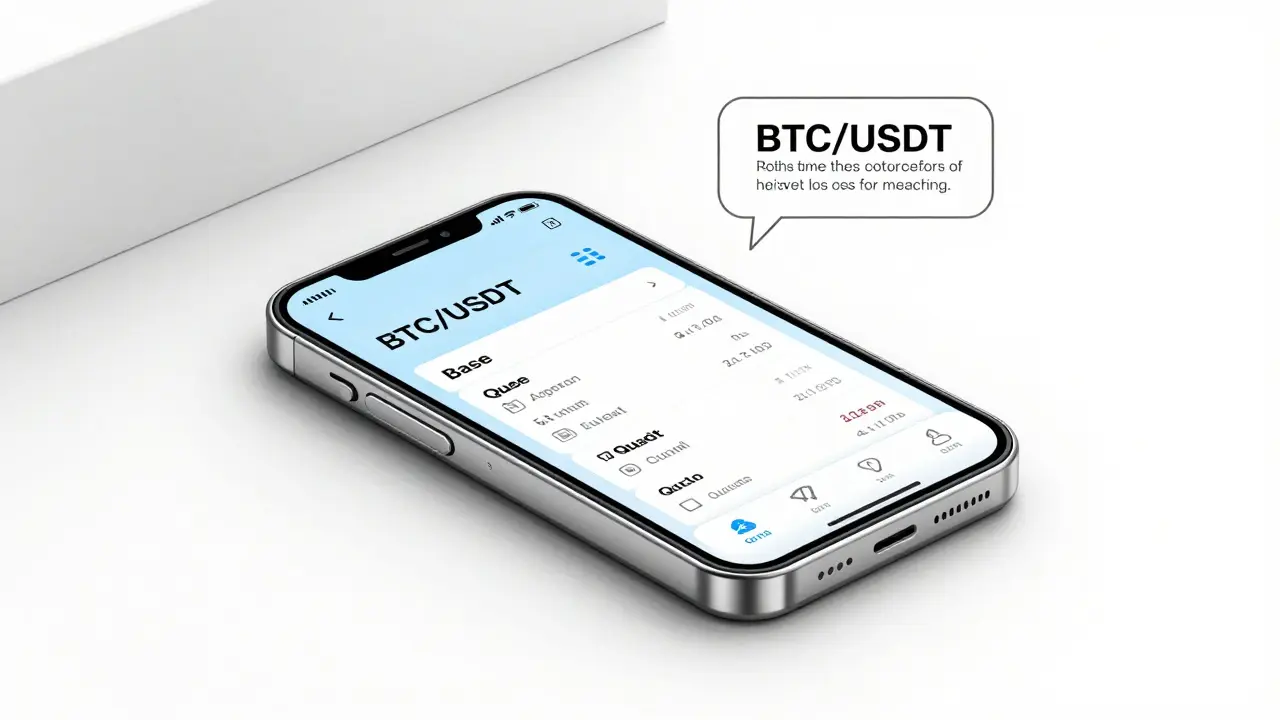
Ever looked at a trading screen and wondered why some pairs are written as BTC/USDT while others are ETH/BTC? It might seem like a small detail, but confusing these two is one of the fastest ways to lose money in the markets. In fact, misidentifying these roles correlates with a 37% higher error rate in trade execution for new traders. If you've ever placed a limit order only to have it rejected or found yourself staring at a profit/loss figure that doesn't seem to match your local currency, you're likely dealing with a base currency and quote currency mix-up.
The Core Difference: Which is Which?
At its simplest, a trading pair is just a ratio. It tells you how much of one asset you need to buy another. The first asset listed is always the Base Currency is the asset being bought or sold. The second asset is the Quote Currency, which is the currency used to express the value of the base asset. Think of the quote currency as the "price tag."
If you see the pair BTC/USDT, Bitcoin is the base and Tether is the quote. If the price is $65,000, it means 1 unit of the base (BTC) costs 65,000 units of the quote (USDT). When you click "Buy" on this pair, you are acquiring the base currency and spending the quote currency. When you "Sell," you're getting rid of the base to collect the quote.
| Feature | Base Currency (The First Asset) | Quote Currency (The Second Asset) |
|---|---|---|
| Primary Role | The asset you are trading | The pricing benchmark |
| Action on "Buy" | You receive this asset | You pay with this asset |
| Action on "Sell" | You give up this asset | You receive this asset |
| PnL Calculation | Value is derived from it | Profits/Losses are measured in this |
How the Math Actually Works
The relationship is a straightforward mathematical equation: 1 Base = X Quote. This structure isn't random; it's borrowed from the traditional Forex markets, which have used this standardization since the 1970s. In crypto, this allows for a predictable process called price discovery.
Let's look at a non-fiat example: ETH/BTC. If the price is 0.05, it means 1 Ethereum (base) equals 0.05 Bitcoin (quote). If you want to buy 10 ETH, you'll need to pay 0.5 BTC. This is where things get tricky for beginners. Many assume that the "strongest" or most popular currency is always the quote, but that's not how it works. While USDT is a common quote currency because of its stability, Bitcoin often switches roles. In BTC/USDT, BTC is the base. In ETH/BTC, BTC is the quote.
One critical detail to remember is that your profit and loss (PnL) are always denominated in the quote currency. If you trade BTC/USDT, your gains aren't measured in how much Bitcoin you made, but in how many Tether you earned. This is why institutional desks often prefer BTC-quote pairs for cross-asset trades; it allows them to measure the relative strength of an altcoin against the market leader rather than a stablecoin.
Common Pitfalls and Costly Mistakes
Mistakes usually happen when traders switch platforms or enter complex trades. For instance, while major exchanges like Binance and Coinbase follow the same labeling, some regional platforms in Asia occasionally invert these conventions. If you're used to BTC/USD and suddenly find yourself on a platform that lists it differently, you might accidentally sell the asset you intended to buy.
Another danger zone is the stop-loss order. There are horror stories in trading communities, like on Reddit, of users losing hundreds of dollars because they set a stop-loss trigger based on the wrong currency. If you're trading ETH/USDT, your trigger price must be in USDT. If you confuse this with the amount of ETH you hold, your order will either never trigger or close your position at the wrong time.
Then there's the issue of Slippage. During the 2022 TerraUSD collapse, many users tried to exit UST positions. Those who used UST/BTC pairs instead of the more liquid UST/USDT pairs saw much higher slippage-sometimes 22% higher-because they didn't understand how the liquidity of the quote currency affected the execution of their trade.

Pro Tips for Execution and Verification
To avoid these traps, a few habits can save your portfolio. First, always double-check the pair labeling on your specific exchange. For example, Binance.US might use BTC/USD, while international Binance uses BTC/USDT. They look similar, but the quote asset is different, which affects your balance.
- Check the Chart Volume: Most platforms display volume in the base currency. If you're looking at a BTC/USDT chart, the volume bars usually tell you how many Bitcoins were traded, not how many Tether moved.
- Verify Technical Indicators: Remember that every indicator-whether it's a Moving Average or the RSI-is referencing the price action of the base currency relative to the quote.
- Watch for Inversions: On some decentralized exchanges like Uniswap, liquidity pools can sometimes result in pairs that feel inverted compared to centralized exchanges. Always check the "Trade" or "Swap" window to see exactly what you are giving and receiving.
If you're still unsure, many modern platforms have introduced color-coded indicators or "Pair Translators" that show you the price in both directions. Using these tools can reduce execution errors significantly, especially when you're dealing with high volatility.

Looking Ahead: The Path to Standardization
The industry is moving toward a future where these mistakes are harder to make. Regulatory frameworks like the EU's MiCA now require exchanges to clearly and unambiguously designate base and quote currencies in their interfaces. This removes the guesswork for the average person.
We're also seeing a shift in how different players use these pairs. Retail traders heavily favor stablecoin-quote pairs (like BTC/USDT) because it's easier to track value in "dollar terms." Institutional traders, however, often lean toward BTC-quote pairs to hedge against the overall volatility of the crypto market. As the market matures, we can expect API responses to become even more explicit, with mandatory fields for "baseCurrency" and "quoteCurrency" to ensure that bots and humans are always on the same page.
If I buy the BTC/USDT pair, what am I actually getting?
You are buying Bitcoin (the base currency) and paying for it using Tether (the quote currency). Your wallet will see an increase in BTC and a decrease in USDT.
Why do some people prefer trading pairs like ETH/BTC instead of ETH/USDT?
Traders use ETH/BTC to measure the relative performance of Ethereum against Bitcoin. If ETH/BTC is rising, Ethereum is gaining strength compared to Bitcoin, regardless of whether the overall market is going up or down in dollar terms.
How does the quote currency affect my profit calculation?
All profits and losses are calculated in the quote currency. In a BTC/USDT trade, your PnL is shown in USDT. If you trade BTC/ETH, your profit will be shown in ETH.
Can the base and quote currencies be swapped?
Yes, but it changes the price. If BTC/USDT is 60,000, then USDT/BTC would be 1 divided by 60,000 (0.00001667). Most exchanges stick to one convention to avoid confusion, but some allow "inverted pairs."
What happens if I confuse the two when setting a stop-loss?
You risk your order not triggering or triggering at the wrong price. A stop-loss trigger is always a price value in the quote currency. Setting a trigger based on the amount of base currency you own is a common and costly mistake.


