
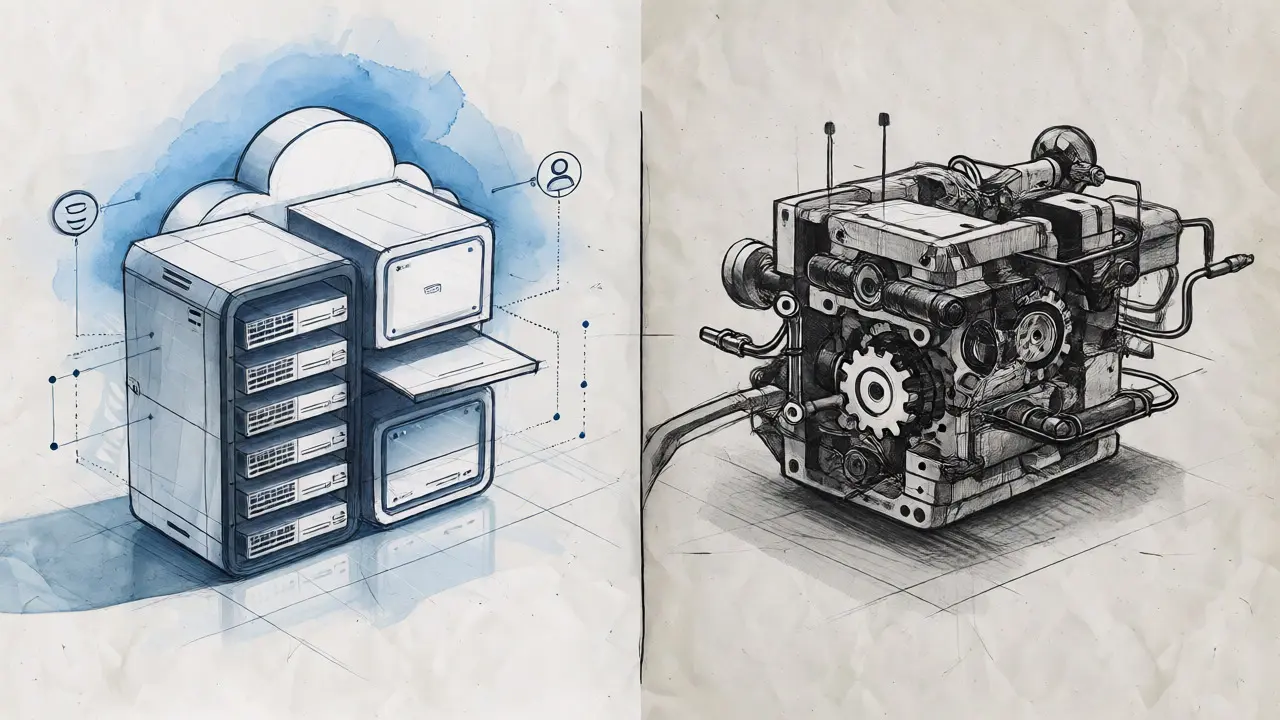
You have a brilliant idea for a decentralized application. Maybe it’s a supply chain tracker that actually works, or a digital identity system that doesn’t require a password reset every Tuesday. Now comes the hard part: how do you build it? You’re standing at a fork in the road. On one side is Blockchain as a Service (BaaS), a convenient, cloud-hosted shortcut. On the other is Custom Blockchain Development, building the whole engine from scratch. Choosing wrong here can cost you six figures and months of lost time.
This isn’t just about picking a tech stack; it’s about matching your business reality to technical capability. BaaS lets you rent infrastructure from giants like AWS or Microsoft Azure. Custom development means you own the code, the nodes, and the headaches. Let’s break down which path makes sense for you, based on real-world data and expert insights from 2024 and 2025.
The Core Difference: Renting vs. Owning
Think of BaaS like renting an apartment in a managed building. The landlord (AWS, Azure, IBM) handles the plumbing, electricity, and security. You just move in and decorate (write smart contracts). If the elevator breaks, you call maintenance. You don’t know how the elevator works, and frankly, you don’t care until it stops working.
Custom Blockchain is building your own house. You choose the foundation, the wiring, and the lock mechanism. If the elevator breaks, you are the mechanic. This gives you total control but demands specialized skills. According to Gartner’s 2024 report, 68% of enterprises start with BaaS because it’s easier to get off the ground. Only 22% jump straight into custom builds. Why? Because most businesses don’t need to reinvent the wheel-they just need to roll fast.
When BaaS Saves Your Skin
If speed matters more than perfection, BaaS wins. BitGo’s 2023 case study showed companies using BaaS launched products 70% faster than those building in-house. For retail and logistics, this elasticity is gold. Cisin’s 2024 survey found 82% of retail companies chose BaaS for supply chains because they could scale up during Black Friday and scale down when sales dipped, paying only for what they used.
Cost efficiency is another huge factor. Debut Infotech’s 2024 analysis shows BaaS cuts initial investment by 65-80%. You might pay $0.50 per hour for basic nodes on AWS Blockchain Templates, or up to $15,000 monthly for enterprise-grade setups on Azure. Compare that to custom development, which averages $150,000 to $500,000 upfront according to Rapid Innovation’s 2025 data. For startups testing product-market fit, burning half a million dollars before knowing if customers even want the product is a risky bet.
- Rapid Deployment: Get a network running in 1-3 months versus 6-9 months for custom builds.
- Managed Security: Providers like Kaleido handle FIPS 140-2 encryption and SOC 2 audits so you don’t have to hire a dedicated security team immediately.
- Elastic Scaling: Automatically handle traffic spikes without buying new hardware.

Why Some Businesses Still Build Custom
So why would anyone choose the hard path? Control and compliance. In highly regulated sectors like healthcare and finance, "good enough" security often isn't good enough. BitGo’s 2024 analysis revealed that 92% of healthcare blockchain implementations were custom-built. Why? HIPAA compliance requires specific data handling protocols that standard BaaS platforms simply couldn’t support.
Performance is another driver. While AWS Managed Blockchain supports up to 5,000 transactions per second (TPS), a financial institution might need 15,000 TPS. PixelPlex’s 2024 technical analysis notes that custom blockchains can achieve 30-40% better performance for domain-specific use cases by optimizing consensus algorithms. If your app relies on high-frequency trading or massive data throughput, the pre-built consensus mechanisms in BaaS (like Proof-of-Authority) might hit a ceiling you can’t lift.
| Attribute | Blockchain as a Service (BaaS) | Custom Blockchain |
|---|---|---|
| Time to Market | 1-3 Months | 6-9 Months |
| Initial Cost | $0.50/hr - $15k/month | $150k - $500k |
| Customization Level | Limited (API constraints) | Total Control |
| Talent Required | Cloud Developers | Cryptographers & Distributed Systems Experts |
| Vendor Lock-in Risk | High (58% report migration issues) | Low |
The Hidden Costs of Each Path
BaaS looks cheap until you try to leave. Vendor lock-in is the silent killer. A European bank saved $2.1 million in Year 1 using BaaS for document verification, but then regulatory rules changed. Their BaaS provider couldn’t implement the necessary modifications quickly. The result? They incurred $450,000 in extra costs and had to migrate anyway. Rapid Innovation warns that 58% of enterprises face significant challenges switching providers. You’re renting their infrastructure, and moving out is expensive.
Custom development has its own traps. CertiK’s 2023 blockchain security report found that 78% of failures in custom implementations traced back to inadequate cryptographic implementations. Building it yourself means you own the bugs. If your consensus algorithm fails, there’s no support ticket to file. You fix it, or the network halts. Furthermore, finding talent is brutal. A Consortium Blockchain Network survey indicated that 73% of failed custom projects lacked sufficient expertise. You need developers who understand distributed systems architecture-skills that take years to master.

Hybrid Models: The Emerging Middle Ground
Here is where things get interesting. The binary choice between BaaS and Custom is fading. Microsoft announced Azure Blockchain Service 3.0 in March 2025 with "customizable consensus layers," addressing previous rigidity. AWS introduced a "Hybrid Blockchain Framework" allowing partial customization. Gartner predicts that by 2027, 55% of enterprise implementations will use hybrid models-renting the infrastructure but writing custom application logic on top.
This approach mitigates risk. You get the stability of managed nodes but keep the flexibility of custom code. For many mid-sized enterprises, this is the sweet spot. It avoids the heavy upfront capex of full custom builds while escaping the tight API limits of pure BaaS.
How to Decide: A Quick Checklist
Don’t guess. Use these criteria to make your decision:
- Regulatory Pressure: Are you in healthcare or finance with strict data sovereignty laws? Go Custom or Hybrid.
- Performance Needs: Do you need >5,000 TPS consistently? Look at Custom.
- Budget & Timeline: Need to launch in under 3 months with <$50k budget? Choose BaaS.
- In-House Talent: Do you have a team familiar with Solidity and Hyperledger Fabric? If not, BaaS reduces the learning curve from months to weeks.
- Long-Term Strategy: Is blockchain core to your IP, or just a utility? If it’s core, owning the stack protects your competitive advantage.
The market reflects this nuance. MarketsandMarkets reports BaaS holds 63% market share today, valued at $24.7 billion. But custom development remains dominant in mission-critical systems, with 41% of Fortune 500 companies maintaining custom blockchains alongside their BaaS experiments. There is no universal winner. There is only the right tool for your specific job.
Is BaaS cheaper than custom blockchain development?
Generally, yes, especially for initial deployment. BaaS reduces initial investment by 65-80% compared to custom development, which often starts at $150,000. However, long-term operational costs can rise if you need to migrate away due to vendor lock-in or feature limitations, potentially eroding those early savings.
What is vendor lock-in in the context of BaaS?
Vendor lock-in occurs when migrating your blockchain application from one BaaS provider (e.g., AWS) to another (e.g., Azure) becomes technically difficult or prohibitively expensive. Since each provider uses proprietary management tools and APIs, switching often requires rewriting integration layers. About 58% of enterprises report significant migration challenges.
Do I need cryptography experts to use BaaS?
No. BaaS abstracts the underlying cryptographic complexity. You typically need developers skilled in standard cloud services and smart contract languages like Solidity or Chaincode. Custom blockchain development, however, requires deep expertise in cryptography and distributed systems, often necessitating specialized hires or consultants.
Which industries prefer custom blockchain over BaaS?
Healthcare and Finance dominate custom blockchain adoption. BitGo’s 2024 analysis showed 92% of healthcare implementations were custom-built to meet HIPAA compliance requirements. Similarly, 89% of financial institutions use custom solutions for core transaction systems to ensure specific regulatory adherence and performance standards.
Can I switch from BaaS to custom later?
Yes, but it’s complex. Many companies start with BaaS to test viability and then migrate to custom solutions as they scale or face regulatory hurdles. The TreasuryXL case study highlighted a bank that started with BaaS but incurred significant costs migrating when regulations changed. Planning for potential migration early can save money later.